Where the Autopista Ends
Two motorcycle bloggers in the San Francisco Bay Area.
Chasing Asphalt to Ecuador
Posted on January 30, 2014
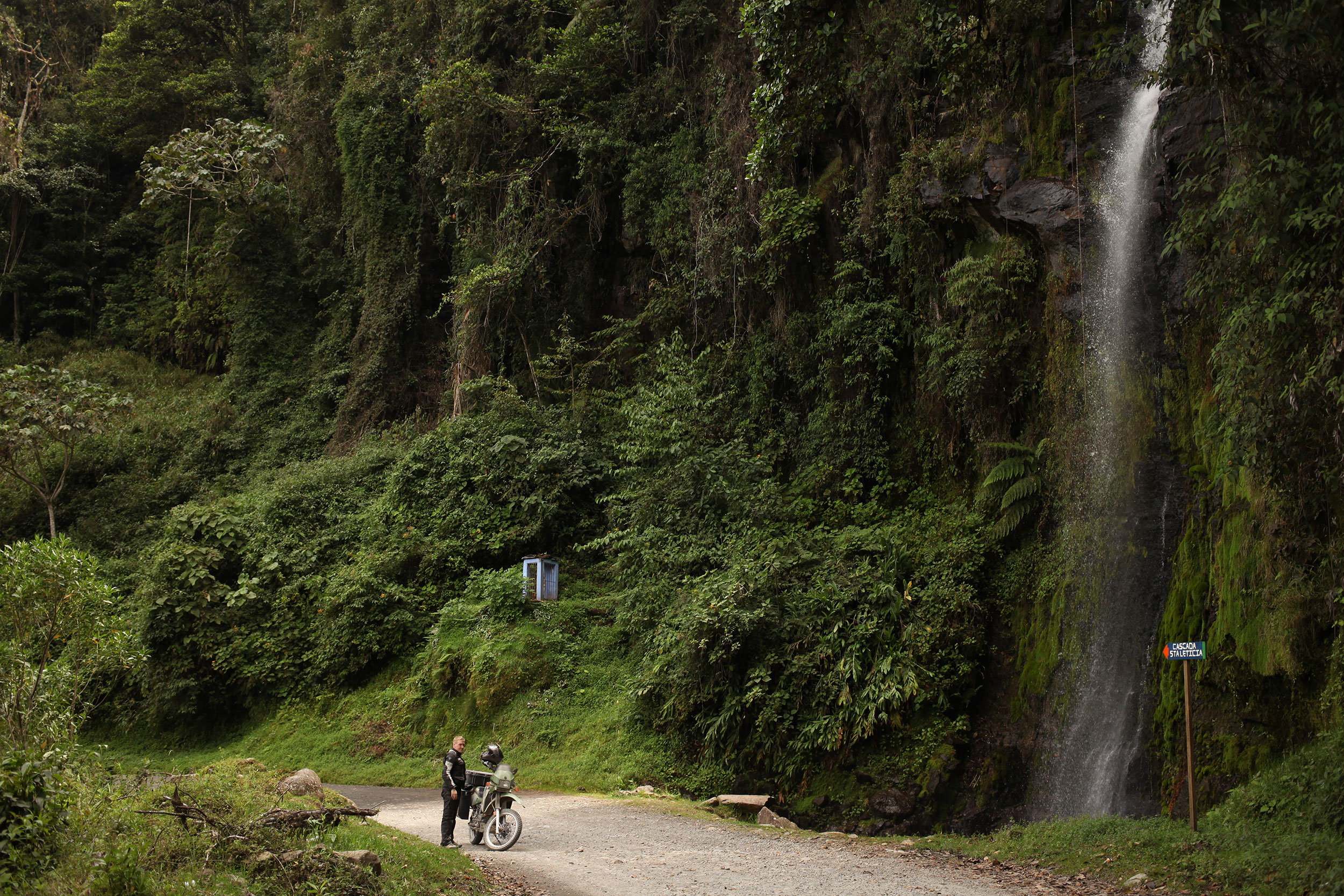
Between La Plata and Popayan Colombia we found the Staleticia waterfall. We pulled over without discussing it and just stopped to appreciate it for a minute. Photo: Alex Washburn
After Bogota it was like Willie Nelson said “on the road again”, the miles just keep coming and we are going with them. From Bogota we were headed for Tatacoa (the desert we thought we were going to with the KLR riders), but ended up passing on through (a longer story of how we got lost and would have had to cross a river on a dingy is involved, but we wont go there) and kept on the road. It went Bogota, Espinal, La Plata, Popayan, Pasto, 500+ miles of riding to get to the border and into Ecuador.
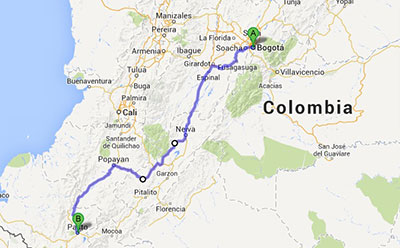
The only glitch was in looking at Google maps and not realizing that even if a road is listed as a highway it might just in fact be a dirt, rock, pothole road that stretches on for 75 miles. That was the day of riding when we went from La Plata to Popayan, at the beginning of which Alex famously said:
“I think it will be all paved today.”
The scenery of Colombia has been just amazing, but it is hard to focus on when your going ten miles an hour and getting bounced all over the place. Imagine riding on a road that is going through middle earth (J.R.R. Token’s Middle Earth), the scenery is amazing, but I don’t think those hobbits put a lot of effort into smooth roads for their wagons. The next day was an exhilarating ride through the Andes to Pasto, at some points literally riding on the side of mountains and dodging trucks trying to get to a warm bed and a hot meal (because a warm shower is a little to much to hope for).
The next morning it was up early and off to the border, with a stop on the way at Las Lajas, where there is a cathedral built into the side of a mountain over a river. I had seen pictures before we got there, however the site impresses regardless the way few sites really do compared to photos.
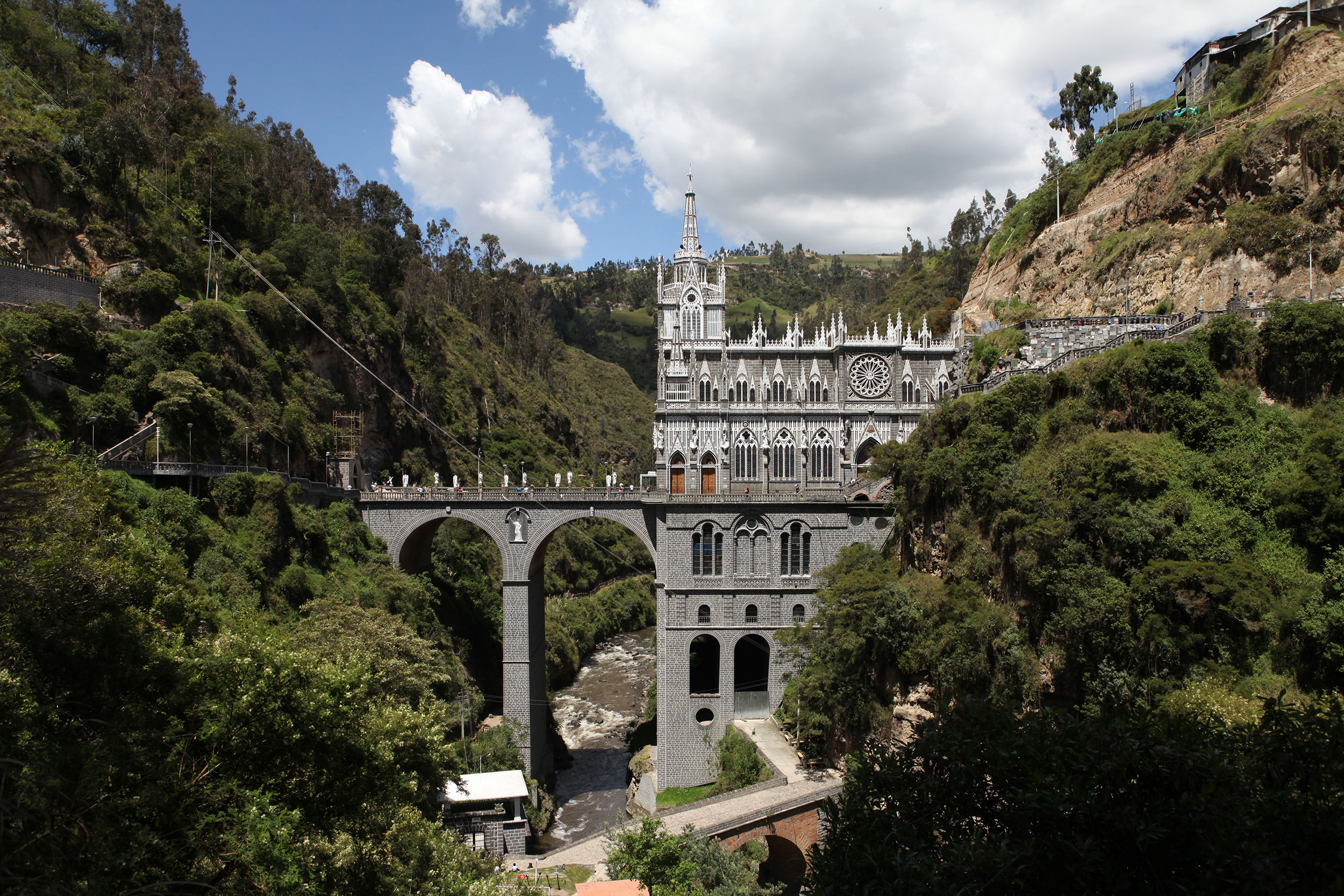
The Santuaria de Las Lajas is an incredible place to visit… When we arrived I couldn’t help thinking ‘Colombia just HAD to wow us one more time.’ Photo: Alex Washburn
As we pulled up to the parking lot, I saw another KLR with a trailer and the driver approached me before I even made it into a slot. The pilot is a Norwegian named Jørgen who is planning to ride to the tip of South America by the end of the year. He bought the KLR in Colombia, it had been in the country way beyond the allowed time and so he was heading to the border as well, with a plan to just drive across and then walk back and get a stamp before heading to Ecuador (the plan worked by the way).
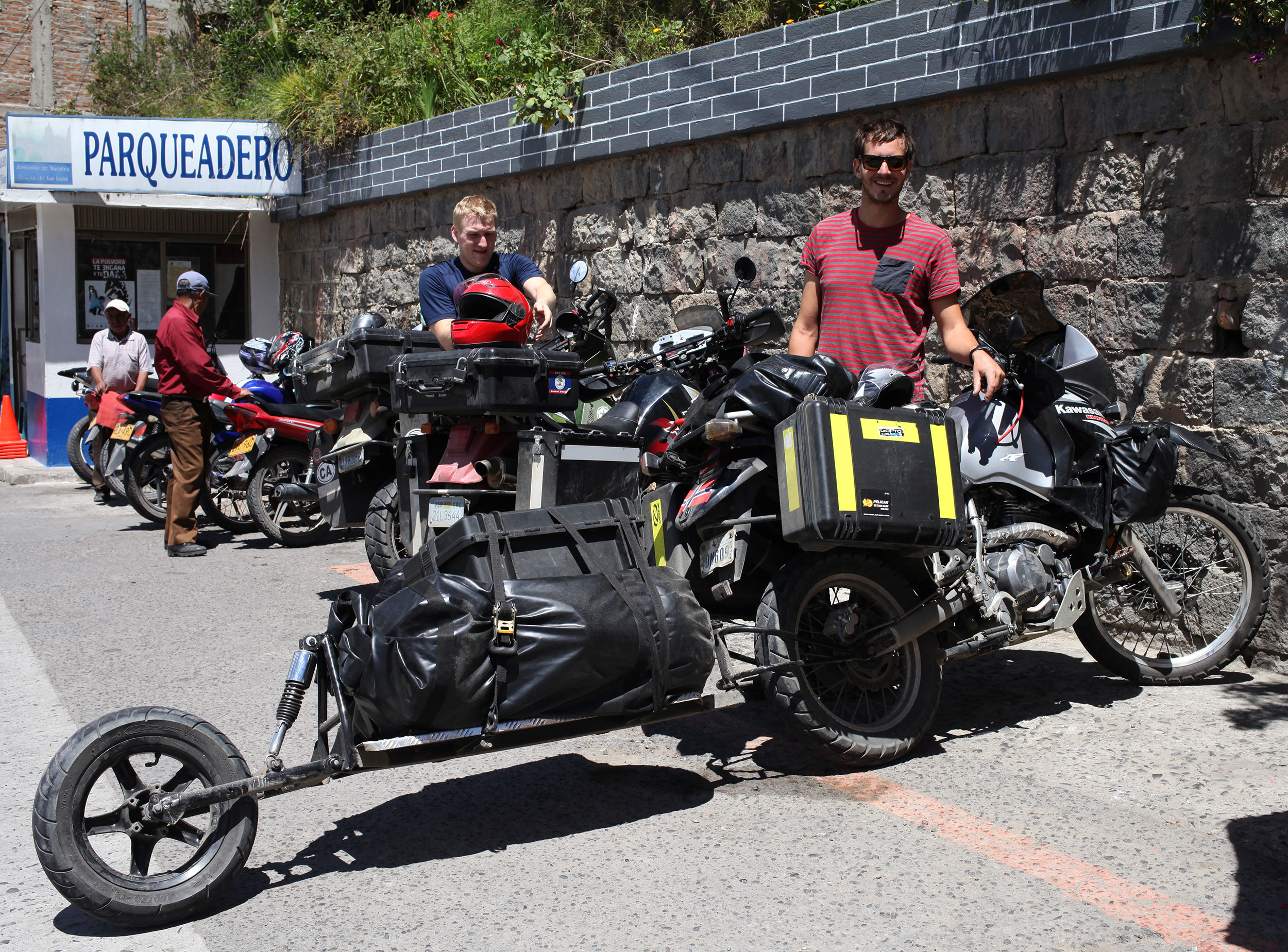
Jørgen poses with his KLR650 and the trailer he had custom made (for less than $100) before we leave the Sanctuario de Las Lajas to go have guinea pig for lunch. Photo: Alex Washburn
After this is was time for lunch (cuy, which is a large guinea pig) and then off to another border crossing and our 11th country of the trip!
We made it to a little town called Otavalo, which was rumored to have a massive market on Saturdays. As we cruised into town it was apparent the rumors were true, as almost every street in the centro had stalls selling everything from bracelets and textiles, to food and spices. We high-tailed it to a hostel and then headed out to the markets to see what we could find.
The market covers most of the downtown, with the main square having many stalls that are stationary and then tons of tarps thrown up to create many nomad stalls. We spent the majority of the day watching all the gringos shopping and haggling with the vendors. While the market does cover a tremendous amount of space, most of the wears start to blur together without a tremendous amount of variety if you aren’t interested in textiles of some sort.


In the evening we met up with Jørgen who had made it to Otavalo and ended up having a meal of delicious street food: tamales, empanads, meat kebabs, and a hot strawberry drink to help fight off the chill at such a high altitude. A couple hours of good conversation with a fellow traveler before it was time to hit the sack for another riding day.

We pose on each side of the equator line at the La Mitad Del Mundo monument just outside of Quito. Photo: Alex Washburn
What really struck Alex and I was that we had ridden from California to the center of the world. It marked a milestone in the trip and we were happy that we had done it together (without killing each other…yet). There are still miles to go and adventures to be had, but for the rest of the day we basked in accomplishment, now officially in the southern hemisphere.
Bogota
Posted on January 23, 2014
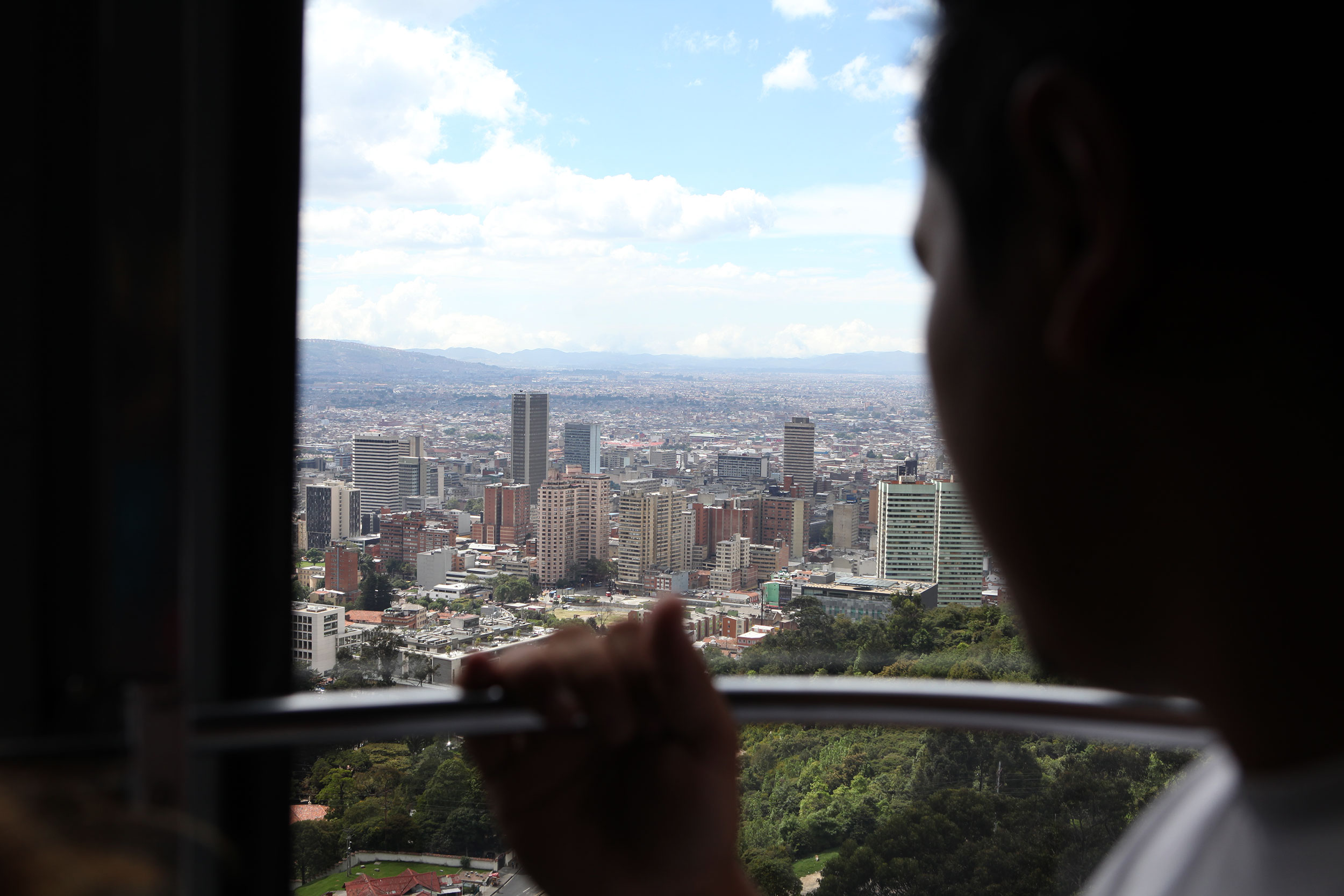
A man looks out over Bogota Colombia from the Transferico cable car that gives tourists and locals a view of the city from the top of a nearby mountain. Photo: Alex Washburn
Riding into Bogota, the capital of Columbia, was nothing like I expected. A few days earlier we had cruised into Bucaramanga, which you enter via mountain roads that give a view of the entire city as you crest them. This is what I expected when coming into Bogota, a city of 6.73 million people, but as Alex and I entered the city the limits, the city only slowly grew up around us.
In what reminded us of LA, and to a lesser extent Sacramento, Bogota is expansive, a main city built years ago that was expanded in the following decades. LA is 503 square miles, and Bogota is 613, which should give you an idea of how far it stretches. In a normal city the streets from north to south and east to west will be labeled Calle and Carrera, think street and avenue, and wont normally go past twenty or thirty. At the beginning of where Alex and I started we were at Calle 222, and we needed to get to Calle 9.

A group of tourists checks out a display at the Museo de Oro (Gold Museum) in downtown Bogota. Photo: Alex Washburn
Bogota brings together quaint neighborhoods, dirty trash heaps, museums, universities, street vendors, and churches in a way few other capital cities we have visited do. In La Candelaria, where our hostel was located (side-note: Musicology Hostel is one of the best hostels we have stayed at on this trip. The staff are friendly, the vibe is chill, and you can park a motorcycle in the entrance!) is the historic old town, full of churches and museums. It has a smaller town feel, until you ascend the church on Monserrate and get a full view of the city and how far it reaches.
While there could be many associations with Bogota, the City of Museums should be one. Within a six block radius of our hostel, there were at least five museums, and probably more that I am not aware of. There is the Military Museum, the Botero Museum, but the most prominent would be the Gold museum, which show cases gold workings from all over Colombia and easily has over 6,000 pieces on display. It can get a little overwhelming by the end and there are three sold floors of exhibits to peruse, though I was told Pablo Escobar’s gold Harley Davidson would be there and was slightly disappointed when I didn’t see it.
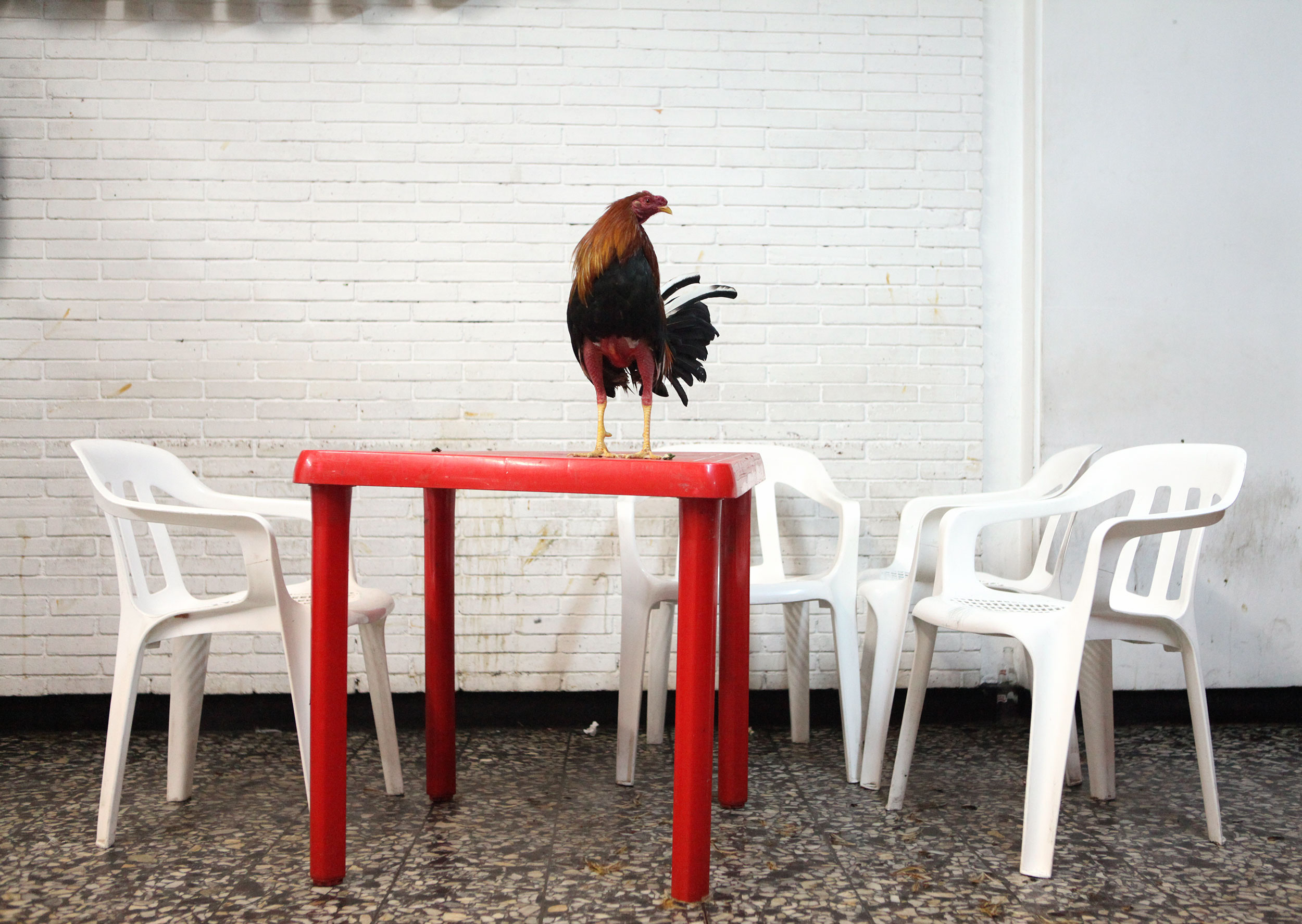
Alex being a photojournalist wanted to go to Club Gallistico and take photos. Club Gallistico is one of the oldest cockfighting establishments in the city and she’ll be doing a full post for that on her personal photoblog. Here a rooster waits to have fighting spurs attached to his feet. Photo: Alex Washburn
Bogota is located in a high plateau situated in the Andes mountain range, which means that it was a bit on the cold side even though it is middle of summer in South America. What helped to take the chill off was a local dish to the region, hot chocolate with cheese and bread with butter. We were a bit confused on how to eat the dish and ended up just dipping the cheese in the hot chocolate and nibbling on it only to find out later that you’re supposed to mix the cheese in and let it melt a little while you eat the bread and then drink the chocolate with the melted cheese inside of it.
As Alex mentioned in her previous post, there is a plethora of street food in Bogota, and many restaurants serving up traditional favorites such as Ajiaco (Colombian chicken soup) and tamals (think Mexican Tamales, but cooked in plantain leaves and considerably bigger with a softer form of masa). We weren’t left wanting once again for restaurants, but it is still hard to find good places among all the mediocrity, however asking locals and police officers never fails to produce results.
Bogota is so expansive you couldn’t ever explore all of it, from the historic downtown, to the more modern financial district (that has a building that at night would put Las Vegas to shame), to the outskirts with its apartments and neighborhoods. Alex and I enjoyed our time in Bogota, and thought it was the city that most surprised us thus far on the trip. Sure it is big and loud, like most capital cities, but there are treasures to be had if you put in the time to find them — and have a really great hostel to stay at!
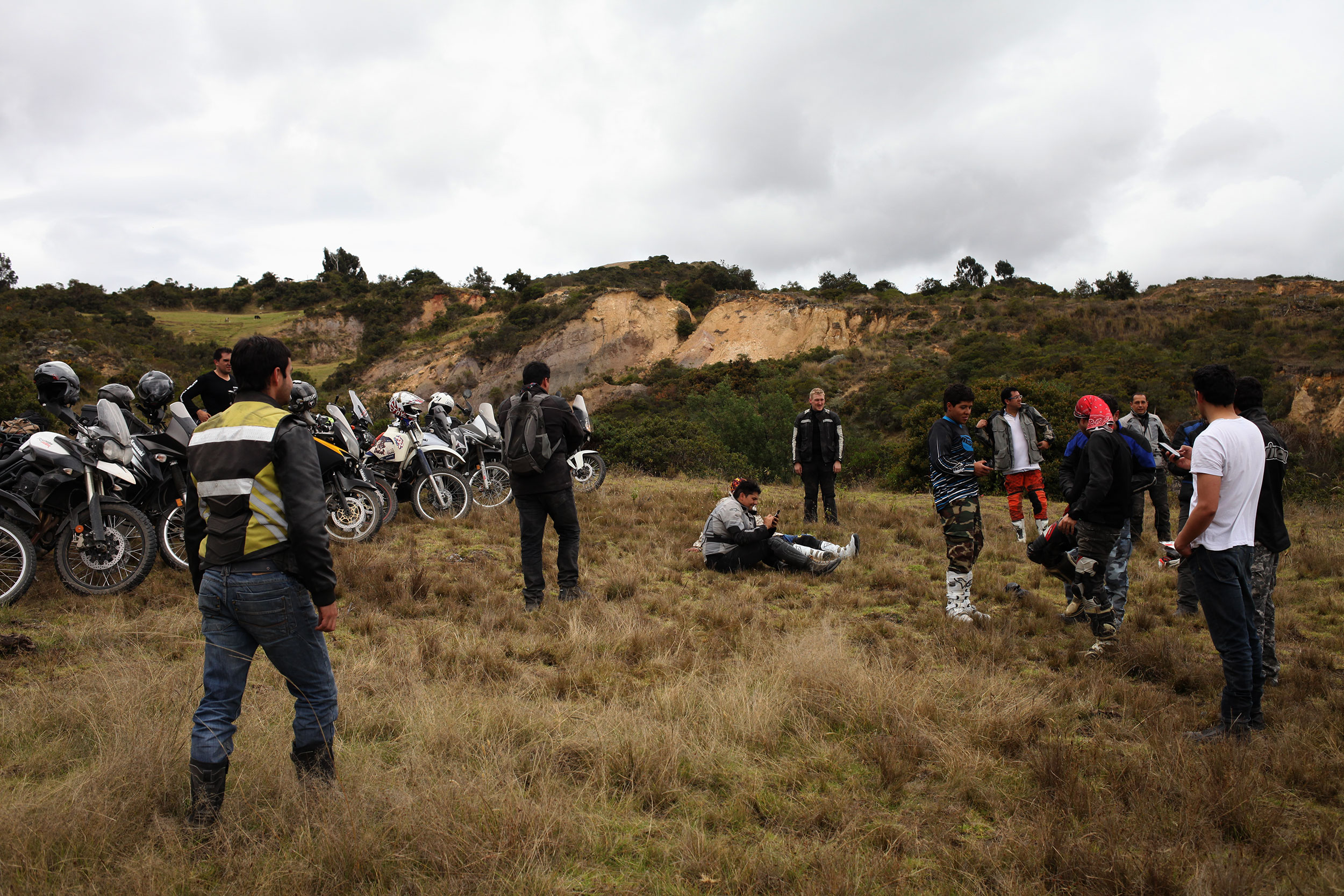
Our last full day in Bogota we met up with a group of Colombian motorcyclists and went off-roading just outside of Bogota. Alex has a ton of bruises from the adventure (full post on the ride tomorrow). Photo: Alex Washburn
A.T.T.C.C.
Posted on January 17, 2014
A.T.T.C.C. is A Tale of Two Colonial Cities. Colombia has two well known towns that are colonial to the bone, both well preserved since their founding and now a days keeping up appearances for tourists. The older of the two is Villa de Leyva founded in 1572 and the baby brother is Barichara founded in 1705. Both are promoted by Lonely Planet and as they are within driving distance (and on our way to Bogota) we decided to do a back to back comparison.
Barichara
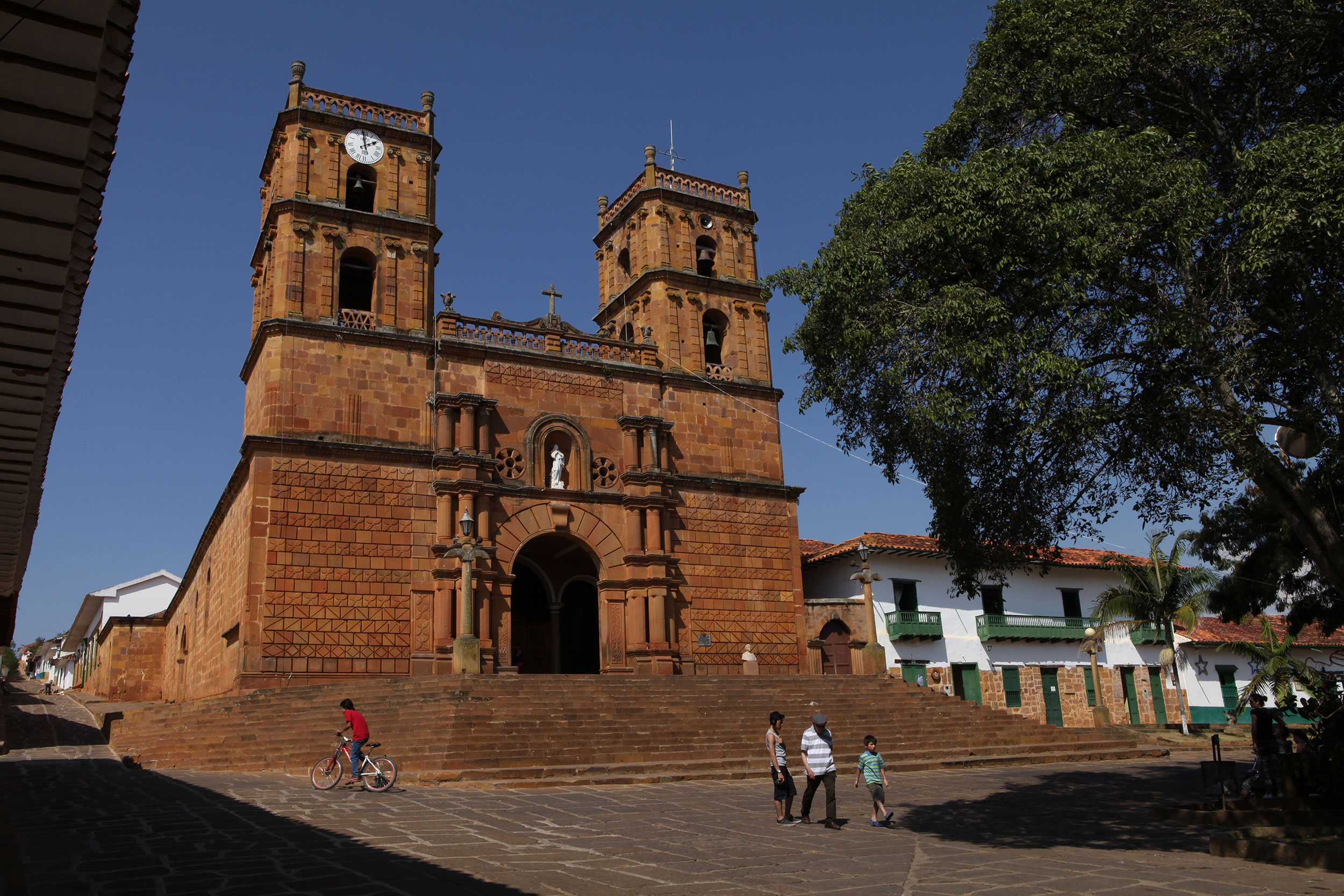
The Cathedral of Barichara dates back to 1705 and seems to dwarf the tiny puebla on the hillside. Photo: Alex Washburn
Barichara is located in the hills above San Gil, sitting atop a plateau that overlooks a dry valley below with a river running through. The landscape between San Gil and Barichara is pastoral bliss and once your in the town, it reminds one of the hills in Tuscany (our what I imagine they are like). The streets are cobblestone, but they have been cemented together, and though most likely slick when wet, it makes driving around on a motorcycle pleasant.
There is the sense that this isn’t just a tourist trap, but a real town nestled in the Colombian countryside. There are not an overwhelming amount of restaurants or knickknack shops, though there are more than enough cafes for some reason (this also is the case in Villa de Leyva). However, you see tons of locals on the streets, or sitting on stoups at night enjoying the country living.
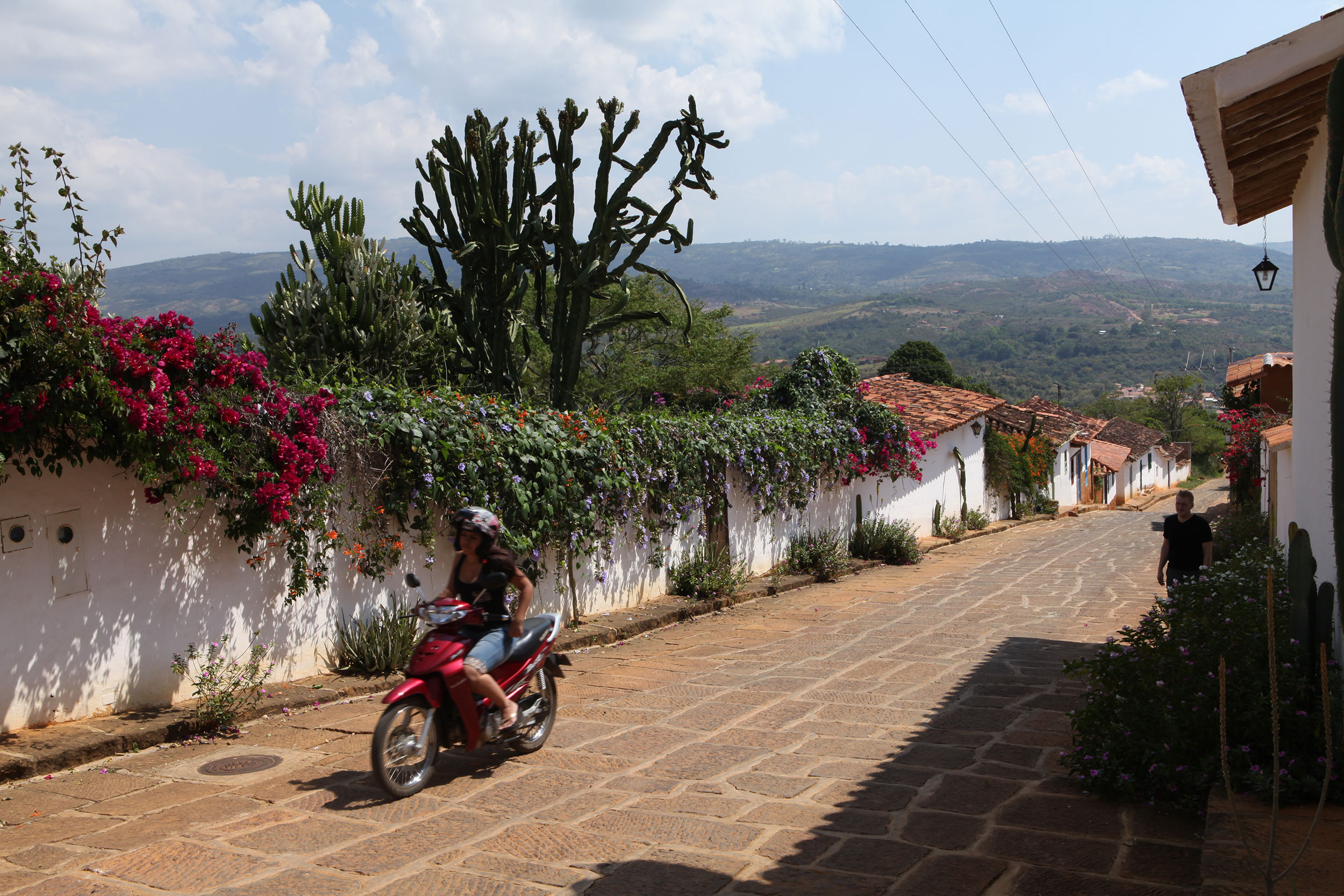
In Barichara you are always either walking up or down a hill. It creates lovely views from every street! Photo: Alex Washburn
Barichara is built on a hill and as you climb your way to the top the views of the surrounding valley only intensify, no matter which street you look down. The citizens and local government has done a great job of keeping up the facades of the houses and there is a cohesive feeling between the buildings that you would expect from a great colonial town.
There are three churches in town, the largest being Catedral de la Inmaculada Concepción, which is located in the main square of town. A couple of look out points on the west side gives great views of the valley, and the whole town can be traversed in under an hour at a lazy pace leaving plenty of time to sip a lemonada at one of the many mentioned cafes.
Sleepy, quite, and what you would want in a little getaway, though the lack of restaurants may leave you a little hungry at dinner time.
Villa de Leyva

The Plaza Mayor in Valle De Leyva is one of the biggest plazas in the Americas. It’s a huge open cobblestone square with a small fountain in the middle and a handful of eateries on its edges. Photo: Alex Washburn
On a dusty road off of Highway-62, between San Gil and Bogota, in a high valley lies Villa de Leyva. The valley, unlike the aird environment of Barichara, is lush and the ride reminded Alex of the hills in Switzerland. The whole town revolves around the Plaza Mayor, which is one of the largest in the Americas and does feel impressive when you stand in the middle.
White washed walls prevail throughout the town, and like Barichara, the architecture is consistent throughout. Villa de Leyva does have a feeling of being more developed, many cafes and trinket shops along with jewelry stores and clothing shops line the inner streets and near the outskirts there are shops where locals would do their shopping.
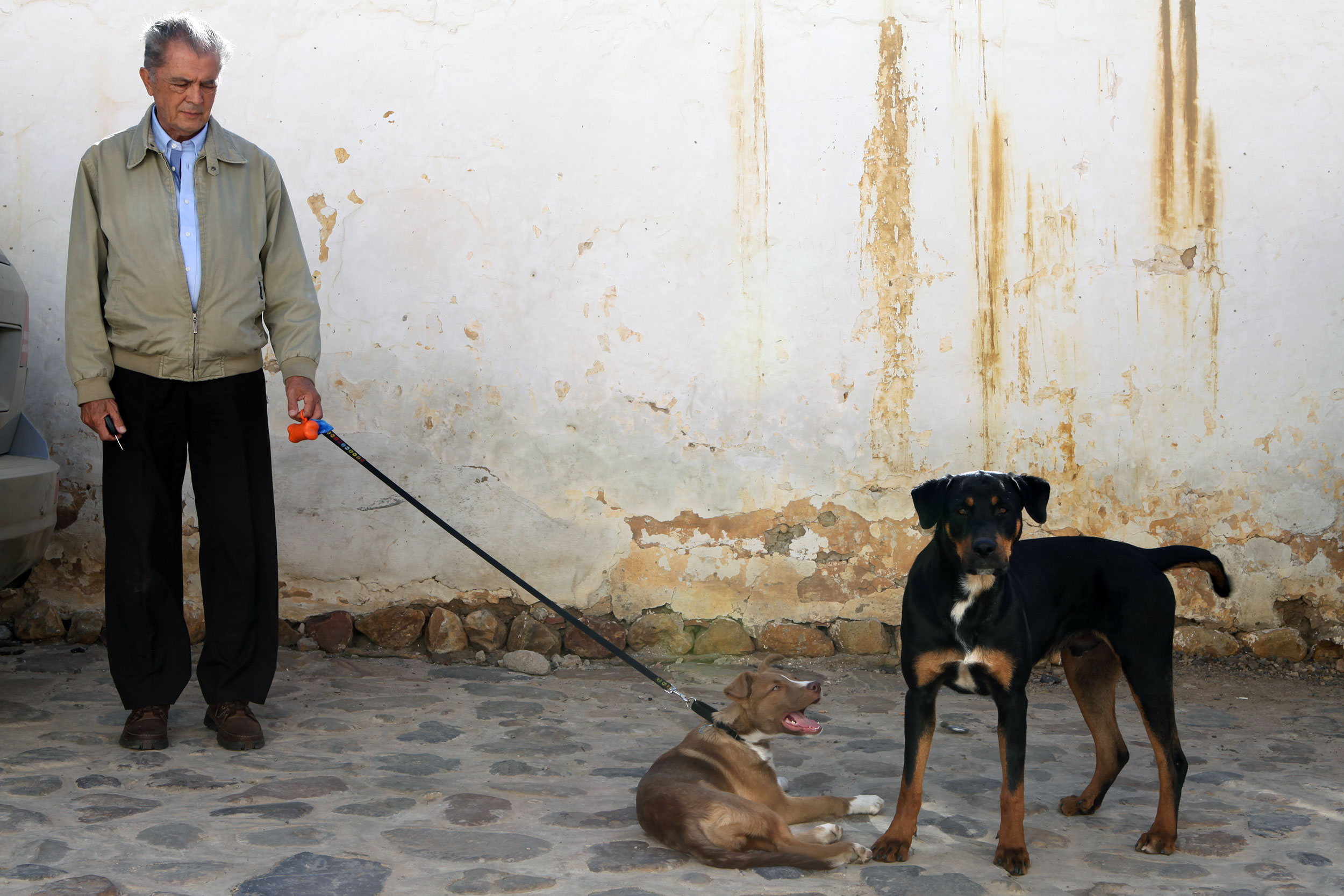
Villa De Leyva is full of people walking their dogs (some on leashes some not). It further adds to the quiet no-hurry atmosphere. Photo: Alex Washburn
The streets are cobblestone too, however laid in the traditional style, which makes driving a motorcycle on them…interesting. Upon entering town, Alex and I ended up going down a one way, the wrong way, and were told by cops to turned around. This is easier said than done on cobblestone, and an elderly gentleman came running up and helped pull us both backwards so we could turn around.
The town is about twice as big as Barichara, but there aren’t any more restaurants as one might expect. As in most smaller towns, stores tend to close early, and that might leave you without many options for dinner if you don’t plan ahead.
Lush, cobbley, and far from the bright lights of Bogota, it is a great escape from the larger cities, though the high altitude may have you reaching for a jacket instead of the sunscreen.
Both towns have hits and misses, Alex prefers Villa de Layva and I was more partial to Barichara. The best advice would be to hit up one or the other that fits best into your itinerary and then know that you got most of the experience of the other.
Tegulcigapa (again)
Posted on December 7, 2013
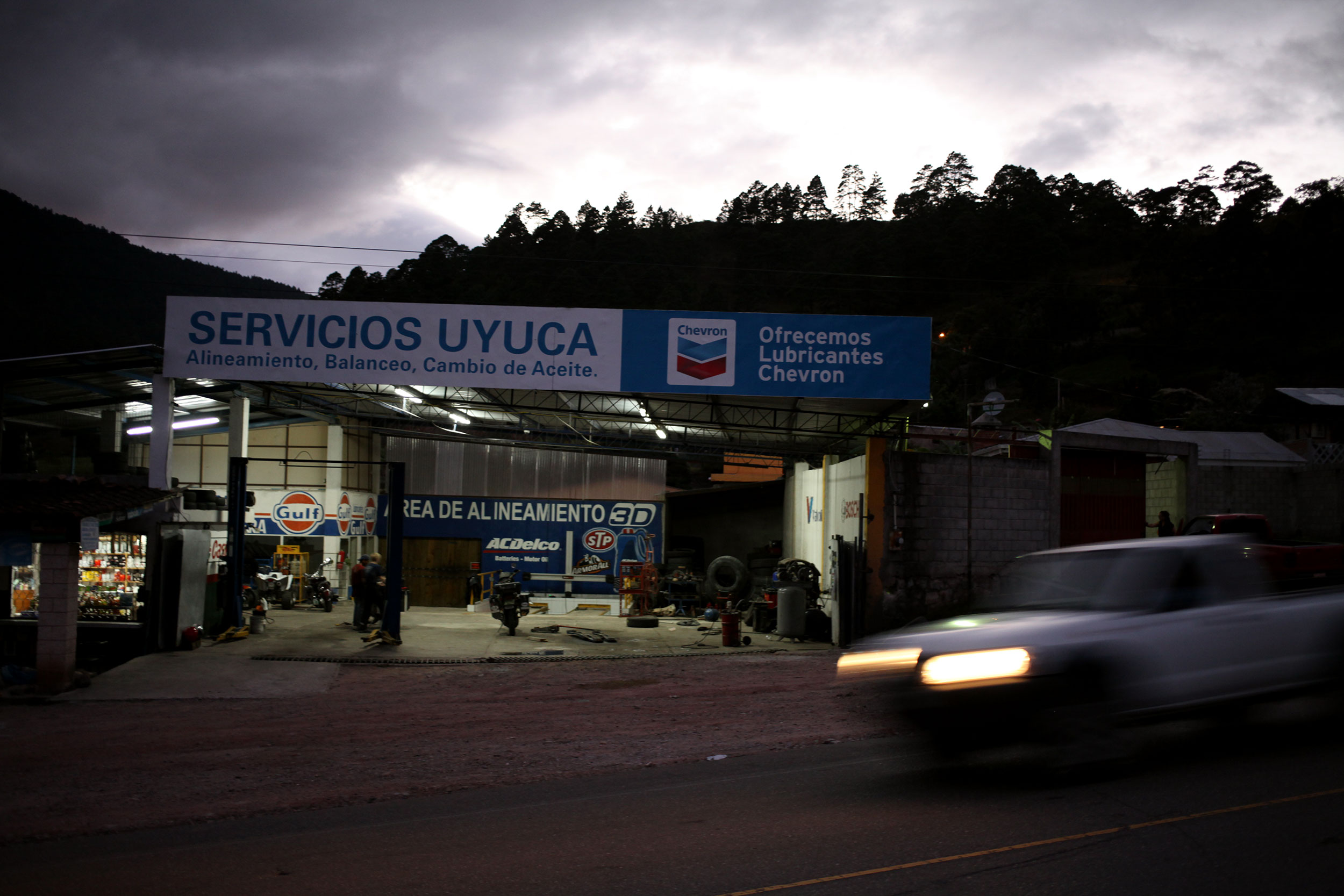
Storm clouds approach as two mechanics in a town we don’t know the name of work to get both our bikes back on the road. Photo: Alex Washburn
Yesterday we planned to have breakfast in a cute town just outside Tegucigalpa Honduras and then make our way to a small town near the Nicaraguan border so we could cross early today. However, the gods of the Autopista had their own plans and although it wasn’t the worst possible day of riding it was probably the most dangerous day of riding we’ve had so far on this trip.
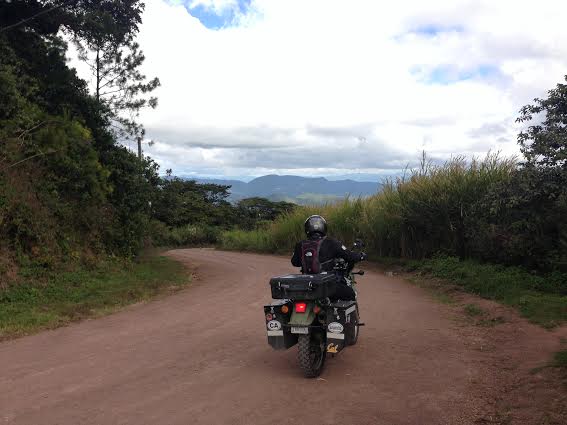
The road from Santa Lucia was beautiful and a great road although it gave us our fair share of problems. Photo: Alex Washburn
Santa Lucia (our goal for breakfast) is an adorable little town in the mountains just outside of “Tegus.” The town built into the green sloping landscape has a clean pond in the middle of it, a town square not much bigger than a basketball court, and a simple white church with a hilltop view of the valley that holds Tegucigalpa.
Unfortunately for us cuteness sometimes comes with cobblestones, which are murder to ride a bike on in Latin America. The stones are huge (typically much bigger than European cobblestones) so if one stone or a series of them have become seriously tilted it can throw your bike around. We finally found the correct cobblestone road out of Santa Lucia heading towards the hills and the rock quickly faded to a hard packed dirt road winding up and up and up.
Every once in a while we would pass a small grouping of houses or a few lonely chickens back-lit by amazing views. Dark green smallish mountains with fields and clouds and sunshine.
It was turning out to be a perfect ride, but around mile 20 there were some really deep indentations in the road from where water runs over the ground in rainstorms. I made it over them and kicked my bike down into first or second gear so that I could ride really slow till Nathaniel showed up again in my mirrors. As I was watching my mirrors I wasn’t paying much attention to where I was going and almost as soon as I saw Nathaniel appear in my mirror I felt my back tire start to slide out from under me in the gravel and I went down.
I clearly wasn’t hurt as you can see in the video and it only took us a second to get the bike back up, however once we did it wouldn’t start. At first I thought maybe the bike had flooded because some gas has started leaking out of it when it was on its side, but after letting the bike sit for several minutes and trying again that was clearly not the case. We decided the only way we were going to be able to get the bike moving again would be to try and roll start it down the hill.
In the process of pushing my bike up the hill and maneuvering it into position for our second attempt at a roll start, Nathaniel noticed that the back tire of his bike was going flat. When I couldn’t get my bike to roll start Nathaniel tried and got it running, which was awesome, however I was supposed to try and follow him slowly up the hill on his bike. When I threw my leg over it I realized his tire wasn’t just going flat – it was a pancake.
We spent probably an hour trying to fix Nathaniel’s tire, first using the goo we had and then plugs from a tire repair kit, neither of which were keeping air in the tire at first. We ran out of our compressed air and then I started asking people passing by if they had anything to inflate tires with in their vehicle.
I hailed a tuk-tuk driver over and asked him if he had one (assuming those little tires must have a lot of problems on these roads) and his passenger became very concerned for Nathaniel and I. We talked for several minutes about where a mechanic might be and how to get the tire inflated. The passenger ended up paying the tuk-tuk driver to take the boy he had been riding with back to their home and the tuk-tuk driver would then bring back something to inflate the tire with as he waited with us to make sure we were okay.
The man that stayed with us was incredibly nice. He was probably in his mid 50’s to early 60’s and he told us that although the area we were in was safe he wanted to make sure visitors to his country were taken care of. Although it’s not something that lives in our minds everyday, it’s worth mentioning Honduras is one of the most murderous countries in the world. It usually places in the top three in any given year above places like Uganda, Malawi, and the Congo.
The tuk-tuk driver returned in about 20 minutes and told us that after he filled Nathaniel’s tire we should follow him to a tire repair shop. He filled the tire from a hand pump and our friend that waited with us used pieces of plant alongside the road to stuff into the hole created by the nail Nathaniel had run over. I started up the road on Nathaniel’s bike after the tuk-tuk as Nathaniel roll started my bike and came after us.
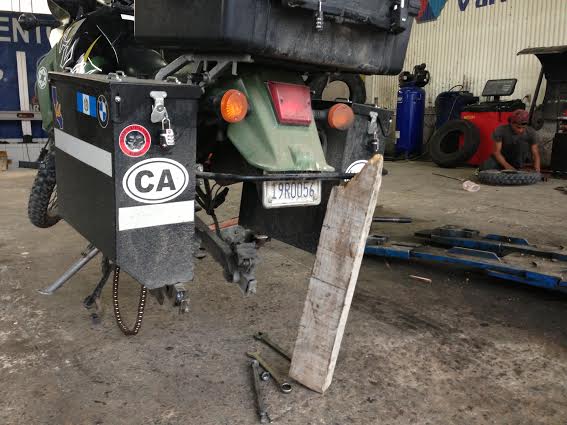
When Nathaniel’s bike is on its’ center stand it is unbalanced and this is how the mechanics held up his bike as they fixed his back tire. Photo: Alex Washburn
The men at the shop charged us $15 for their help and jumped my bike with one of their cars before Nathaniel and I headed off into the night. We avoid riding at night because the roads here are sprinkled with nasty potholes and a lack of ambient light makes them a lot darker then in the US.
Getting back to Tegucigalpa was the worst 15 miles of riding we’ve had on the entire trip. With low visibility in the dark we couldn’t ride fast enough to keep our face shields from fogging and because it was raining they were also covered in water droplets so anytime we met oncoming traffic light would catch in the droplets on my face mask totally blinding me.
It took us a really long time to get back to the hotel we’ve been staying at in Tegucigalpa. Until we got back to the city center I was in a constant cycle of opening my face shield to vent it, wiping the water off it, flipping my mask up and squinting into the rain when cars came, flipping the face shield back down, praying during the moments I was totally blind on the road that I wouldn’t hit a pothole. Plus, I always worried that if I stalled the bike we’d be stuck along a dark rainy road in the middle of Honduras, without a way to start it again.
We’re now back in the same hotel we spend the last three nights and hope to figure out what is wrong with the bike today.
Hello Belize
Posted on November 14, 2013

A map documenting our progress through Mexico. Photo: Alex Washburn
After waiting a day in Chetumal for the Banjercito to open, Monday morning came and the rain clouds cleared to reveal the humid boiling sun. We packed the gear, counted our remaining pesos, and fueled up at the last Pemex of the trip.
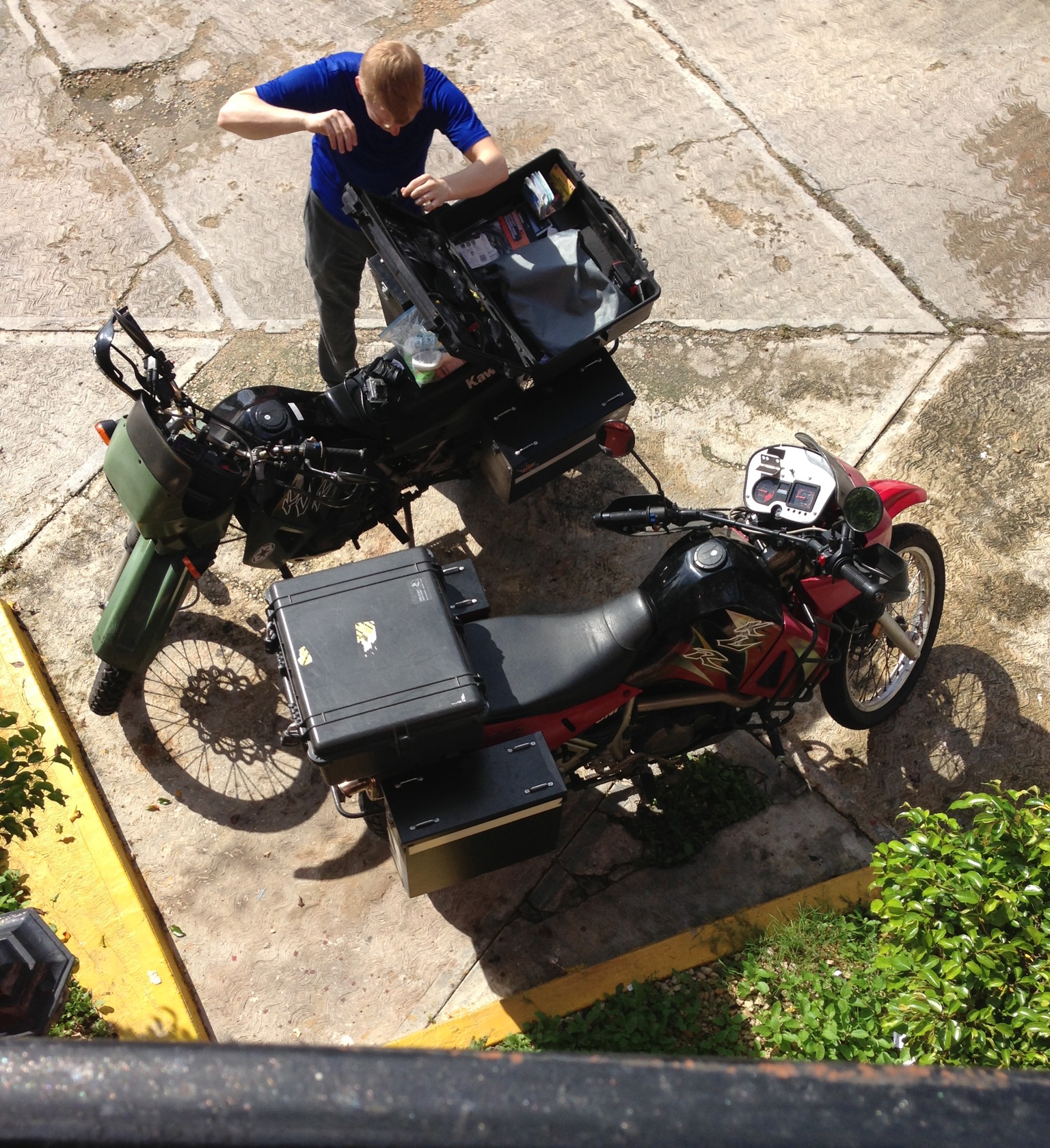
Nathaniel packs his gear, getting ready to cross the Belize border. Photo: Alex Washburn
Chetumal ended up being closer to Belize than we thought, and it took us less than ten minutes to get to the border crossing (we might have been able to cross on Friday, but after all the paperwork I think we may have gotten stuck in limbo). With all the issues we had in La Paz we knew we had all the needed paperwork, but were still ready for some bureaucracy.
First stop was to turn in our FMM cards and get stamps out of Mexico (check). Next off to the Banjercito to get our deposits back and release the bikes from Mexico, we went to the wrong Banjercito first but found our way eventually (check). Next we had to get the bikes fumigated (what?!) and get insurance for Belize.
The office where you get your fumigation certificate is also where you can purchase insurance. However, by the time we got there we were running low on money and Alex had to make a run to an ATM while I hung out with the attendant. It was during this time that a heavy rain moved in, and I discovered that the first language of Belize is English. Once Alex got back, we got the insurance slips and were informed we didn’t need to be fumigated because of the rain (sweet!).
After this it was off to immigration at the Belize border to get the bikes and us into the country. It took some time (the officers were in no hurry to fill the paperwork out to get us processed), but there were no hiccups in getting it done. Once all the stamps had been pushed, I walked over to join Alex in Belize, only to have a middle-aged man approach us.


I didn’t know who it was as Alex introduced me to Hector. The continued to talk in Spanish, and I was afriad this was a scam trying to get us to buy something before we crossed (or worse, be drug mules). I was later to find out that this was one of her Uncles who was running a load from Belize up to Huamantla. It’s such a small world, where you can run into family even at a border crossing. It was fitting, we had family at the beginning, middle, and end of Mexico, the best book ends.
As we left the immigration office we were all smiles walking back to the bikes. As we packed our documents back into the bikes, I saw another bike pass by and head towards the border, but he was soon directed (as we had been) to the immigration parking lot. This is when we met, Thiago Berto who is driving from Alaska to Brazil (or maybe all the way to Argentina, he hasn’t decided). He flew from LA to Fairbanks, Alaska and found this motorcycle (which was driven years ago from Brazil to Alaska and then left by another Brazilian, which it why it has Brazilian plates) that he is now riding down the continent.
We exchanged stories, he questioned us about the process of getting across the border, we asked him where he was going. There is a respect that fellow travelers have for each other, and that camaraderie is only magnified when they are also motorcyclists. Bikers like Thiago make us feel less bad-ass as he was riding in just a light jacket, regular pants, boots and his stuff heaped on the back of the bike, but to each his own (I seem to fall a lot so my choice of gear seems fitting).
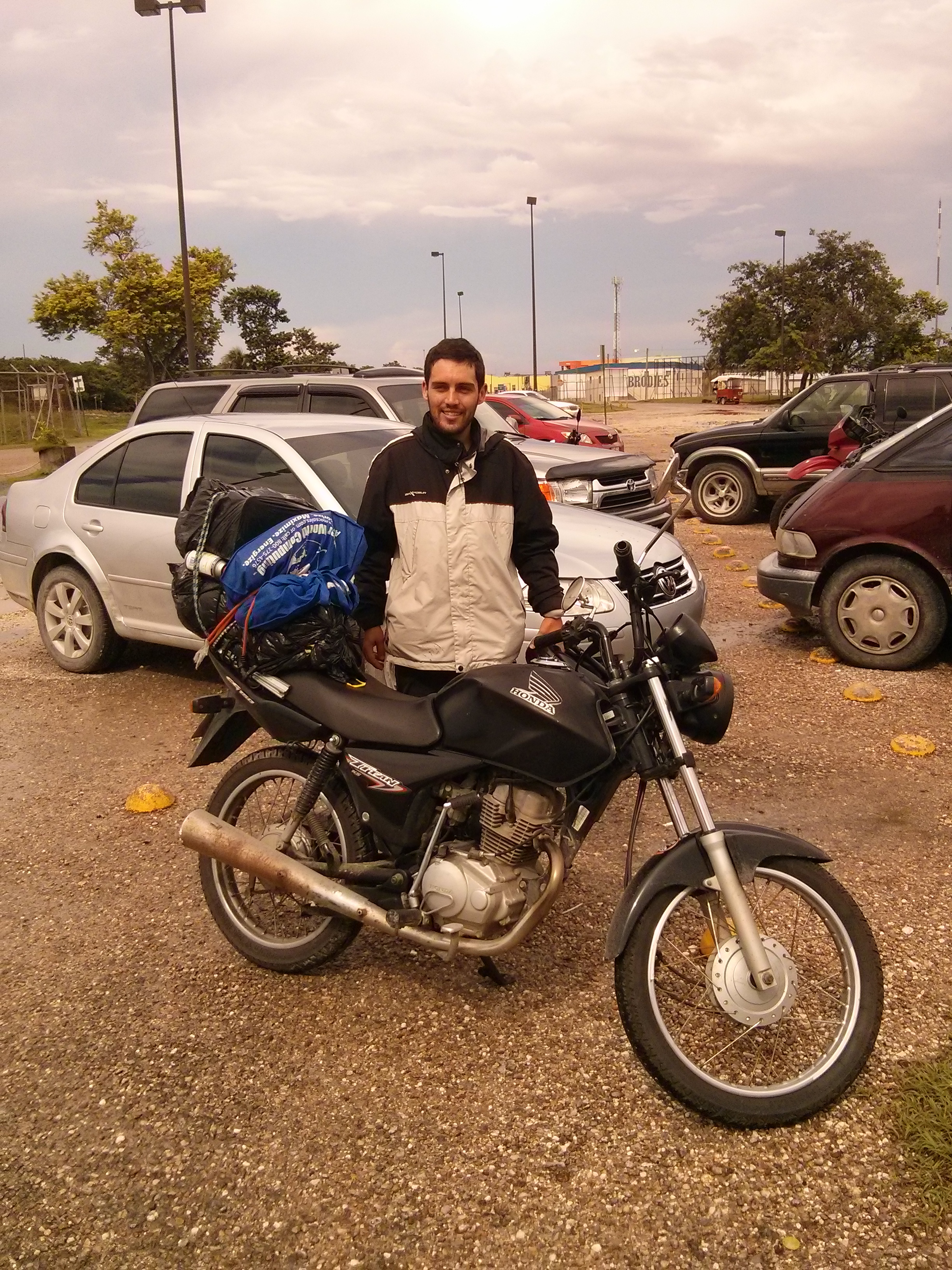
Thiago is riding from Alaska to Brazil, trying now to get through the Belize border (Photo: Nathaniel Chaney).
We wished him luck, readied our papers and made our way for the border crossing. The guard asked me if I was hot in my gear and I replied it was hot, but protective. He responded that that is true, but that falls don’t happened that often. My response? More often than you would think. And with that I was waved on.
We ran into Hector one more time after we crossed, he gave us some final directions (though there is only one real road in Belize) shook our hands and we were off.
About an hour down the road we hit the worst rain of the trip. It wasn’t just raining, it was pouring enough to work its was into our helmets and for me felt like pinpricks as the droplets hit my jacket. Knowing now that Belize is only 174 miles long, would have helped in that situation of knowing how far Belize City was, but we drove on, not worried about the gear getting wet because we knew we would have time to let it dry.
For a while, each time we broke through the black clouds and towards the blue sky the road would veer off back into the heart of the darkness. However, we finally blew past the storm and made our way to Belize City. It took a little while to find a place (Alex gets all the credit for finding the Palm Inn), but when we did and it was amazing. It had parking in the back behind high walls and under an overhang so we were out of the rain.
I will skip the details of Belize city (we were only really there a day and a half), but needless to say it isn’t the best city. It is mainly used as a stopping point for cruise ships and people heading to the Cayes (think of keys, but no bridges) and it shows. There aren’t many restaurants, and there is a hustle to the city that clearly denotes that a main portion of its income is derived from tourists.
Alex and I were happy to plan our escape to Caye Caulker the next day. We spent some time at the Belize Museum and walking around the city, but really we were just biding our time and the moment was coming to escape!
 Where the Autopista Ends