Where the Autopista Ends
Two motorcycle bloggers in the San Francisco Bay Area.
Bogota
Posted on January 23, 2014
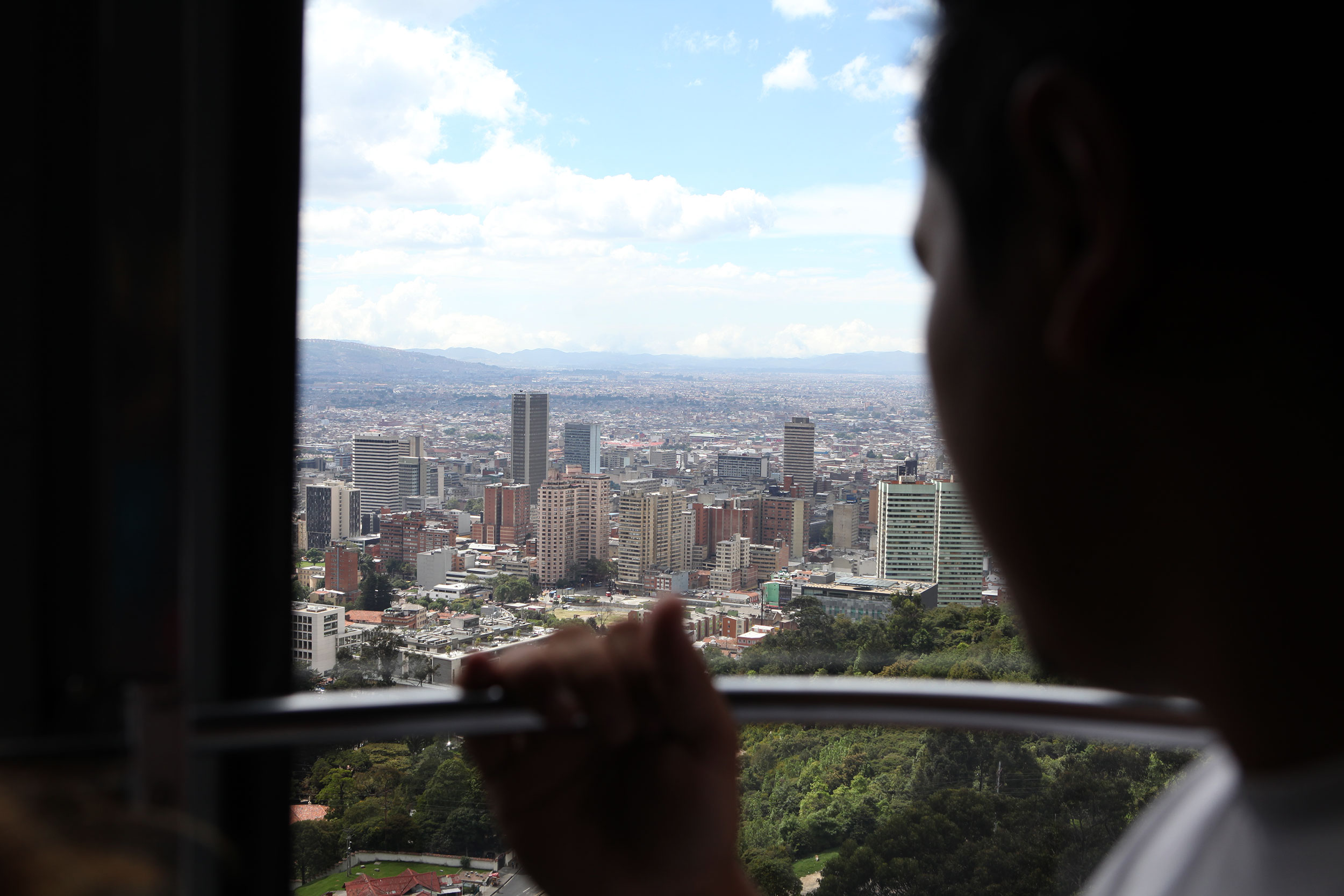
A man looks out over Bogota Colombia from the Transferico cable car that gives tourists and locals a view of the city from the top of a nearby mountain. Photo: Alex Washburn
Riding into Bogota, the capital of Columbia, was nothing like I expected. A few days earlier we had cruised into Bucaramanga, which you enter via mountain roads that give a view of the entire city as you crest them. This is what I expected when coming into Bogota, a city of 6.73 million people, but as Alex and I entered the city the limits, the city only slowly grew up around us.
In what reminded us of LA, and to a lesser extent Sacramento, Bogota is expansive, a main city built years ago that was expanded in the following decades. LA is 503 square miles, and Bogota is 613, which should give you an idea of how far it stretches. In a normal city the streets from north to south and east to west will be labeled Calle and Carrera, think street and avenue, and wont normally go past twenty or thirty. At the beginning of where Alex and I started we were at Calle 222, and we needed to get to Calle 9.

A group of tourists checks out a display at the Museo de Oro (Gold Museum) in downtown Bogota. Photo: Alex Washburn
Bogota brings together quaint neighborhoods, dirty trash heaps, museums, universities, street vendors, and churches in a way few other capital cities we have visited do. In La Candelaria, where our hostel was located (side-note: Musicology Hostel is one of the best hostels we have stayed at on this trip. The staff are friendly, the vibe is chill, and you can park a motorcycle in the entrance!) is the historic old town, full of churches and museums. It has a smaller town feel, until you ascend the church on Monserrate and get a full view of the city and how far it reaches.
While there could be many associations with Bogota, the City of Museums should be one. Within a six block radius of our hostel, there were at least five museums, and probably more that I am not aware of. There is the Military Museum, the Botero Museum, but the most prominent would be the Gold museum, which show cases gold workings from all over Colombia and easily has over 6,000 pieces on display. It can get a little overwhelming by the end and there are three sold floors of exhibits to peruse, though I was told Pablo Escobar’s gold Harley Davidson would be there and was slightly disappointed when I didn’t see it.
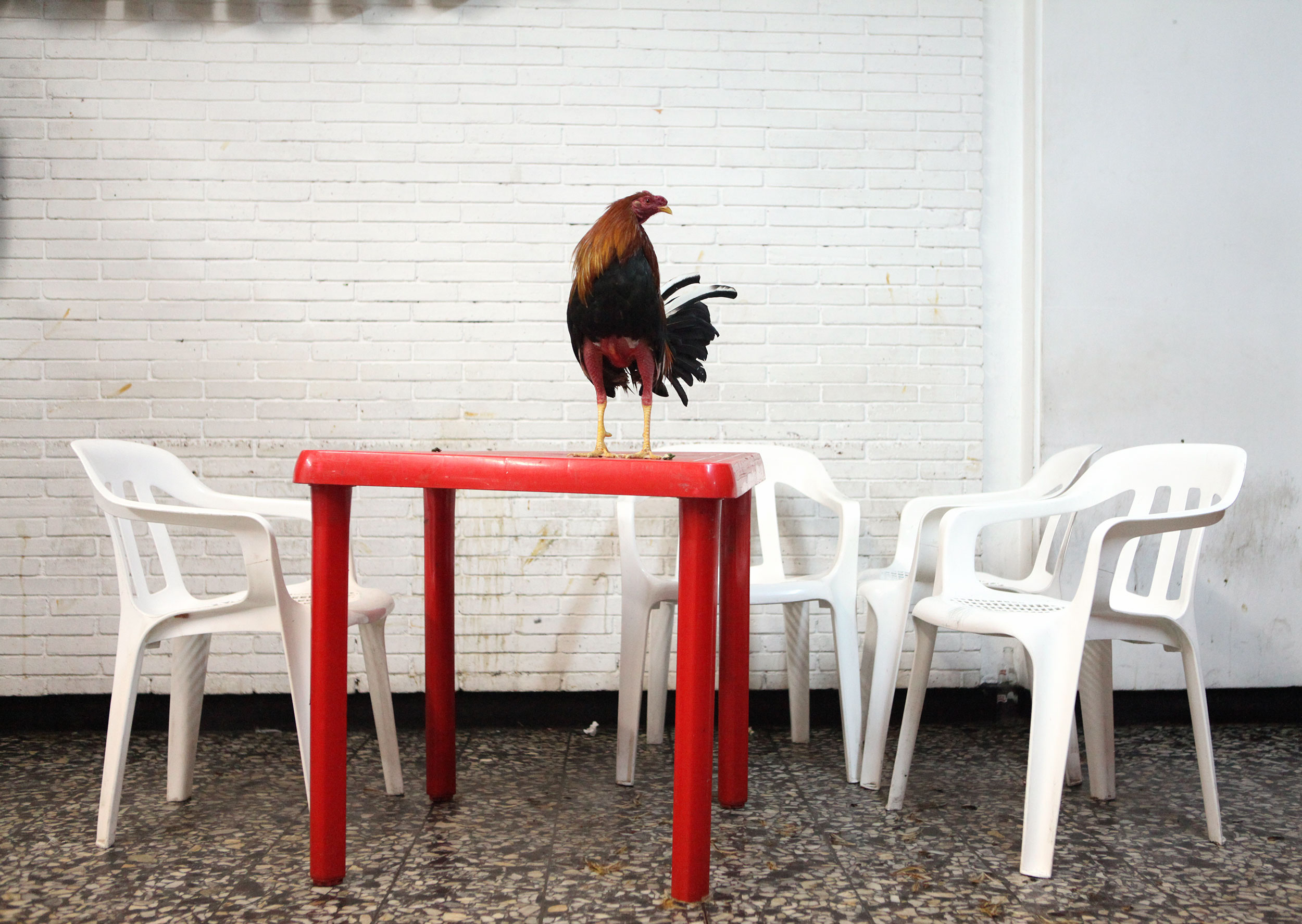
Alex being a photojournalist wanted to go to Club Gallistico and take photos. Club Gallistico is one of the oldest cockfighting establishments in the city and she’ll be doing a full post for that on her personal photoblog. Here a rooster waits to have fighting spurs attached to his feet. Photo: Alex Washburn
Bogota is located in a high plateau situated in the Andes mountain range, which means that it was a bit on the cold side even though it is middle of summer in South America. What helped to take the chill off was a local dish to the region, hot chocolate with cheese and bread with butter. We were a bit confused on how to eat the dish and ended up just dipping the cheese in the hot chocolate and nibbling on it only to find out later that you’re supposed to mix the cheese in and let it melt a little while you eat the bread and then drink the chocolate with the melted cheese inside of it.
As Alex mentioned in her previous post, there is a plethora of street food in Bogota, and many restaurants serving up traditional favorites such as Ajiaco (Colombian chicken soup) and tamals (think Mexican Tamales, but cooked in plantain leaves and considerably bigger with a softer form of masa). We weren’t left wanting once again for restaurants, but it is still hard to find good places among all the mediocrity, however asking locals and police officers never fails to produce results.
Bogota is so expansive you couldn’t ever explore all of it, from the historic downtown, to the more modern financial district (that has a building that at night would put Las Vegas to shame), to the outskirts with its apartments and neighborhoods. Alex and I enjoyed our time in Bogota, and thought it was the city that most surprised us thus far on the trip. Sure it is big and loud, like most capital cities, but there are treasures to be had if you put in the time to find them — and have a really great hostel to stay at!
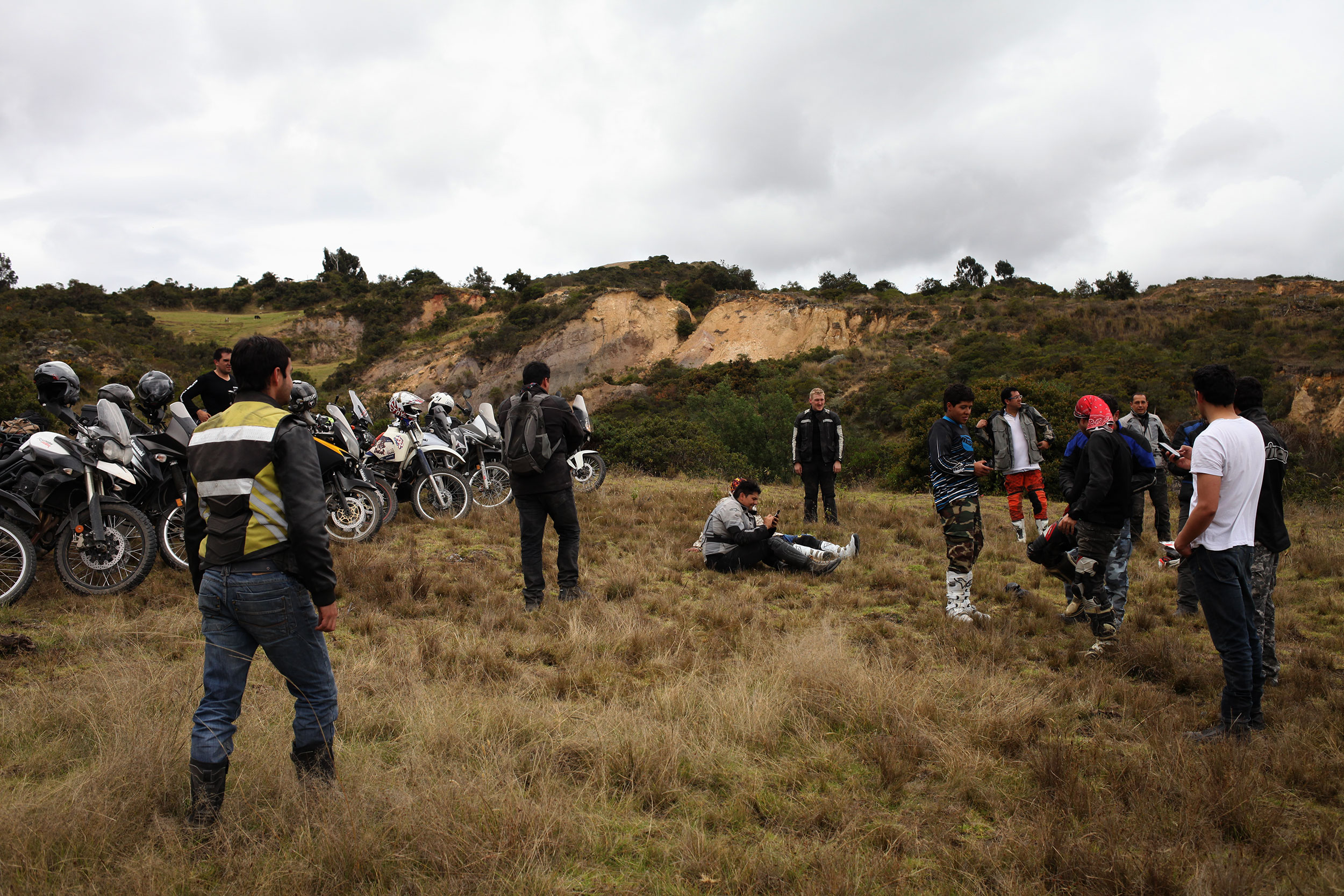
Our last full day in Bogota we met up with a group of Colombian motorcyclists and went off-roading just outside of Bogota. Alex has a ton of bruises from the adventure (full post on the ride tomorrow). Photo: Alex Washburn
A.T.T.C.C.
Posted on January 17, 2014
A.T.T.C.C. is A Tale of Two Colonial Cities. Colombia has two well known towns that are colonial to the bone, both well preserved since their founding and now a days keeping up appearances for tourists. The older of the two is Villa de Leyva founded in 1572 and the baby brother is Barichara founded in 1705. Both are promoted by Lonely Planet and as they are within driving distance (and on our way to Bogota) we decided to do a back to back comparison.
Barichara
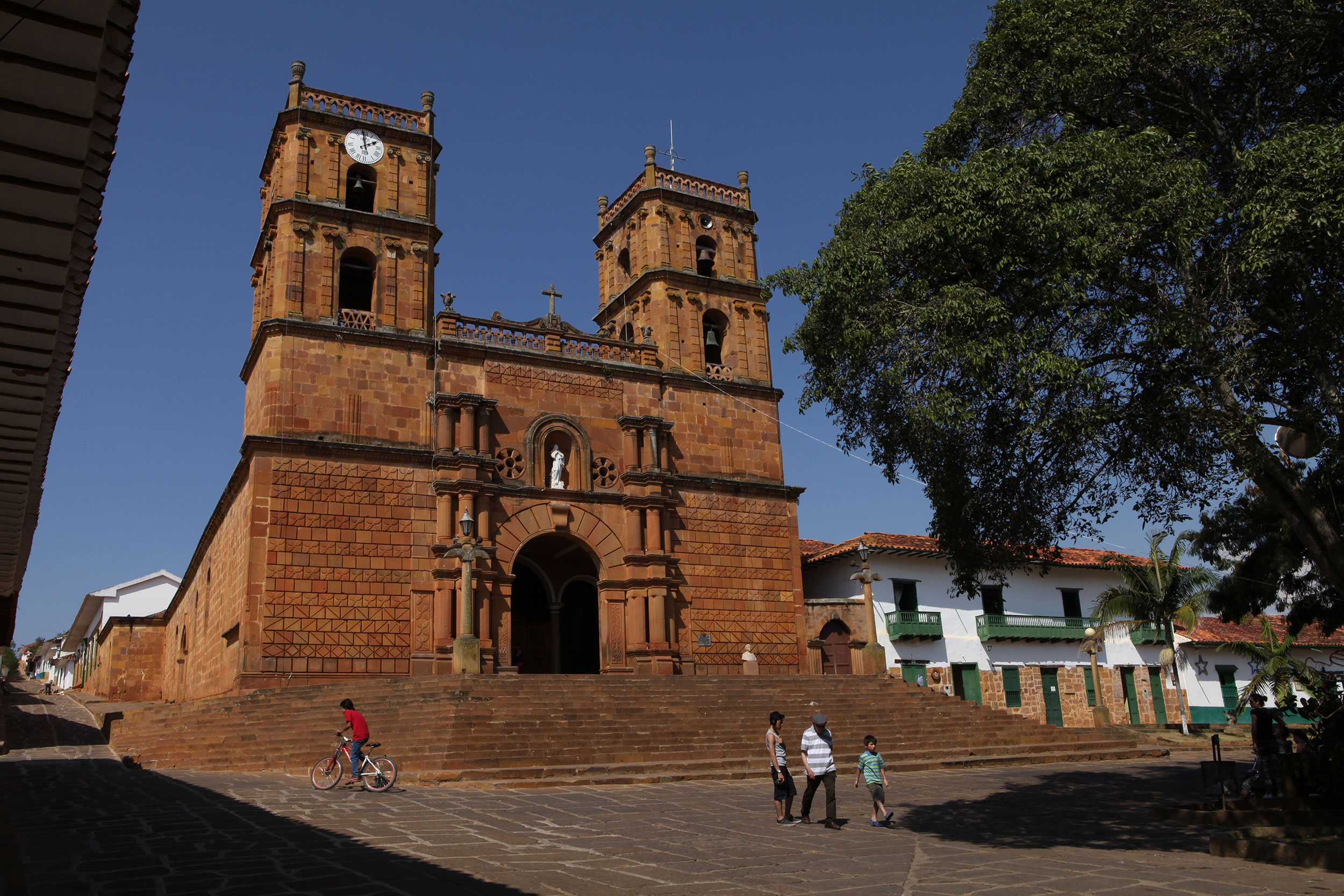
The Cathedral of Barichara dates back to 1705 and seems to dwarf the tiny puebla on the hillside. Photo: Alex Washburn
Barichara is located in the hills above San Gil, sitting atop a plateau that overlooks a dry valley below with a river running through. The landscape between San Gil and Barichara is pastoral bliss and once your in the town, it reminds one of the hills in Tuscany (our what I imagine they are like). The streets are cobblestone, but they have been cemented together, and though most likely slick when wet, it makes driving around on a motorcycle pleasant.
There is the sense that this isn’t just a tourist trap, but a real town nestled in the Colombian countryside. There are not an overwhelming amount of restaurants or knickknack shops, though there are more than enough cafes for some reason (this also is the case in Villa de Leyva). However, you see tons of locals on the streets, or sitting on stoups at night enjoying the country living.
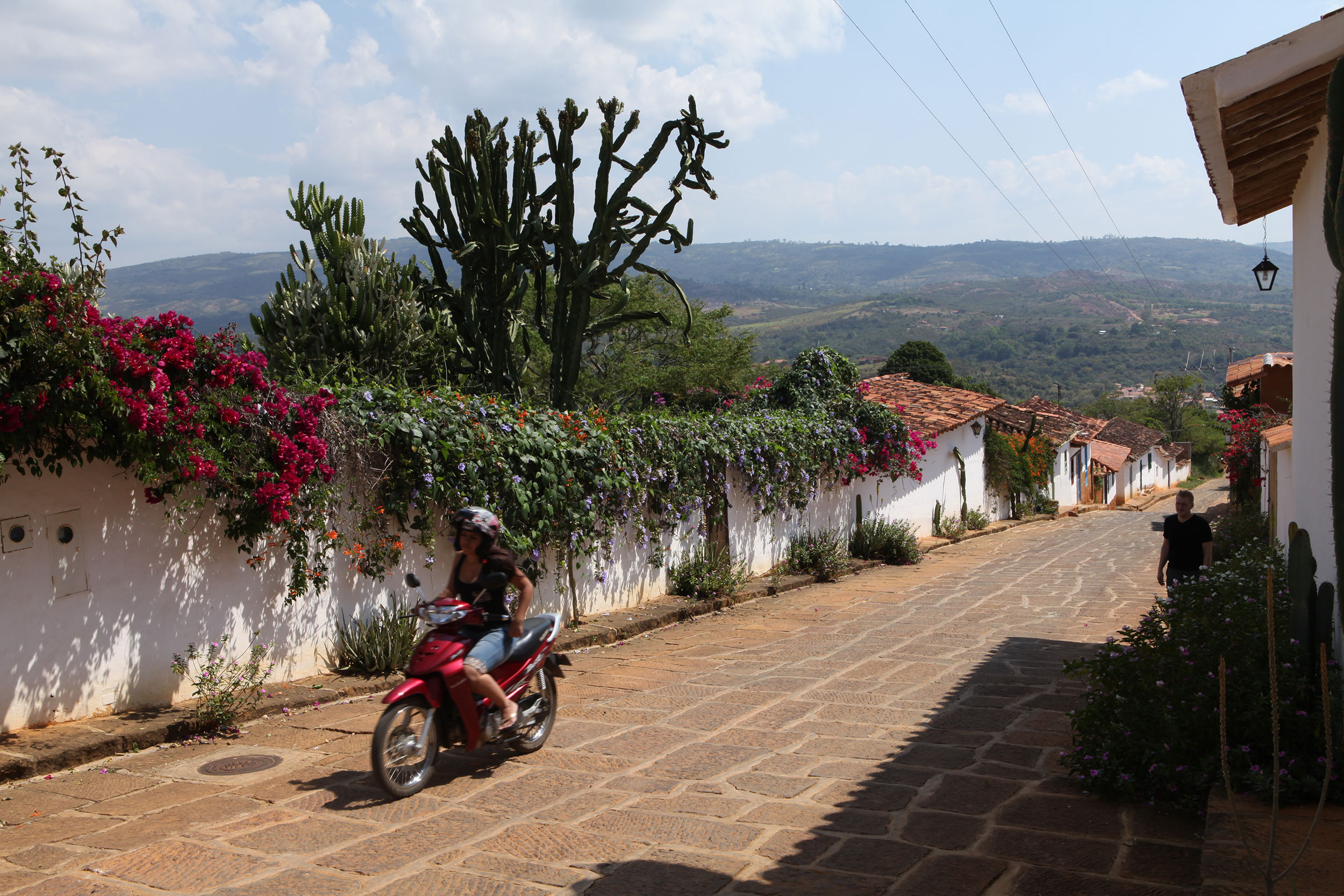
In Barichara you are always either walking up or down a hill. It creates lovely views from every street! Photo: Alex Washburn
Barichara is built on a hill and as you climb your way to the top the views of the surrounding valley only intensify, no matter which street you look down. The citizens and local government has done a great job of keeping up the facades of the houses and there is a cohesive feeling between the buildings that you would expect from a great colonial town.
There are three churches in town, the largest being Catedral de la Inmaculada Concepción, which is located in the main square of town. A couple of look out points on the west side gives great views of the valley, and the whole town can be traversed in under an hour at a lazy pace leaving plenty of time to sip a lemonada at one of the many mentioned cafes.
Sleepy, quite, and what you would want in a little getaway, though the lack of restaurants may leave you a little hungry at dinner time.
Villa de Leyva

The Plaza Mayor in Valle De Leyva is one of the biggest plazas in the Americas. It’s a huge open cobblestone square with a small fountain in the middle and a handful of eateries on its edges. Photo: Alex Washburn
On a dusty road off of Highway-62, between San Gil and Bogota, in a high valley lies Villa de Leyva. The valley, unlike the aird environment of Barichara, is lush and the ride reminded Alex of the hills in Switzerland. The whole town revolves around the Plaza Mayor, which is one of the largest in the Americas and does feel impressive when you stand in the middle.
White washed walls prevail throughout the town, and like Barichara, the architecture is consistent throughout. Villa de Leyva does have a feeling of being more developed, many cafes and trinket shops along with jewelry stores and clothing shops line the inner streets and near the outskirts there are shops where locals would do their shopping.
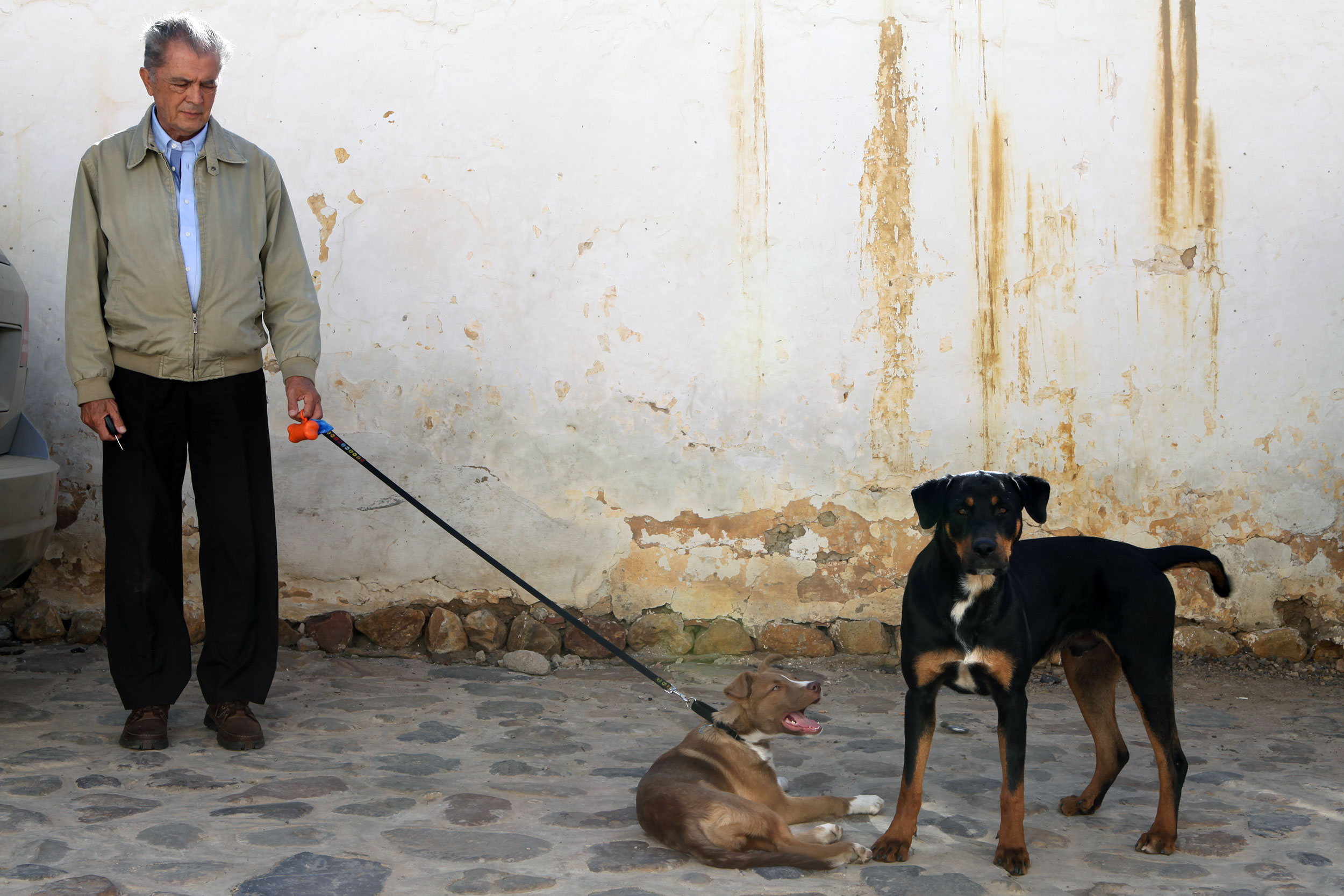
Villa De Leyva is full of people walking their dogs (some on leashes some not). It further adds to the quiet no-hurry atmosphere. Photo: Alex Washburn
The streets are cobblestone too, however laid in the traditional style, which makes driving a motorcycle on them…interesting. Upon entering town, Alex and I ended up going down a one way, the wrong way, and were told by cops to turned around. This is easier said than done on cobblestone, and an elderly gentleman came running up and helped pull us both backwards so we could turn around.
The town is about twice as big as Barichara, but there aren’t any more restaurants as one might expect. As in most smaller towns, stores tend to close early, and that might leave you without many options for dinner if you don’t plan ahead.
Lush, cobbley, and far from the bright lights of Bogota, it is a great escape from the larger cities, though the high altitude may have you reaching for a jacket instead of the sunscreen.
Both towns have hits and misses, Alex prefers Villa de Layva and I was more partial to Barichara. The best advice would be to hit up one or the other that fits best into your itinerary and then know that you got most of the experience of the other.
Tegulcigapa (again)
Posted on December 7, 2013
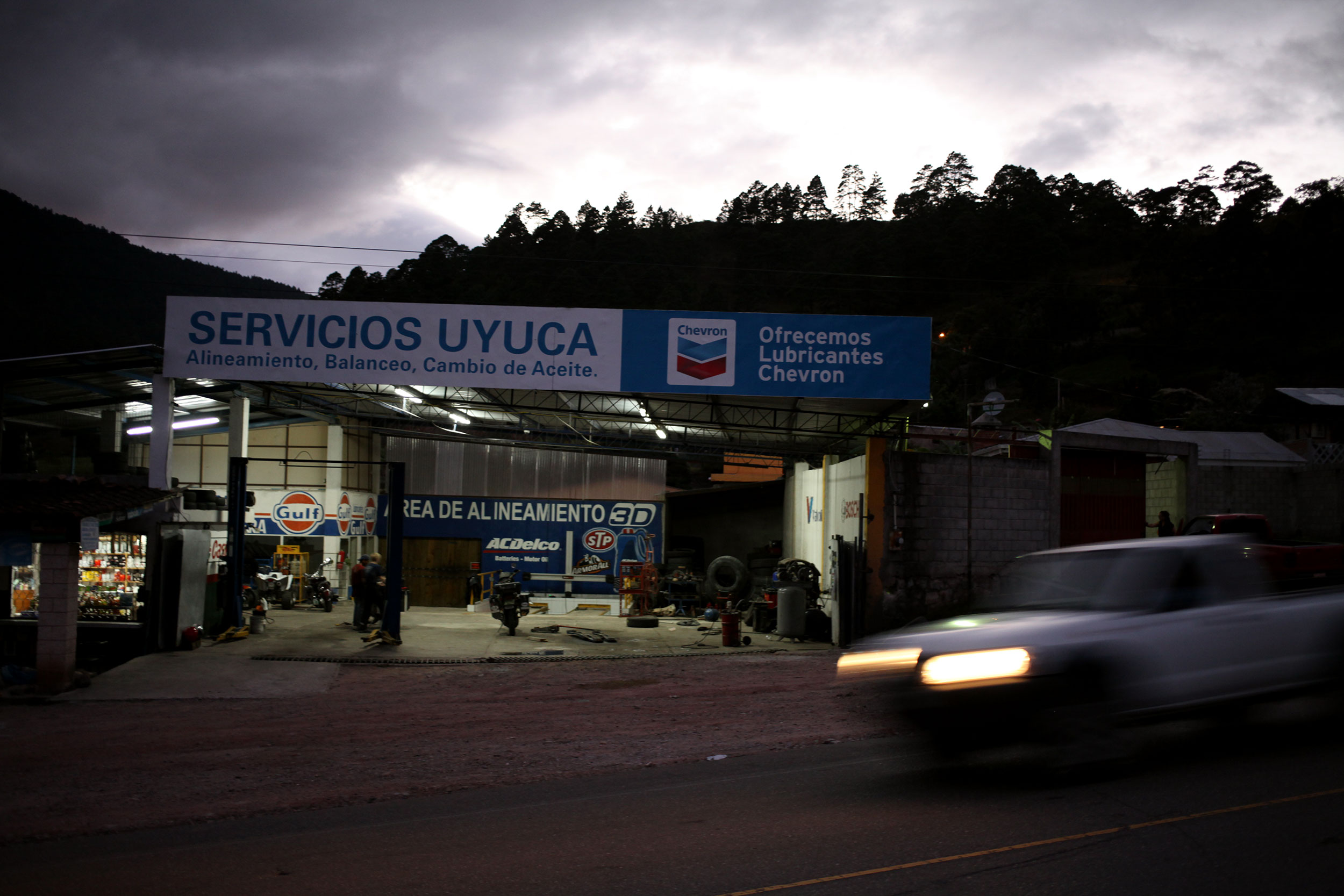
Storm clouds approach as two mechanics in a town we don’t know the name of work to get both our bikes back on the road. Photo: Alex Washburn
Yesterday we planned to have breakfast in a cute town just outside Tegucigalpa Honduras and then make our way to a small town near the Nicaraguan border so we could cross early today. However, the gods of the Autopista had their own plans and although it wasn’t the worst possible day of riding it was probably the most dangerous day of riding we’ve had so far on this trip.
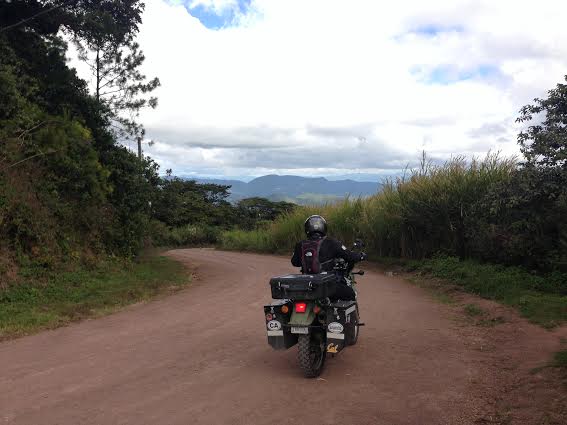
The road from Santa Lucia was beautiful and a great road although it gave us our fair share of problems. Photo: Alex Washburn
Santa Lucia (our goal for breakfast) is an adorable little town in the mountains just outside of “Tegus.” The town built into the green sloping landscape has a clean pond in the middle of it, a town square not much bigger than a basketball court, and a simple white church with a hilltop view of the valley that holds Tegucigalpa.
Unfortunately for us cuteness sometimes comes with cobblestones, which are murder to ride a bike on in Latin America. The stones are huge (typically much bigger than European cobblestones) so if one stone or a series of them have become seriously tilted it can throw your bike around. We finally found the correct cobblestone road out of Santa Lucia heading towards the hills and the rock quickly faded to a hard packed dirt road winding up and up and up.
Every once in a while we would pass a small grouping of houses or a few lonely chickens back-lit by amazing views. Dark green smallish mountains with fields and clouds and sunshine.
It was turning out to be a perfect ride, but around mile 20 there were some really deep indentations in the road from where water runs over the ground in rainstorms. I made it over them and kicked my bike down into first or second gear so that I could ride really slow till Nathaniel showed up again in my mirrors. As I was watching my mirrors I wasn’t paying much attention to where I was going and almost as soon as I saw Nathaniel appear in my mirror I felt my back tire start to slide out from under me in the gravel and I went down.
I clearly wasn’t hurt as you can see in the video and it only took us a second to get the bike back up, however once we did it wouldn’t start. At first I thought maybe the bike had flooded because some gas has started leaking out of it when it was on its side, but after letting the bike sit for several minutes and trying again that was clearly not the case. We decided the only way we were going to be able to get the bike moving again would be to try and roll start it down the hill.
In the process of pushing my bike up the hill and maneuvering it into position for our second attempt at a roll start, Nathaniel noticed that the back tire of his bike was going flat. When I couldn’t get my bike to roll start Nathaniel tried and got it running, which was awesome, however I was supposed to try and follow him slowly up the hill on his bike. When I threw my leg over it I realized his tire wasn’t just going flat – it was a pancake.
We spent probably an hour trying to fix Nathaniel’s tire, first using the goo we had and then plugs from a tire repair kit, neither of which were keeping air in the tire at first. We ran out of our compressed air and then I started asking people passing by if they had anything to inflate tires with in their vehicle.
I hailed a tuk-tuk driver over and asked him if he had one (assuming those little tires must have a lot of problems on these roads) and his passenger became very concerned for Nathaniel and I. We talked for several minutes about where a mechanic might be and how to get the tire inflated. The passenger ended up paying the tuk-tuk driver to take the boy he had been riding with back to their home and the tuk-tuk driver would then bring back something to inflate the tire with as he waited with us to make sure we were okay.
The man that stayed with us was incredibly nice. He was probably in his mid 50’s to early 60’s and he told us that although the area we were in was safe he wanted to make sure visitors to his country were taken care of. Although it’s not something that lives in our minds everyday, it’s worth mentioning Honduras is one of the most murderous countries in the world. It usually places in the top three in any given year above places like Uganda, Malawi, and the Congo.
The tuk-tuk driver returned in about 20 minutes and told us that after he filled Nathaniel’s tire we should follow him to a tire repair shop. He filled the tire from a hand pump and our friend that waited with us used pieces of plant alongside the road to stuff into the hole created by the nail Nathaniel had run over. I started up the road on Nathaniel’s bike after the tuk-tuk as Nathaniel roll started my bike and came after us.
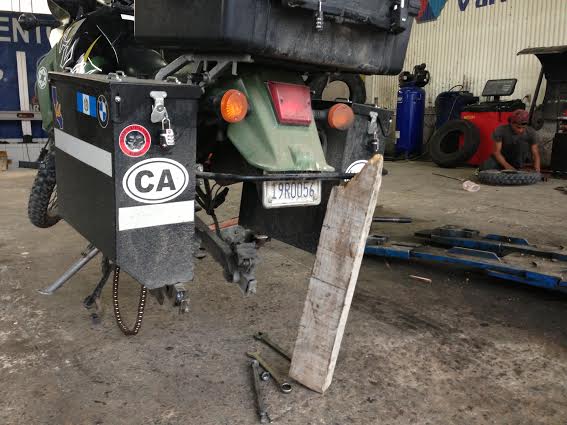
When Nathaniel’s bike is on its’ center stand it is unbalanced and this is how the mechanics held up his bike as they fixed his back tire. Photo: Alex Washburn
The men at the shop charged us $15 for their help and jumped my bike with one of their cars before Nathaniel and I headed off into the night. We avoid riding at night because the roads here are sprinkled with nasty potholes and a lack of ambient light makes them a lot darker then in the US.
Getting back to Tegucigalpa was the worst 15 miles of riding we’ve had on the entire trip. With low visibility in the dark we couldn’t ride fast enough to keep our face shields from fogging and because it was raining they were also covered in water droplets so anytime we met oncoming traffic light would catch in the droplets on my face mask totally blinding me.
It took us a really long time to get back to the hotel we’ve been staying at in Tegucigalpa. Until we got back to the city center I was in a constant cycle of opening my face shield to vent it, wiping the water off it, flipping my mask up and squinting into the rain when cars came, flipping the face shield back down, praying during the moments I was totally blind on the road that I wouldn’t hit a pothole. Plus, I always worried that if I stalled the bike we’d be stuck along a dark rainy road in the middle of Honduras, without a way to start it again.
We’re now back in the same hotel we spend the last three nights and hope to figure out what is wrong with the bike today.
Motociclistas Sin Fronteras
Posted on December 4, 2013
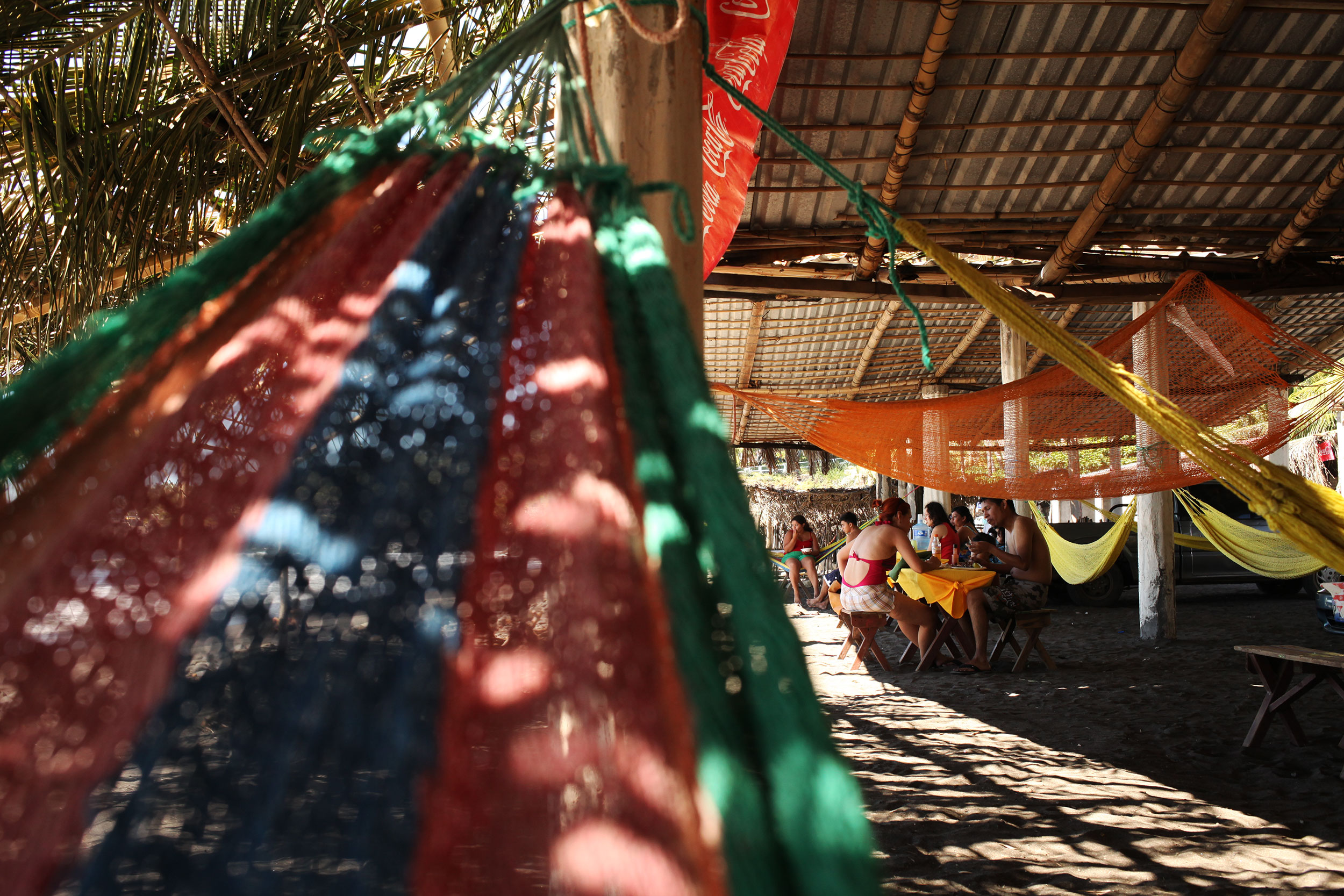
Families relax near the beach in Sunzal El Salvador. Photo: Alex Washburn
The days since we left Antigua have been intense and it’s going to be hard for me to focus on the key events so bear with me. We usually attempt to focus our blogs on a collection of days that are related but the past week has been a total hodge podg of experiences.
Also, my brain has been hyper-focused on trip related issues so I don’t have very many photos from the past few days.
After Antigua we cruised south to a small town closer to the border called Chiquimulila. We stayed one night there before hitting the road for the El Salvador border, however I was not mentally prepared to deal with the ‘fixers’.
In our previous border crossings people haven’t been annoyingly persistent in their attempts to solicit us and it lulled me into believing all people would be so agreeable.
As we approached the El Salvadorian border we saw the first of the trucks. Central American countries have few crossings where the semis can get through and the line of rumbling smoking beasts can stretch for miles leading up to a border. As a motorcyclist or regular car you should just go around them if there is space. They aren’t dealing with the same officials or paperwork as tourists so you aren’t ‘cutting’ anybody.
As we approached the first trucks we swung ourselves into the opposite lane and kept going as a collection of guys with scooters tried to flag us down near the end of the line.
Four men on two scooters then proceeded to follow us weaving in and out of the trucks and trying to motion us through the trucks for the next several miles (see video).
It can get pretty overwhelming to be honest and as Nathaniel and I arrived to the custom office and began parking I totally lost my temper and screamed at them. I’m not fluent enough in Spanish for cursing to happen as an accident (I did not curse at them), but I definitely didn’t plan to yell at them.
I DON’T NEED YOUR HELP. LEAVE ME ALONE.
One of them men jumped backwards and seemed really surprised at my outburst while his partner trailed us for another 10 minutes before finally giving up.
Without any hiccups the crossing took about two hours. It was mostly boring and hot, though not very difficult, although I sometimes get mentally tired constantly dealing with official documents in Spanish.
Something very important about crossing borders with a vehicle in Latin America is that you need originals of your passport, drivers license, title, registration and several copies of all of them before you even think about visiting Aduana (customs).
We left the border and made for Sunzal El Salvador. The coastal road to get there was equal to many sections of Highway 1 in California and we found a place to stay a few hundred feet from the beach for $20 a night, we have now driven from the Pacific Ocean to the Caribbean and back!
We only arrived about an hour before sundown so I asked Nathaniel if we could crash for two nights in Sunzal as the idea of two border crossings in two days (we were on a mission to get to Honduras) made my head hurt.
We spent a very lazy day in Sunzal eating fish papusas, Nathaniel swimming in the ocean (he is Aquaman), and laying on hammocks before getting up early and heading out for the next border. Because of some ATM issues (sometimes finding money in Latin America can be difficult when your off the beaten path) we couldn’t cross the border December 2nd as intended and had to stay in a border town called Santa Rosa de Lima.
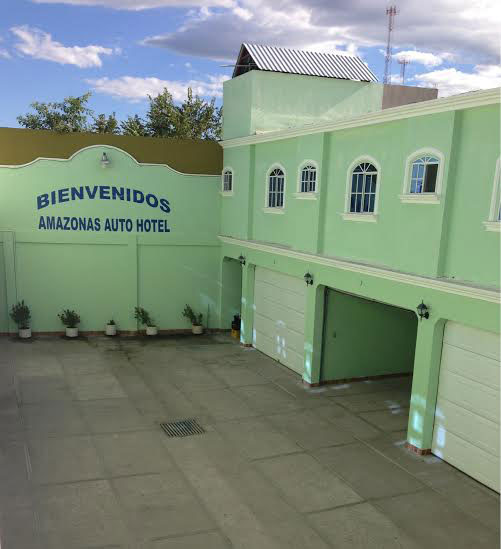
A closed garage door means a room is Occupied. Photo: Alex Washburn
I asked the man how much per night and was okay with the $35 price tag because it meant our bikes would be totally safe for the night as there weren’t any real other viable options in this border town. Once we went up to our room we realized we had accidentally booked ourselves into an infamous ‘Love Hotel‘.
A Love Hotel is basically a place where you can pull your car into a garage, close the door, pay for the room (3 hour minimum) and leave all without ever talking to someone face to face. You pay in cash and they don’t ask for your name.
The room was actually really clean (cleaner than most), but had some very bizarre features that a regular hotel would never have. For starters – they pipe in music and although you can control the volume you can’t quite turn it off. Secondly high up of the wall was an automated air freshener that sprayed the room with sickly flower smell every 15 minutes.
The entire situation was comical but the hotel its self was secure and clean which is why we were able to push the ick-factor out of our minds and hunkerdown with cheeseburgers and an CSI marathon for the night. On CSI commercial breaks I would occasionally go to the window to keep track of the hotel’s turnover rate by counting closed garage doors.
Once again the next morning we zipped up our riding suits (still giggling about the hotel) and put our sights on the next border.
For the El Salvador – Honduras border we had our game faces on.
It’s supposed to be the most grueling Kafkaesque border crossing in all of Central America. We knew it could take a few hours, but we had to be prepared for it to take all day.
We checked multiple sources for information on what we needed before crossing and we found a BRILLIANT post on RideDot (Link) that had a step by step breakdown of the process.
As we approached the fixers quickly surrounded us and I gave them the silent treatment for a few minutes before turning to the most annoying of them and in my best pure-bitch-dehumanizing voice told him:
I’m not going to talk to you. I speak Spanish. I don’t need your help.
And they left us alone pretty quickly.
I hate being rude to people, but I had learned the crossing before that a hundred ‘no thank yous’ won’t go as far as one very direct and angry message.
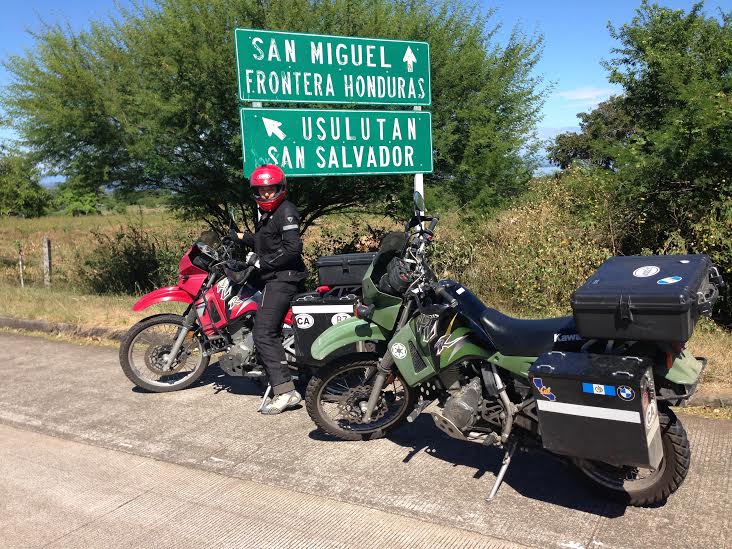
Alex poses next to a sign showing we are close to the Honduran border. Photo: Nathaniel Chaney
We are now in the Honduran capitol of Tegucigalpa and plan on leaving for Leon Nicaragua in a few days.
Thank you for sticking with me through this post – I know it was a little all over the place.
The Coastal Highway
Posted on November 21, 2013
This video was shot on the Coastal Highway in Belize, the road that all of the locals told us not to ride. I shot it all with a GoPro Hero3 silver edition and edited with the new GoPro suite.
 Where the Autopista Ends