Volcano Boarding
Posted on December 13, 2013
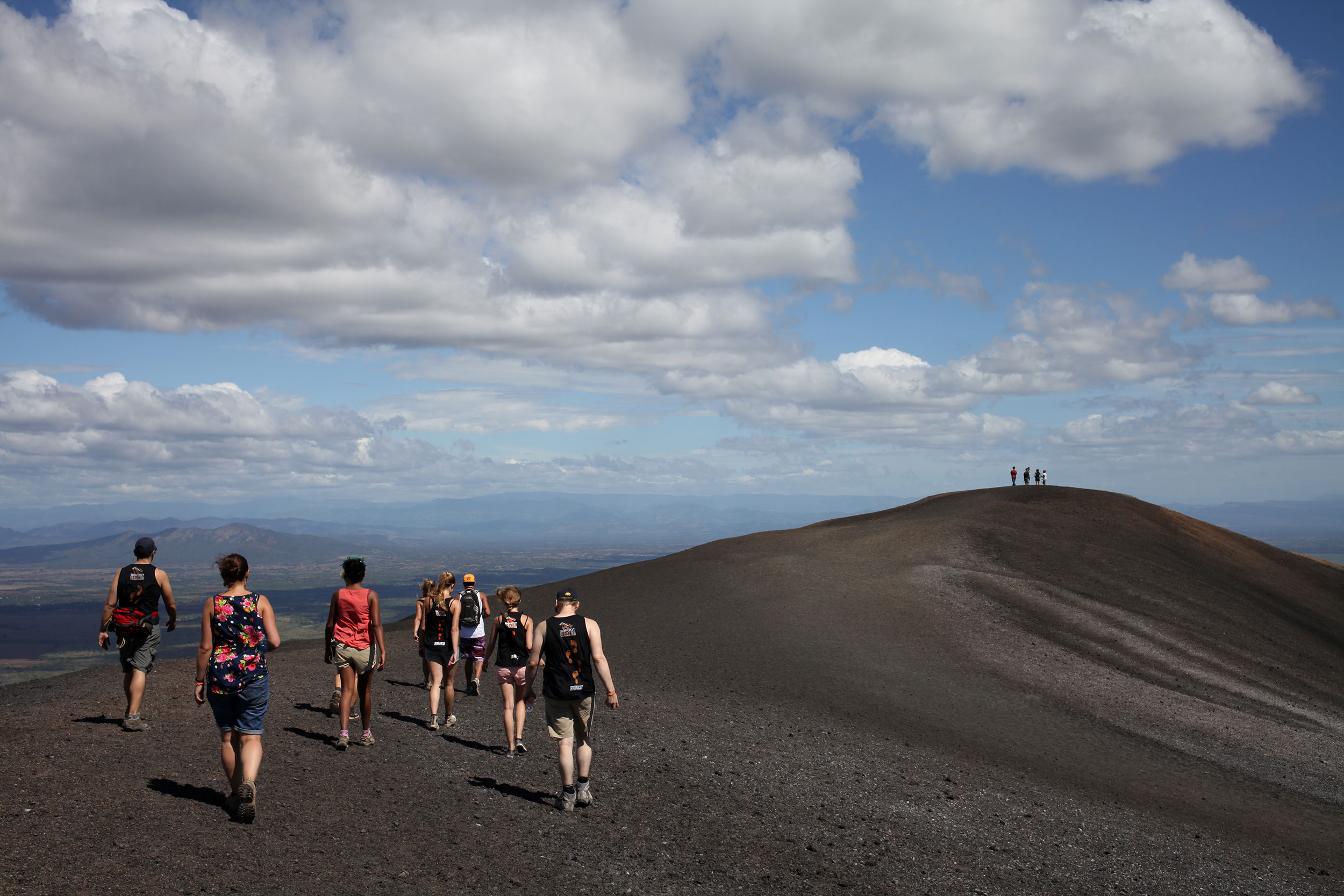
We explore the crown of Cerro Negro after an hour hike to the top. Photo:Alex Washburn
We climb into the back of an absurdly large giant four wheel drive truck with other travelers from the UK, Israel, Germany, Ireland, Australia, Holland and the United States; we all fidget with nervous energy grinning and waiting for our adventure to start.
The truck fires up and lurches off throwing us into one another as it rounds corner after corner, bumping along on small cobblestone roads in a way that would make veterans of the Knight Bus nervous (Harry Potter reference).
There are no seat belts and we grab onto the railings, seats, and each other for stability during the 45 minute ride to Cerro Negro.
About a decade ago an Australian with presumably too much time on his hands visited Leon Nicaragua and decided to turn the active volcano Cerro Negro into an extreme sport destination. He first tried boarding the hill with a snowboard and destroyed his equipment in the process — volcanic rock is not kind to fancy gear. Next he tried a refrigerator door (fail), before moving on to a picnic table (also a fail), a mattress (biggest fail) and a variety of other items he thought might make it down the 42 degree slope of black volcanic rock.
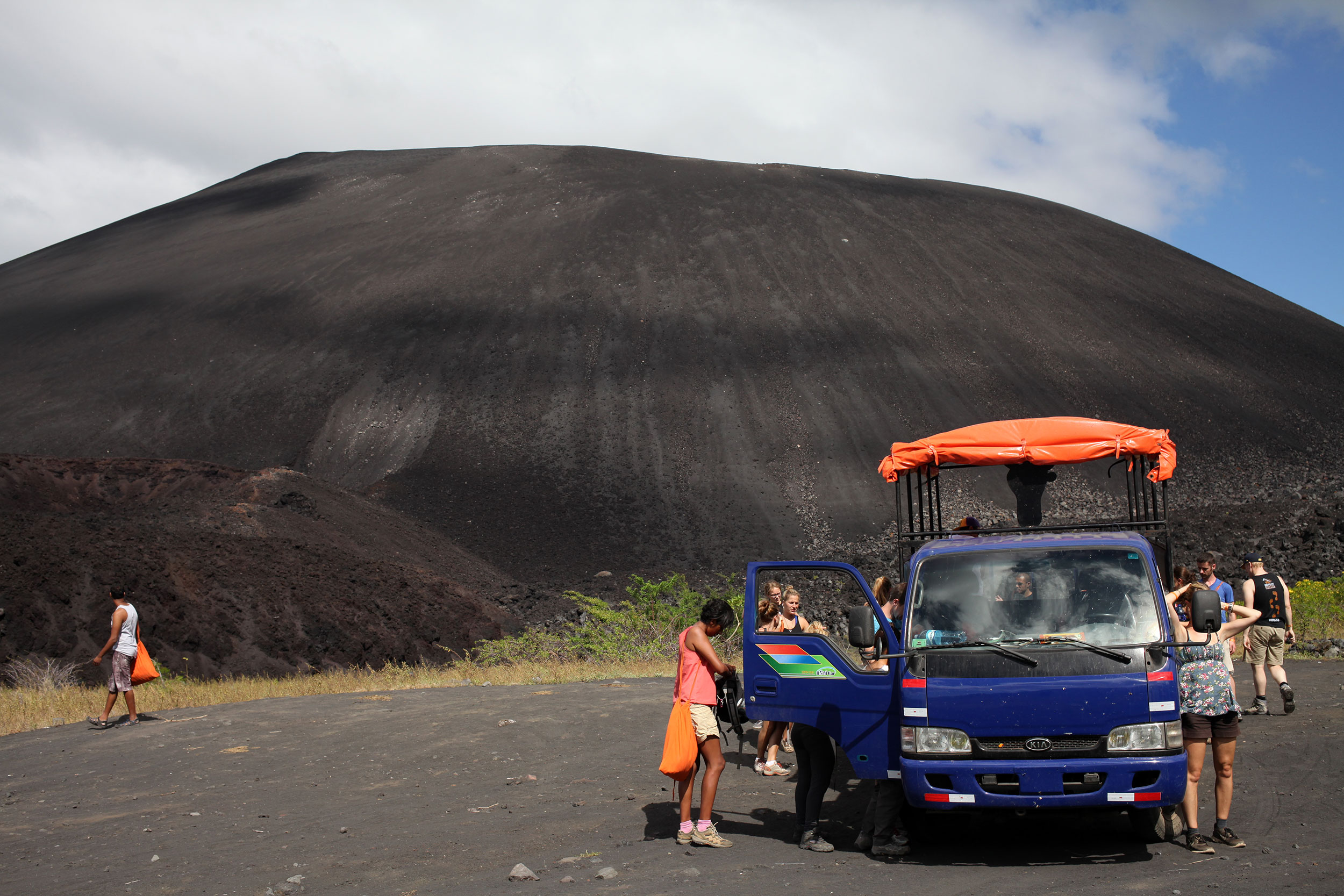
Our Volcano Boarding group arrives to Cerro Negro. Photo: Alex Washburn
The cobblestones quickly gives way to cracked pavement and then dirt. The driver rushes over the small roads kicking up a mountain of dust that engulfs bicyclists, cows, pedestrians and entire busses as he rushes past and the road just keeps going.
Local guides claim that because of the wind patterns in the area Cerro Negro is the only volcano in the world suitable for Volcano Boarding. This may or may not be true but a google search for ‘volcano boarding’ will only give you hits related to Leon Nicaragua.
We pull up to the entrance of the nature park and slide to a stop. We all have to pay a $7 entry fee to enter the park and sign our names in the visitor ledger before we ride the last few kilometers to the base of Cerro Negro.
Cerro Negro isnt impressive looking because of its size, although it feels massive to hike up carrying a piece of metal sheathed plywood and your obligatory jump suit. No- Cerro Negro impresses with its dramatic slopes of black rock. Nothing grows on it and at the top you are greeted only by the smell of of sulfur and the giant bugs that are drawn to it.
Our guide Jose gives us a quick rundown of what to expect on the hike, how to best carry our board and tells us that we will stop three times along the way for information and to rest — we begin.
The hike starts easy enough on roughly shaped steps made out of larger rocks the size of your head, but as the slope gets steeper, the rocks get smaller, and the wind picks up hitting your board like a kite, it can get scary. We creep along the side of the volcano stopping and posing for photos when Jose tells us to and gripping the boards for dear life as we march up the path.
The real tragedy would be falling off the path, losing your board, and doing the hike for nothing. It takes an hour to climb the Volcano and less than a minute to slide down it, less than 30 seconds if you’re going for a record or are interested in seriously hurting yourself.
At the top we take time to appreciate the view and Jose scuffs a mark into the dirt and has us feel the earth just a few inches below the surface, surprisingly it is almost too hot to touch and you can see a few people’s faces questioning the sanity of sliding through it wearing a cotton jumpsuit and flimsy plastic goggles.
I am already wearing my goggles because it’s so windy at the top of the volcano little bits of rock and dust keep flying into my face. I don’t care if I look silly – I’d rather not blind myself before the ride.
Jose gives the command to ‘SUIT UP!’ and the moonscape at the top of the volcano gets even more bizarre as a dozen tourists start pulling on orange jump suits and goggles, a prison gang run wild. I ignore the command (sorry Jose) and buzz about taking photos of people getting ready as Jose starts his safety speech.
The single rider speed record on Cerro Negro is over 50 mph. When you consider you aren’t going to be wearing gloves or a helmet as you slide down a hill comprised solely of volcanic rocks, then listening to Jose when he gives you safety instructions is key. However – I’ve done this before and I have no desire to break a speed record.
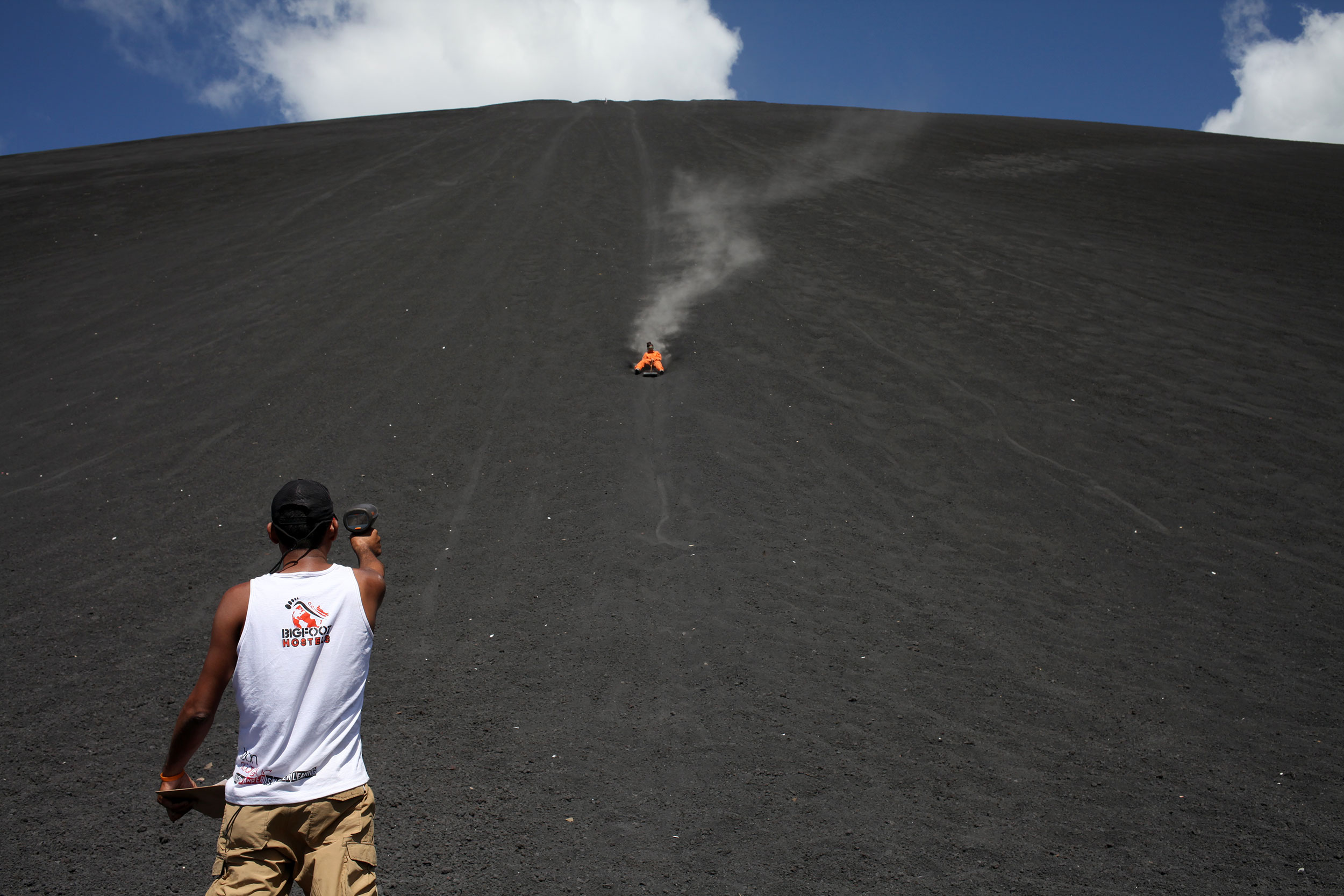
Our secondary guide waits at the bottom of Cerro Negro with a speed gun. Photo: Alex Washburn
It’s at this point I wrap my 5D Mark II in plastic with my iPhone and stick it in my backpack before pulling the jump suit over it. We take our places in two lines as Jose issues his final instruction before disappearing over the lip of the volcano to take pictures of us as we board down.
Several people take their turns and then suddenly it’s my turn. I carefully position myself on the board as I try and center myself in the starting chute while Nathaniel looks down at me with his GoPro.
The signal is given and I start scooting myself to the edge. I have problems getting out of the chute (the guy before me did it too fast and fell off his board), but once I hit the slope I start to slide easily down the volcano.
Gripping my rope I think I am going too fast so I dig my feet in, but I can’t seem to slow myself down. Once I reach Jose I know I am not allowed to brake anymore because the slope becomes too steep to safely slow yourself down. One of Jose’s biggest warnings at the top:
Once you pass me do NOT try and brake. 45 degrees is too steep to brake on, you will lose control and it will hurt.
The adrenaline starts to pump through me and I am reminded to keep my mouth closed as I taste the grit flying into my teeth. I clamp my mouth shut as I slide past Jose and then I lift my feet. I can use them to steer still – letting my motorcycle boots carefully skim the surface of the volcano, but I resist the urge to bury my feet in the rock.


I can feel the friction heat up the board underneath me and I wonder to myself if something could catch fire with that much heat. My speed starts to increase as pure gravity and the formica slicked board do their work. I start to hop slightly over a few bumps and for a second I think I am going sideways – rushing past our secondary guide who holds a speed gun I safely come to a stop.
Nothing moves.
I stand up, careful to pick up my board by the rope (the board is now hot enough to burn you) and I give my guide my name ‘Alex’ so he can record my speed. I join the others at the truck and start to strip off my jump suit watching the next few people make their way down Cerro Negro.
Once everyone has made it to the bottom we watch in awe as Jose runs down. He passes out our beers and takes a celebratory photo of all of us before we climb back on the truck for an even crazier ride back to our Hostel. At the hostel all volcano boarders are given a free mojito, most people caked in black dust gulp it down and make for the showers.
These are the days that make travel worth it.
Tegulcigapa (again)
Posted on December 7, 2013
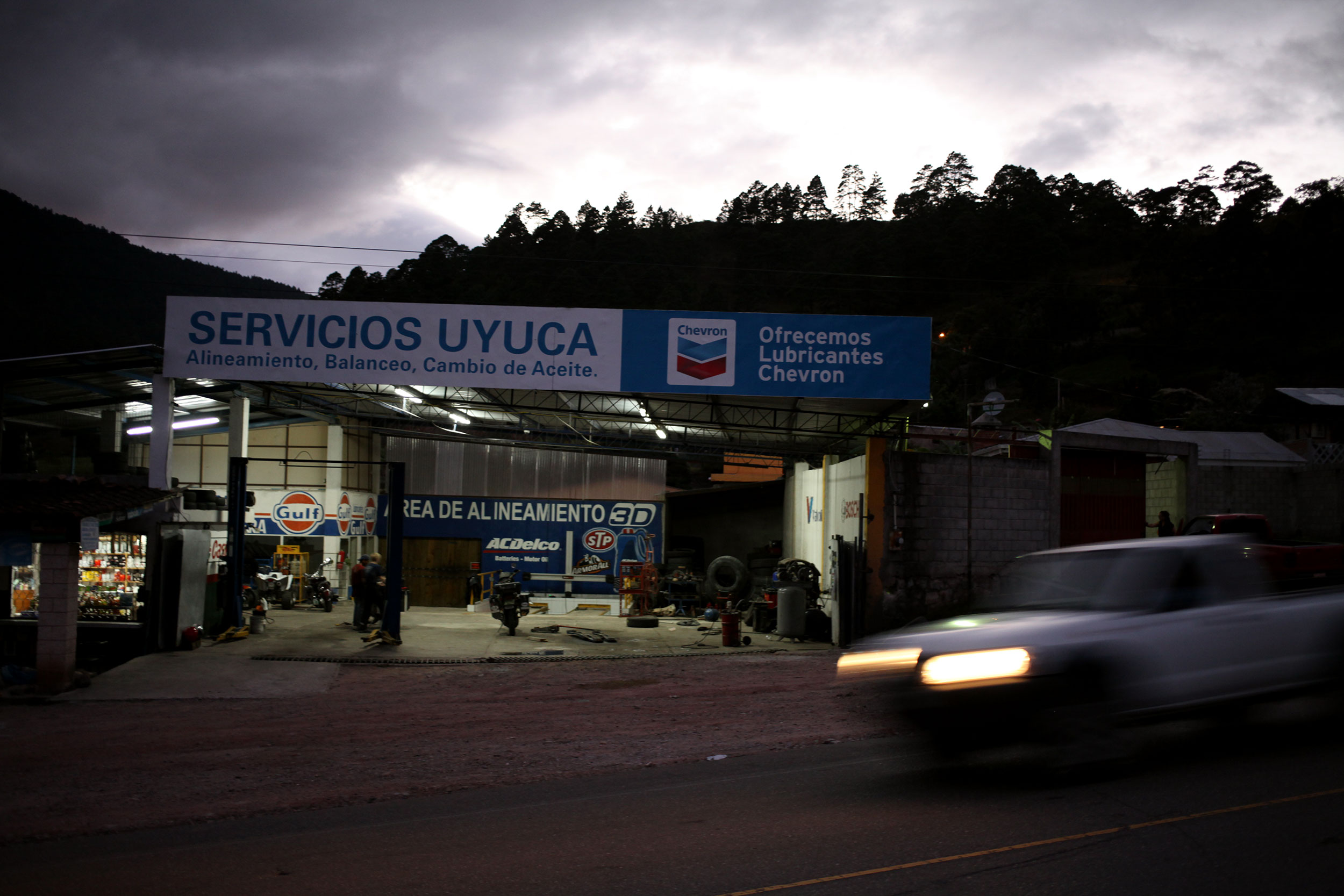
Storm clouds approach as two mechanics in a town we don’t know the name of work to get both our bikes back on the road. Photo: Alex Washburn
Yesterday we planned to have breakfast in a cute town just outside Tegucigalpa Honduras and then make our way to a small town near the Nicaraguan border so we could cross early today. However, the gods of the Autopista had their own plans and although it wasn’t the worst possible day of riding it was probably the most dangerous day of riding we’ve had so far on this trip.
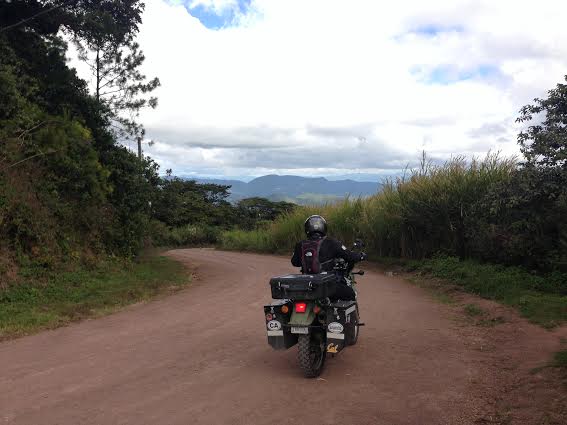
The road from Santa Lucia was beautiful and a great road although it gave us our fair share of problems. Photo: Alex Washburn
Santa Lucia (our goal for breakfast) is an adorable little town in the mountains just outside of “Tegus.” The town built into the green sloping landscape has a clean pond in the middle of it, a town square not much bigger than a basketball court, and a simple white church with a hilltop view of the valley that holds Tegucigalpa.
Unfortunately for us cuteness sometimes comes with cobblestones, which are murder to ride a bike on in Latin America. The stones are huge (typically much bigger than European cobblestones) so if one stone or a series of them have become seriously tilted it can throw your bike around. We finally found the correct cobblestone road out of Santa Lucia heading towards the hills and the rock quickly faded to a hard packed dirt road winding up and up and up.
Every once in a while we would pass a small grouping of houses or a few lonely chickens back-lit by amazing views. Dark green smallish mountains with fields and clouds and sunshine.
It was turning out to be a perfect ride, but around mile 20 there were some really deep indentations in the road from where water runs over the ground in rainstorms. I made it over them and kicked my bike down into first or second gear so that I could ride really slow till Nathaniel showed up again in my mirrors. As I was watching my mirrors I wasn’t paying much attention to where I was going and almost as soon as I saw Nathaniel appear in my mirror I felt my back tire start to slide out from under me in the gravel and I went down.
I clearly wasn’t hurt as you can see in the video and it only took us a second to get the bike back up, however once we did it wouldn’t start. At first I thought maybe the bike had flooded because some gas has started leaking out of it when it was on its side, but after letting the bike sit for several minutes and trying again that was clearly not the case. We decided the only way we were going to be able to get the bike moving again would be to try and roll start it down the hill.
In the process of pushing my bike up the hill and maneuvering it into position for our second attempt at a roll start, Nathaniel noticed that the back tire of his bike was going flat. When I couldn’t get my bike to roll start Nathaniel tried and got it running, which was awesome, however I was supposed to try and follow him slowly up the hill on his bike. When I threw my leg over it I realized his tire wasn’t just going flat – it was a pancake.
We spent probably an hour trying to fix Nathaniel’s tire, first using the goo we had and then plugs from a tire repair kit, neither of which were keeping air in the tire at first. We ran out of our compressed air and then I started asking people passing by if they had anything to inflate tires with in their vehicle.
I hailed a tuk-tuk driver over and asked him if he had one (assuming those little tires must have a lot of problems on these roads) and his passenger became very concerned for Nathaniel and I. We talked for several minutes about where a mechanic might be and how to get the tire inflated. The passenger ended up paying the tuk-tuk driver to take the boy he had been riding with back to their home and the tuk-tuk driver would then bring back something to inflate the tire with as he waited with us to make sure we were okay.
The man that stayed with us was incredibly nice. He was probably in his mid 50’s to early 60’s and he told us that although the area we were in was safe he wanted to make sure visitors to his country were taken care of. Although it’s not something that lives in our minds everyday, it’s worth mentioning Honduras is one of the most murderous countries in the world. It usually places in the top three in any given year above places like Uganda, Malawi, and the Congo.
The tuk-tuk driver returned in about 20 minutes and told us that after he filled Nathaniel’s tire we should follow him to a tire repair shop. He filled the tire from a hand pump and our friend that waited with us used pieces of plant alongside the road to stuff into the hole created by the nail Nathaniel had run over. I started up the road on Nathaniel’s bike after the tuk-tuk as Nathaniel roll started my bike and came after us.
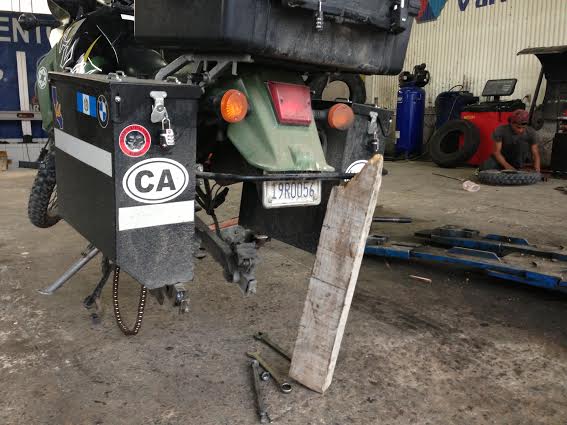
When Nathaniel’s bike is on its’ center stand it is unbalanced and this is how the mechanics held up his bike as they fixed his back tire. Photo: Alex Washburn
The men at the shop charged us $15 for their help and jumped my bike with one of their cars before Nathaniel and I headed off into the night. We avoid riding at night because the roads here are sprinkled with nasty potholes and a lack of ambient light makes them a lot darker then in the US.
Getting back to Tegucigalpa was the worst 15 miles of riding we’ve had on the entire trip. With low visibility in the dark we couldn’t ride fast enough to keep our face shields from fogging and because it was raining they were also covered in water droplets so anytime we met oncoming traffic light would catch in the droplets on my face mask totally blinding me.
It took us a really long time to get back to the hotel we’ve been staying at in Tegucigalpa. Until we got back to the city center I was in a constant cycle of opening my face shield to vent it, wiping the water off it, flipping my mask up and squinting into the rain when cars came, flipping the face shield back down, praying during the moments I was totally blind on the road that I wouldn’t hit a pothole. Plus, I always worried that if I stalled the bike we’d be stuck along a dark rainy road in the middle of Honduras, without a way to start it again.
We’re now back in the same hotel we spend the last three nights and hope to figure out what is wrong with the bike today.
Motociclistas Sin Fronteras
Posted on December 4, 2013
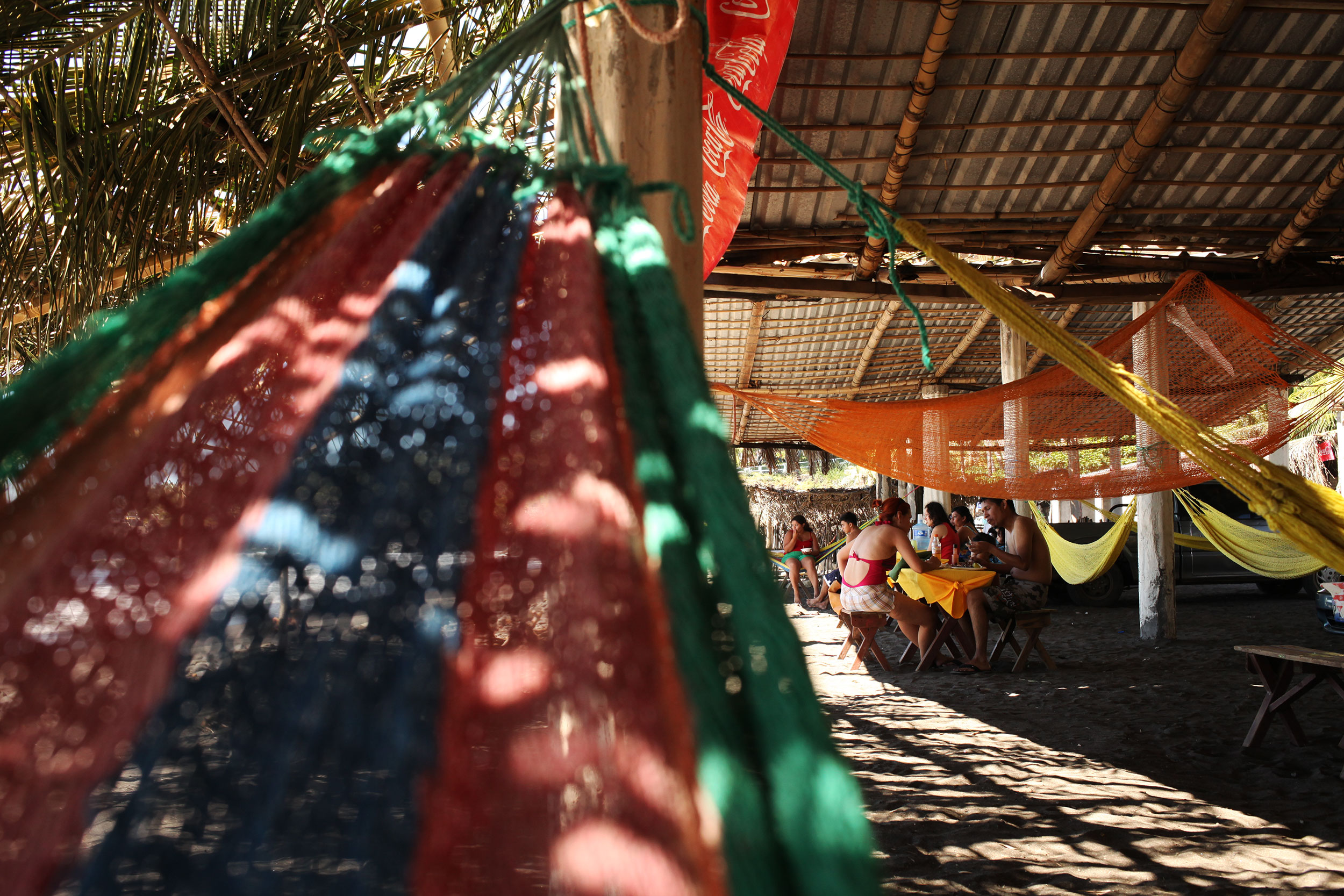
Families relax near the beach in Sunzal El Salvador. Photo: Alex Washburn
The days since we left Antigua have been intense and it’s going to be hard for me to focus on the key events so bear with me. We usually attempt to focus our blogs on a collection of days that are related but the past week has been a total hodge podg of experiences.
Also, my brain has been hyper-focused on trip related issues so I don’t have very many photos from the past few days.
After Antigua we cruised south to a small town closer to the border called Chiquimulila. We stayed one night there before hitting the road for the El Salvador border, however I was not mentally prepared to deal with the ‘fixers’.
In our previous border crossings people haven’t been annoyingly persistent in their attempts to solicit us and it lulled me into believing all people would be so agreeable.
As we approached the El Salvadorian border we saw the first of the trucks. Central American countries have few crossings where the semis can get through and the line of rumbling smoking beasts can stretch for miles leading up to a border. As a motorcyclist or regular car you should just go around them if there is space. They aren’t dealing with the same officials or paperwork as tourists so you aren’t ‘cutting’ anybody.
As we approached the first trucks we swung ourselves into the opposite lane and kept going as a collection of guys with scooters tried to flag us down near the end of the line.
Four men on two scooters then proceeded to follow us weaving in and out of the trucks and trying to motion us through the trucks for the next several miles (see video).
It can get pretty overwhelming to be honest and as Nathaniel and I arrived to the custom office and began parking I totally lost my temper and screamed at them. I’m not fluent enough in Spanish for cursing to happen as an accident (I did not curse at them), but I definitely didn’t plan to yell at them.
I DON’T NEED YOUR HELP. LEAVE ME ALONE.
One of them men jumped backwards and seemed really surprised at my outburst while his partner trailed us for another 10 minutes before finally giving up.
Without any hiccups the crossing took about two hours. It was mostly boring and hot, though not very difficult, although I sometimes get mentally tired constantly dealing with official documents in Spanish.
Something very important about crossing borders with a vehicle in Latin America is that you need originals of your passport, drivers license, title, registration and several copies of all of them before you even think about visiting Aduana (customs).
We left the border and made for Sunzal El Salvador. The coastal road to get there was equal to many sections of Highway 1 in California and we found a place to stay a few hundred feet from the beach for $20 a night, we have now driven from the Pacific Ocean to the Caribbean and back!
We only arrived about an hour before sundown so I asked Nathaniel if we could crash for two nights in Sunzal as the idea of two border crossings in two days (we were on a mission to get to Honduras) made my head hurt.
We spent a very lazy day in Sunzal eating fish papusas, Nathaniel swimming in the ocean (he is Aquaman), and laying on hammocks before getting up early and heading out for the next border. Because of some ATM issues (sometimes finding money in Latin America can be difficult when your off the beaten path) we couldn’t cross the border December 2nd as intended and had to stay in a border town called Santa Rosa de Lima.
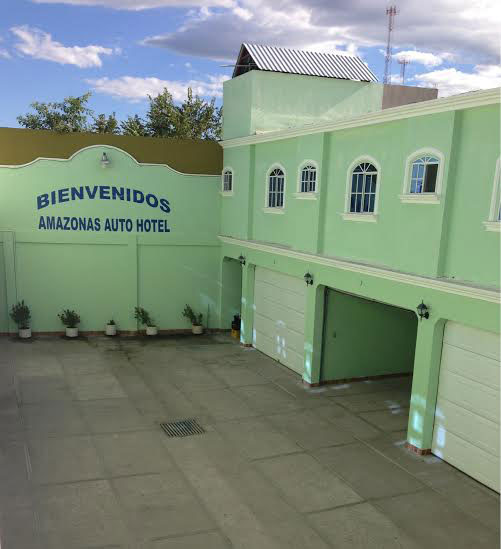
A closed garage door means a room is Occupied. Photo: Alex Washburn
I asked the man how much per night and was okay with the $35 price tag because it meant our bikes would be totally safe for the night as there weren’t any real other viable options in this border town. Once we went up to our room we realized we had accidentally booked ourselves into an infamous ‘Love Hotel‘.
A Love Hotel is basically a place where you can pull your car into a garage, close the door, pay for the room (3 hour minimum) and leave all without ever talking to someone face to face. You pay in cash and they don’t ask for your name.
The room was actually really clean (cleaner than most), but had some very bizarre features that a regular hotel would never have. For starters – they pipe in music and although you can control the volume you can’t quite turn it off. Secondly high up of the wall was an automated air freshener that sprayed the room with sickly flower smell every 15 minutes.
The entire situation was comical but the hotel its self was secure and clean which is why we were able to push the ick-factor out of our minds and hunkerdown with cheeseburgers and an CSI marathon for the night. On CSI commercial breaks I would occasionally go to the window to keep track of the hotel’s turnover rate by counting closed garage doors.
Once again the next morning we zipped up our riding suits (still giggling about the hotel) and put our sights on the next border.
For the El Salvador – Honduras border we had our game faces on.
It’s supposed to be the most grueling Kafkaesque border crossing in all of Central America. We knew it could take a few hours, but we had to be prepared for it to take all day.
We checked multiple sources for information on what we needed before crossing and we found a BRILLIANT post on RideDot (Link) that had a step by step breakdown of the process.
As we approached the fixers quickly surrounded us and I gave them the silent treatment for a few minutes before turning to the most annoying of them and in my best pure-bitch-dehumanizing voice told him:
I’m not going to talk to you. I speak Spanish. I don’t need your help.
And they left us alone pretty quickly.
I hate being rude to people, but I had learned the crossing before that a hundred ‘no thank yous’ won’t go as far as one very direct and angry message.
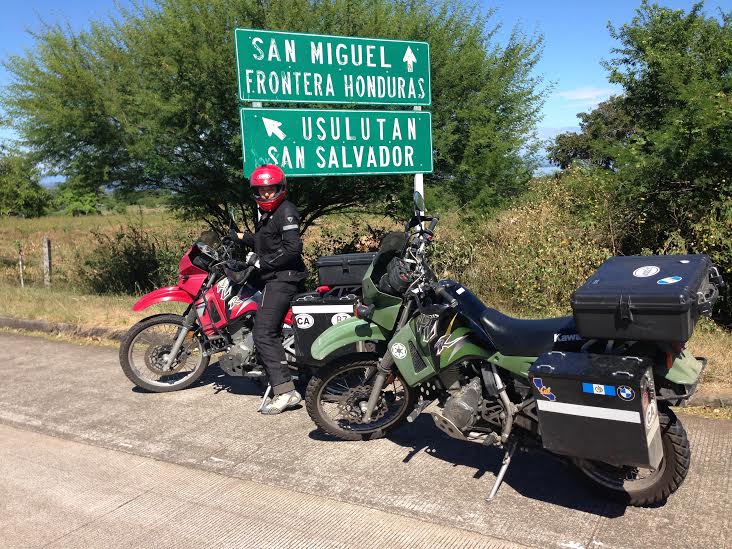
Alex poses next to a sign showing we are close to the Honduran border. Photo: Nathaniel Chaney
We are now in the Honduran capitol of Tegucigalpa and plan on leaving for Leon Nicaragua in a few days.
Thank you for sticking with me through this post – I know it was a little all over the place.
La Antigua
Posted on November 29, 2013
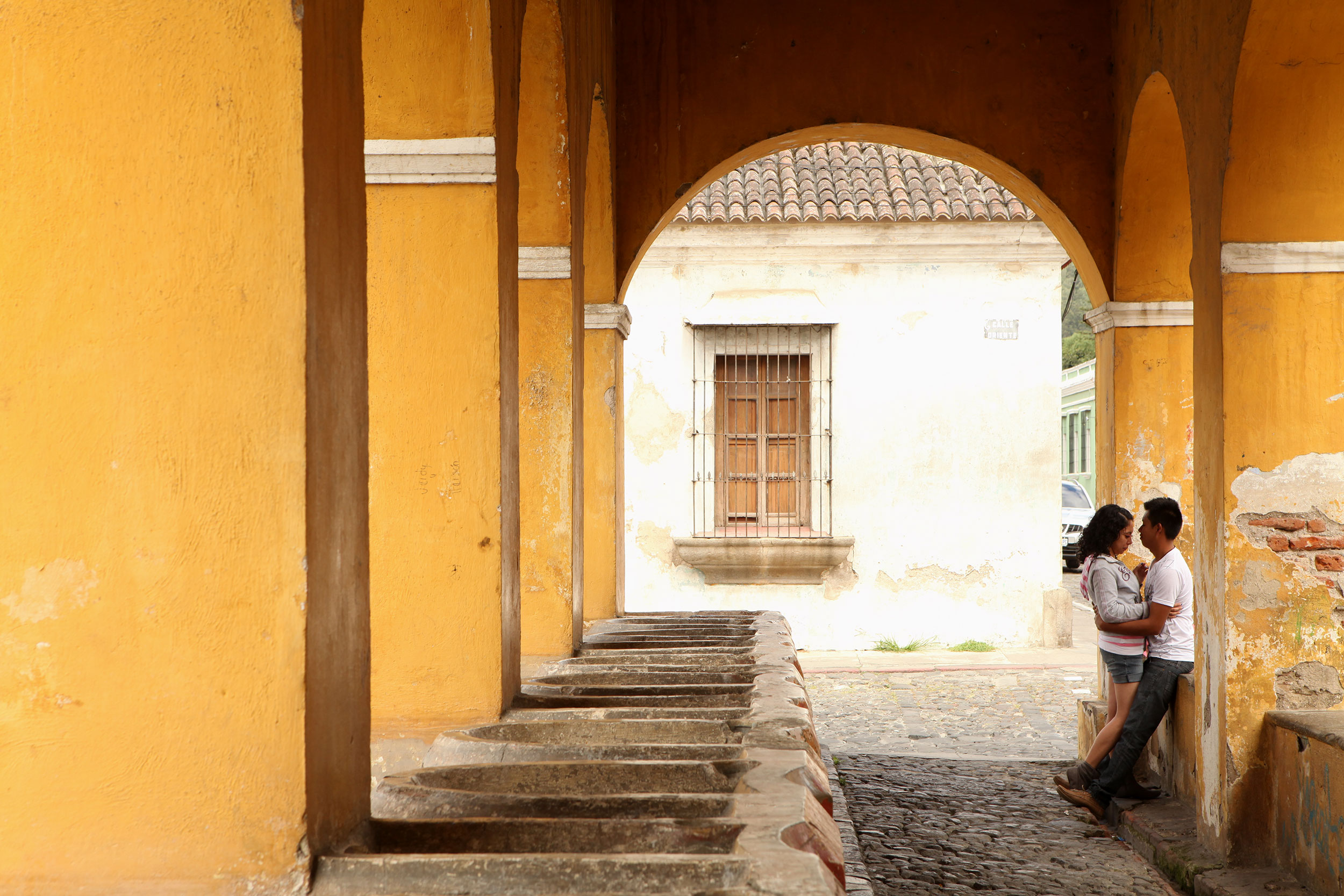
Two teens kiss and flirt in Antigua Centro. Photo: Alex Washburn
As mentioned before, we were rained on all the way to Cobán, which was a shame because the roads from Flores to Coban were amazing. We were still wet from the previous day as we suited up again and prepared for a rainy day all the way from Cobán to Antigua.
The day started foggy and cold. There was a running race going on in Cobán as we rode out of town we waved at runners of all ages struggling up the hills. Off into the mist and then sprinkling, I pulled up my soaked coat and gripped my handle bars readying myself for a long rainy day.
What had been dense green jungle the day before slowly gave way to pine crested mountains that reminded me of Alex and my earlier rides in the bay area, I almost expected to see Alice’s Restaurant around the next corner. We climbed and climbed the mountains, and as we crested the top the sun poked through the clouds.
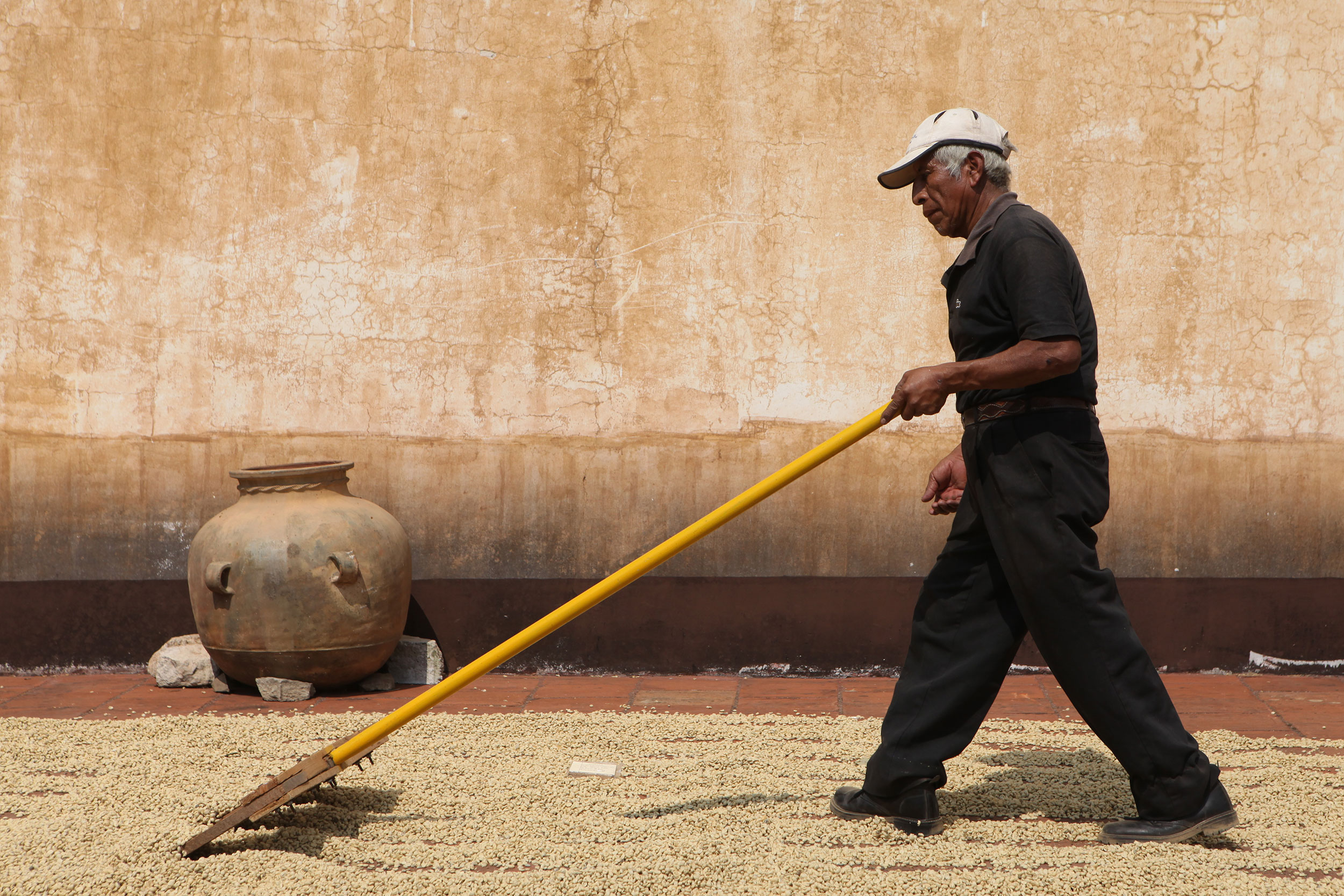
While coffee beans are drying at R. Dalton they are inspected and rotated manually every 45 minutes. Photo: Alex Washburn
In a valley surrounded by volcanoes lies a sleepy cobble stone strewed town full of colorful buildings and friendly people. Antigua has that hipster vibe one gets in San Francisco or Portland and backs it up with its artisanal coffee roasters, bike co-ops, and immersion language schools. Though there is a plethora of tourists that flock to this city, their presence doesn’t feel as oppressive as in Oaxaca, and wandering the streets one can still get a feeling for its inhabitants.
Antigua is surrounded by agriculture land that produces everything from coffee and cocoa to macadamia nuts. On a tour of the R. Dalton coffee farm we learned that to be able to get arabica plants to grow in the volcanic soil of Guatemala they have to graft the roots of the robusta plant onto them when they are two to three months old. Only this root system can withstand the soil and the bugs that live in it.
The coffee is picked, processed, and even roasted (when it isn’t being shipped raw) on site. The head of the wet mill, who decides when coffee is ready to move from water tanks to the drying floors (a costly mistake if he is wrong) has been working there for 45 years. Watching him work the beans on the drying floor, checking the water density of the husks, you saw an expert working in his element.


One of the other experiences worth mentioning was today, even though we weren’t in a home kitchen making Thanksgiving dinner, we did make it to a kitchen, to make chocolate. There is a museum of chocolate here, and we took a class to learn the history of chocolate and how it is made. The class was informative, and we made traditional Mayan drinking chocolate (spicy and slightly sweet), European Hot Chocolate (with milk and cardamom), and our own chocolate candies. Good option if you have kids or just a couple free hours in the city.
Happy Thanksgiving!
Big Pictures – Guatemala
Posted on November 24, 2013
(We are constantly trying to think of ways to tell our story without just giving our readers an elongated blow by blow of our trip in every single post. This post is going to summarize the last few days with photos and extended cutlines – enjoy!)
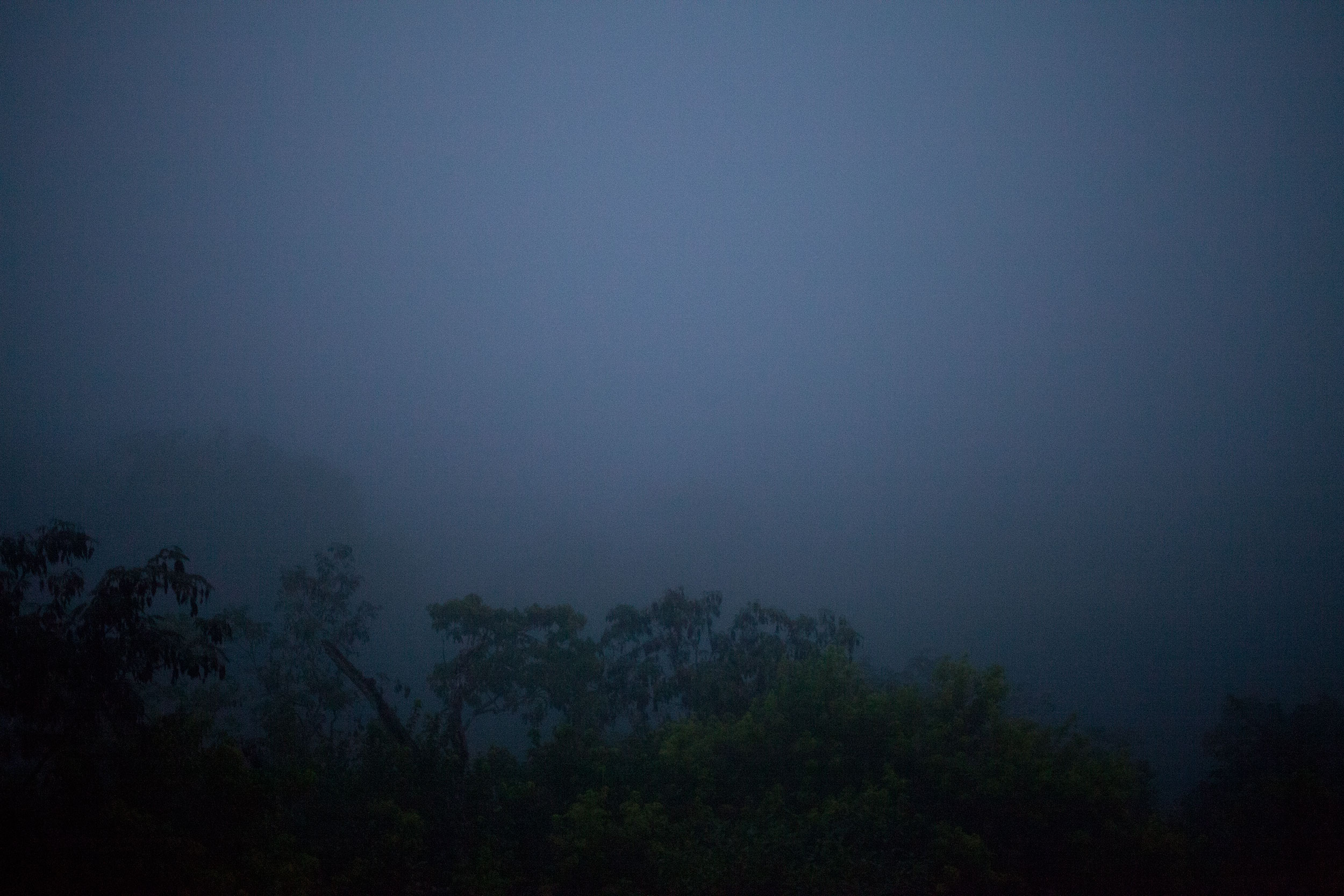
The border crossing from Belize to Guatemala took about two hours because we sought shelter in the Aduana office from a rainstorm but it should have taken only 45 minutes. We immediately left for Tikal National Park from the border and arrived to our hotel at 5:30pm. Should you ever go to Tikal we recommend the 4am hike to Temple 4. As the darkness starts to lift your view from the top of the pyramid goes from pitch black to grey (seen here) and just the tops of the trees are visible as the howler monkeys and birds start their morning. Sitting on the top of a 1,271 year old pyramid hearing the forest come alive is one of my favorite travel experiences to date – made more poignant by my realization that the sounds we were enjoying have existed far longer than the pyramid. This photo represents my favorite spanish word – ‘Madrugada’ The sliver of time between night and day. Photo: Alex Washburn
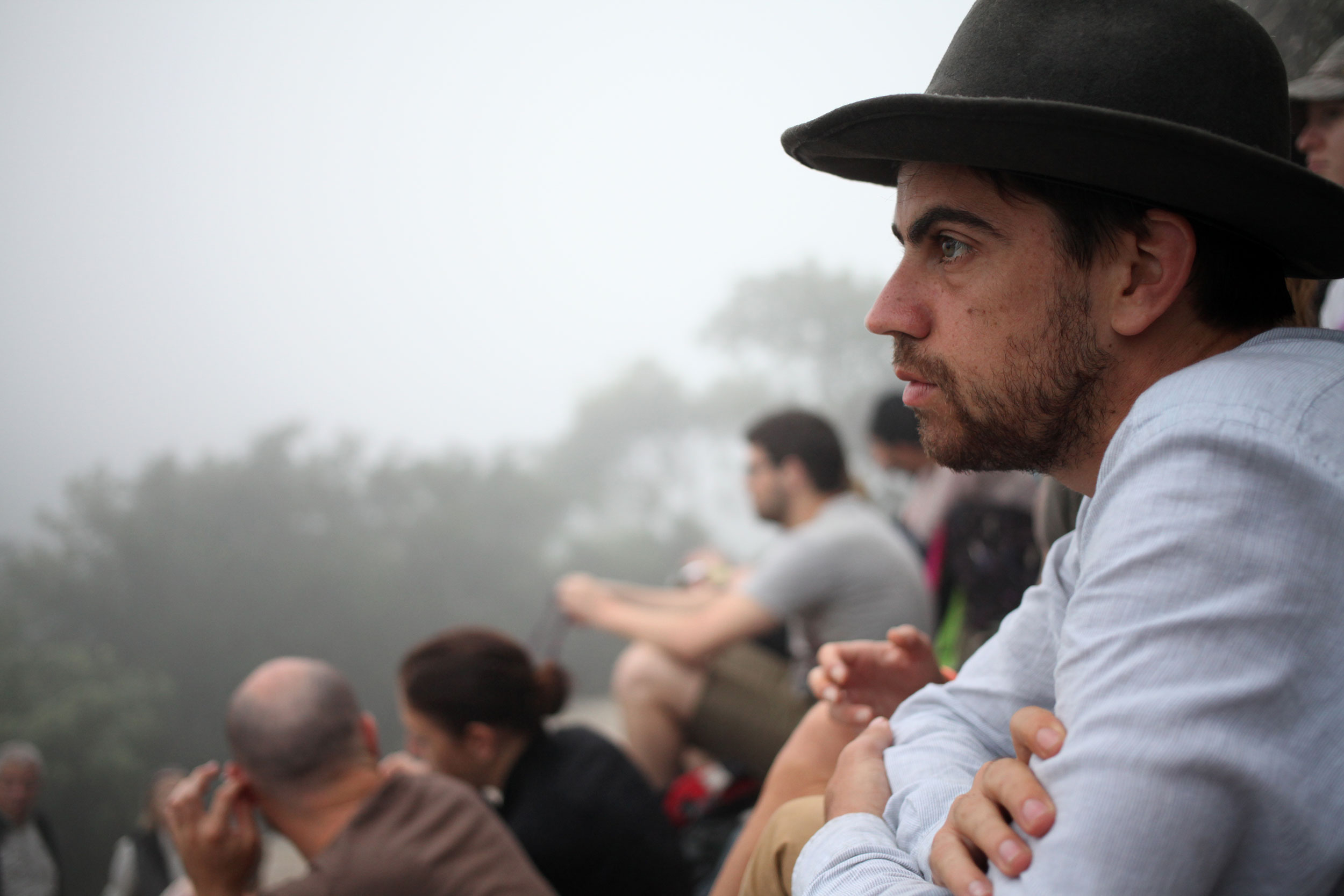
A tourist channeling Indiana Jones looks out across Tikal National Park from the top of Temple 4 just after sunrise. The moments where the tourists could collectively refrain from fidgeting were remarkable. Photo: Alex Washburn

Our tour guide (he wasn’t very good) leads the group towards Temple 1 in Tikal National Park. This temple was actually in one of the star wars movies and is quite famous. A benefit to going to the site so early is that there are very few other tour groups and the day hasn’t gotten unbearably hot yet. Photo: Alex Washburn
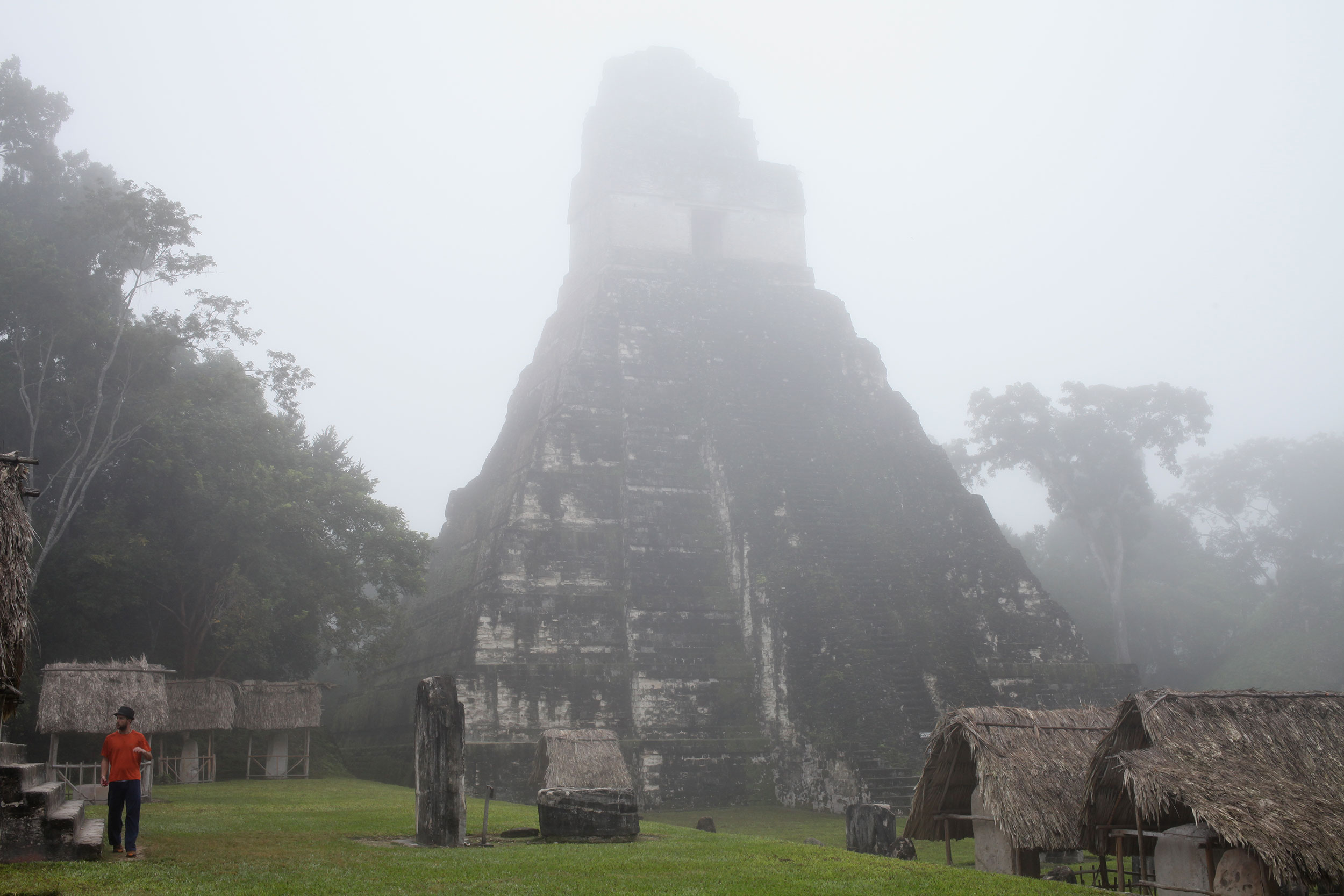
Our tour guide kept apologizing for the fog but I liked the way it looked. There is something very pleasing about walking around in it. Photo: Alex Washburn
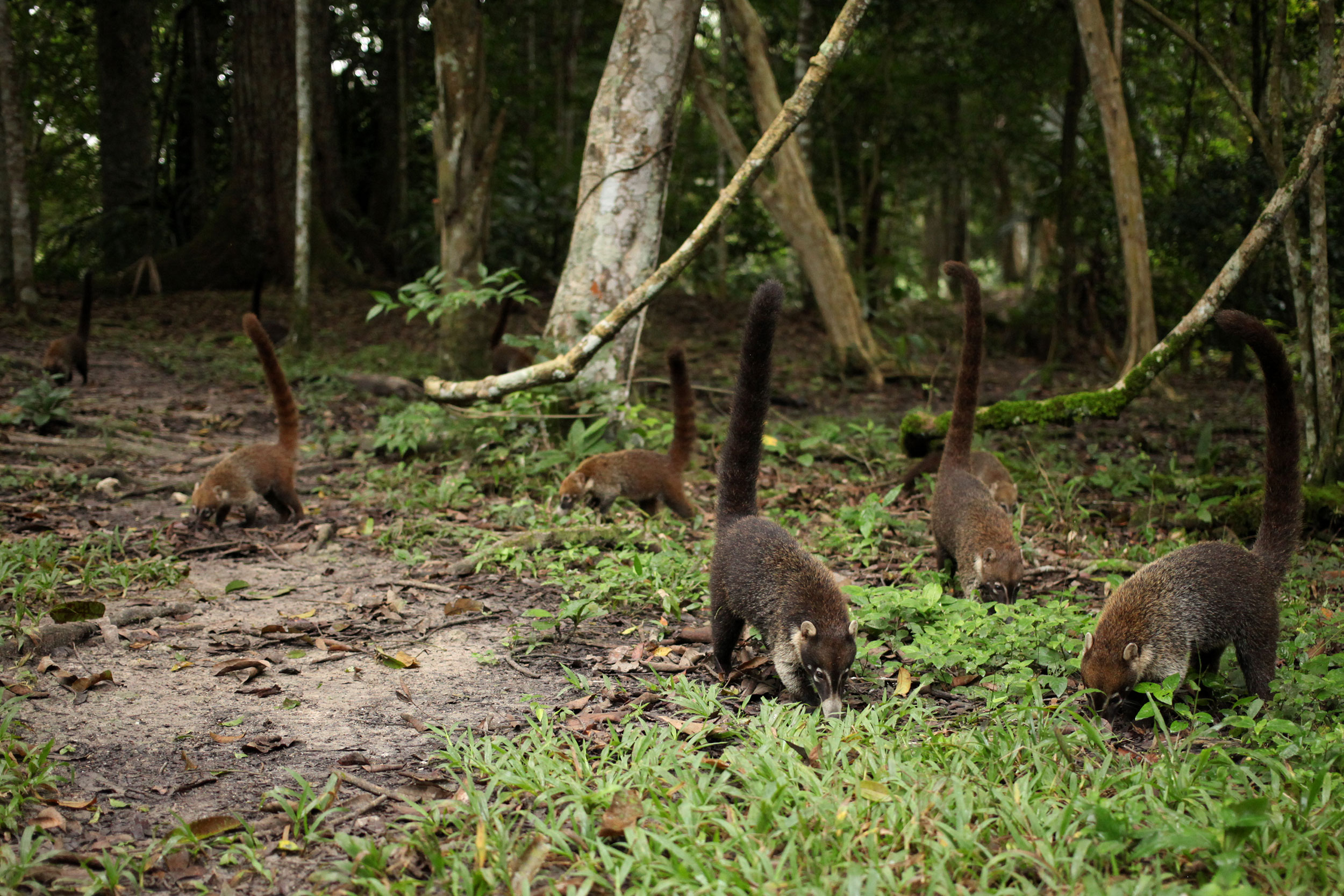
Seeing this family of Coatis was one of the best parts about staying in Tikal. This relative of the raccoon spends its day rooting around the forest floor like little pigs. I walked up to within about 15 feet of them and the older ones were totally unafraid. On their search for food they noodled within two or three feet of me. Photo: Alex Washburn
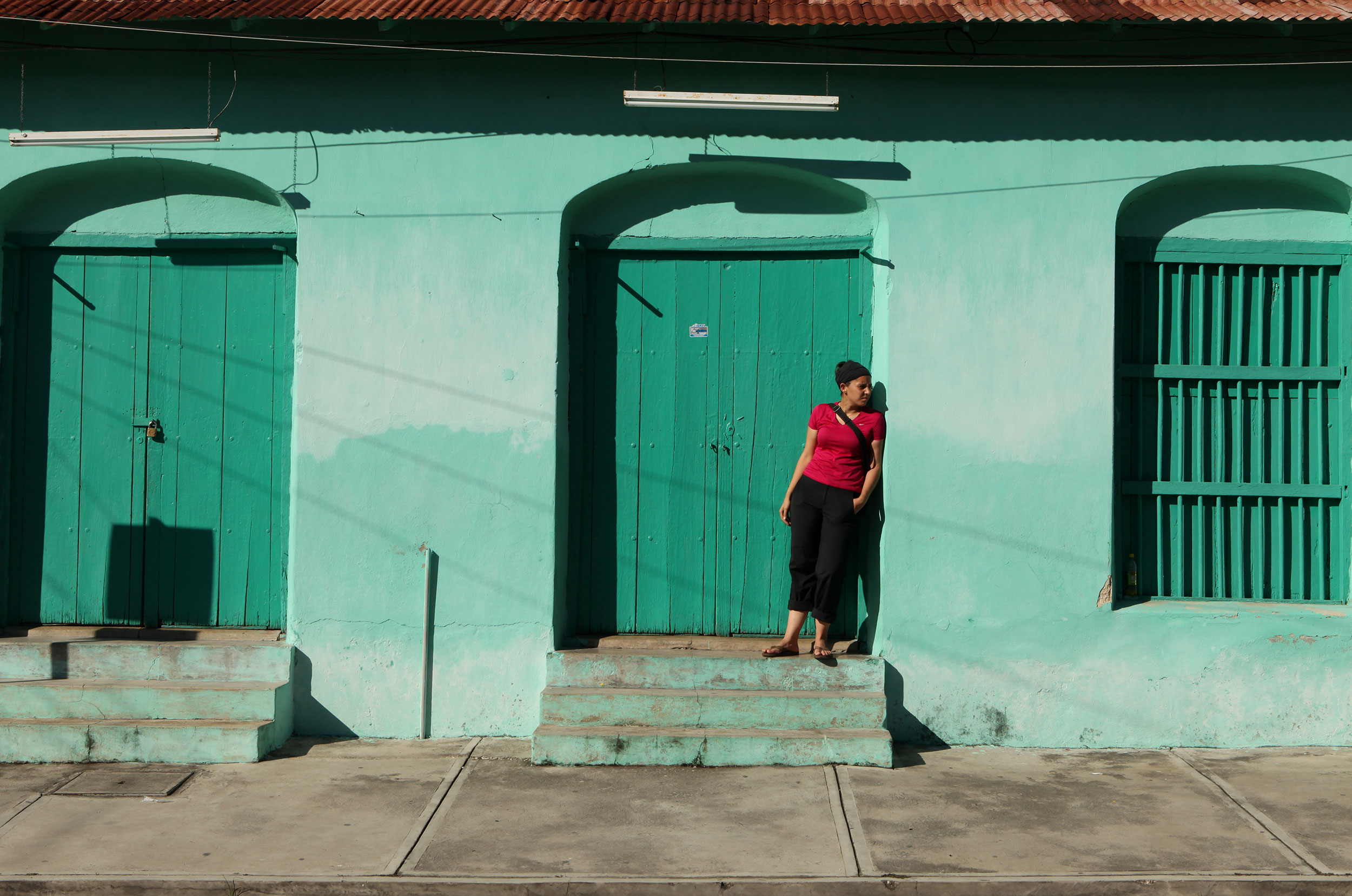
After Tikal’s dawn hike we took a quick nap and hit the road for Flores. I don’t really enjoy posing in front of monuments and things but I am a sucker for a really awesome wall. I had Nathaniel take this our first day in Flores. Photo: Nathaniel Chaney
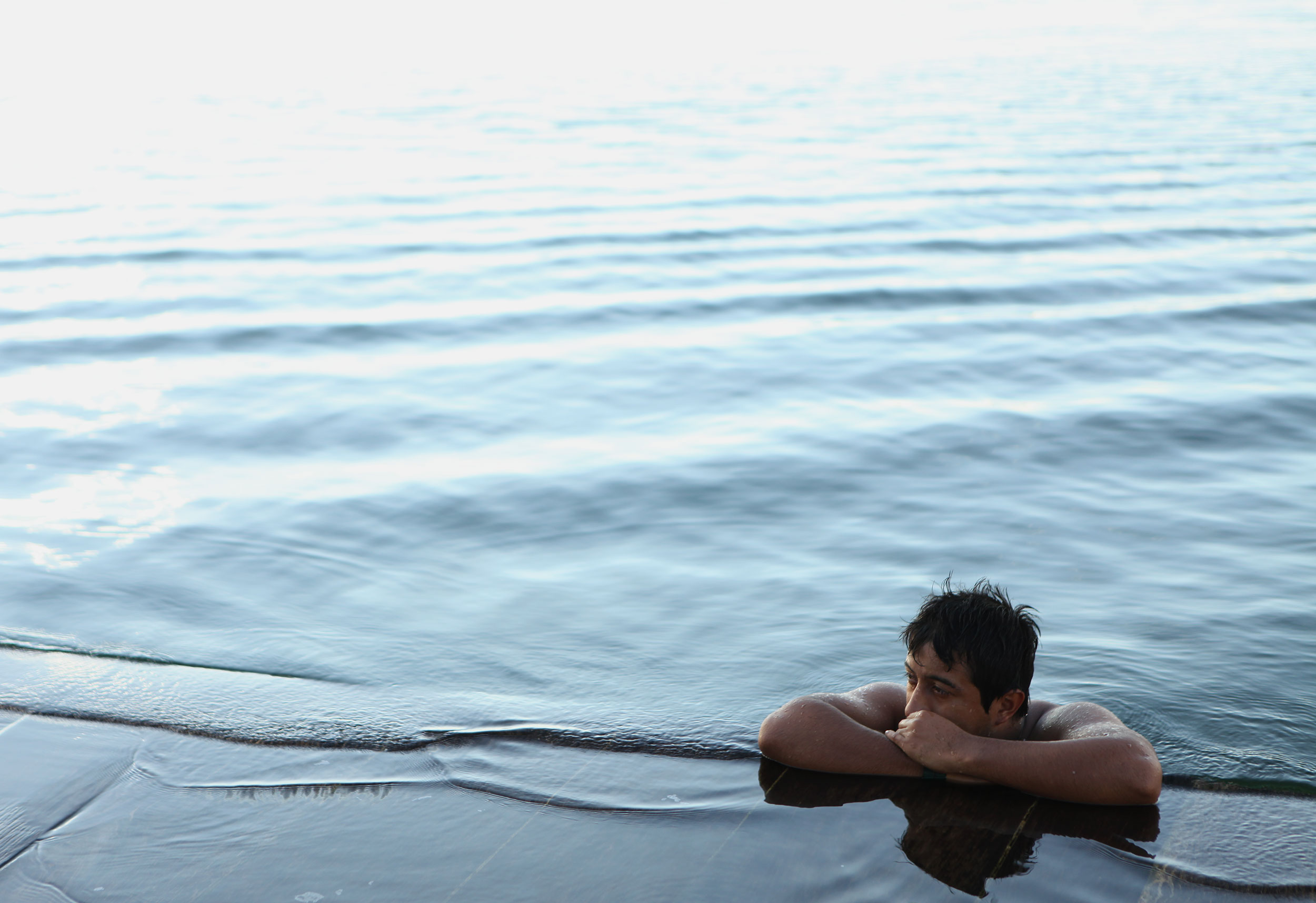
Flores Guatemala is a tiny island in the middle of Lake Peten Itza. The residents have a habit of jumping in the water at random moments – swimming for just a few minutes and then going back to whatever they were doing. This gentleman went for a really long swim and is resting for a moment while his girlfriend waits on the shore. Photo: Alex Washburn
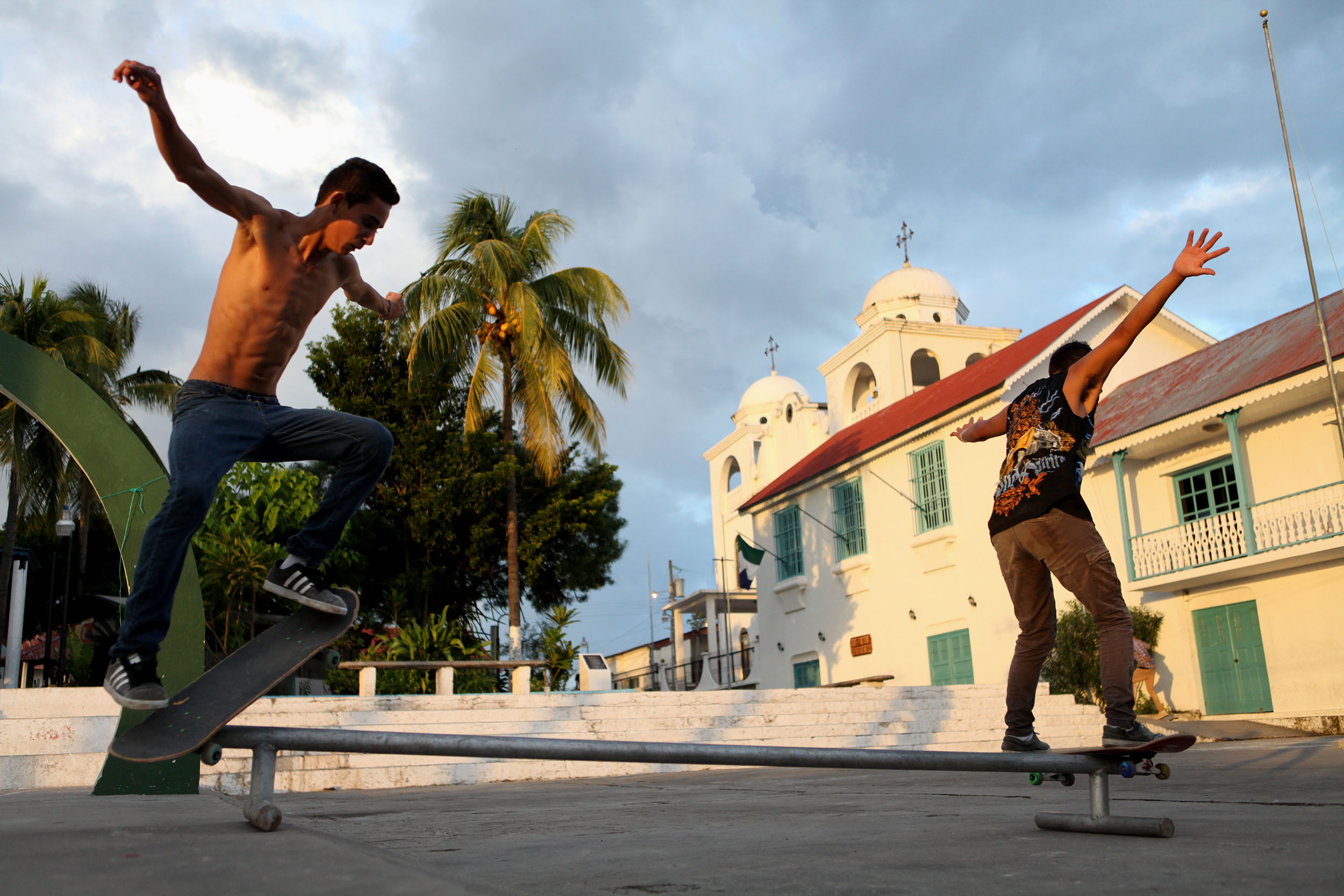
Flores is an island but it’s also basically one big hill full of one way cobblestone streets. The only place in town good for skateboarding is in the plaza at the very middle and top of the small community. The plaza has a church, basketball court and plenty of open concrete where the skateboarders have a rail to grind on. Xavier, 15, and Julio Ramirez, 17, (left to right) were some of the local kids we found hanging out there. Photo: Alex Washburn
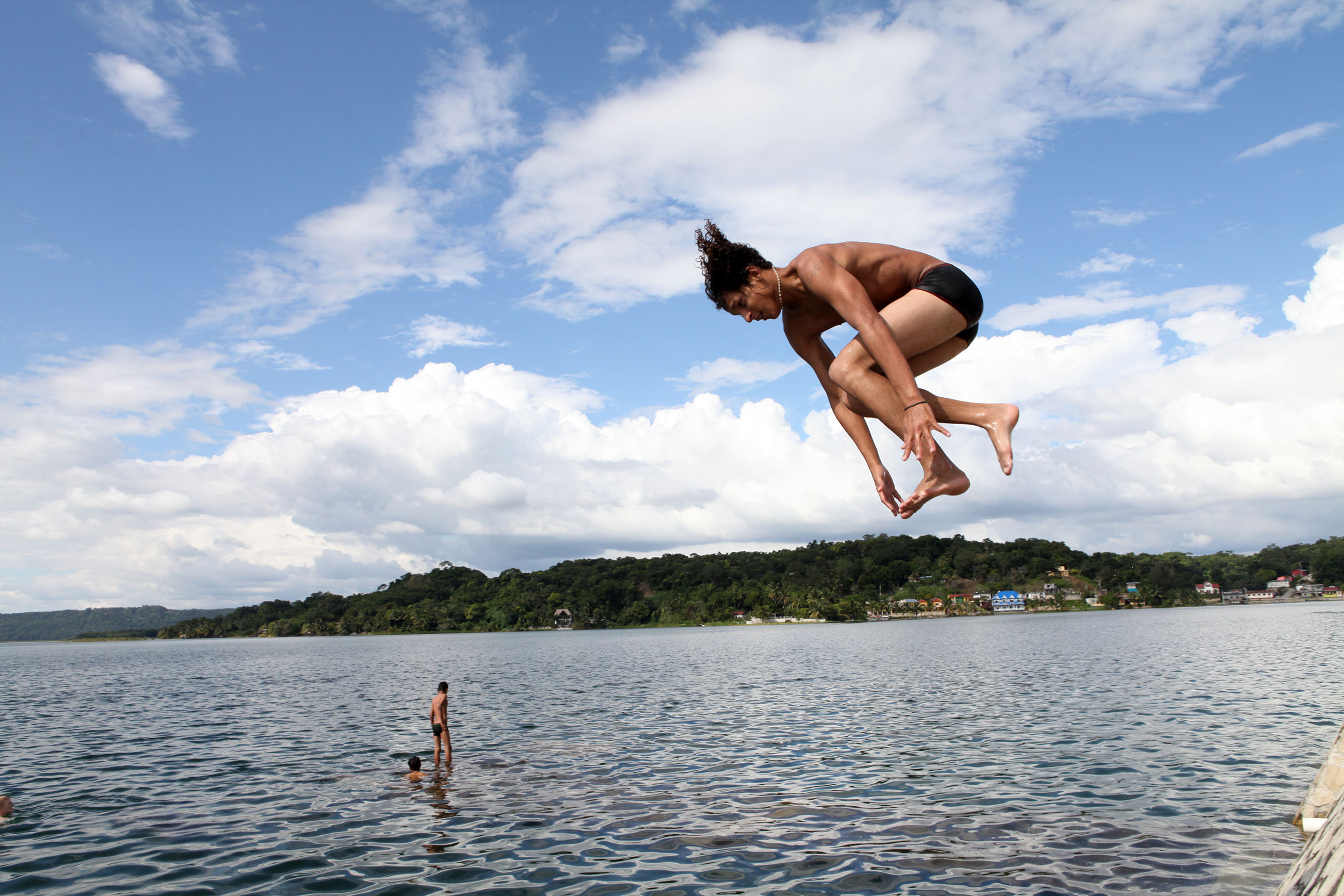
This is one of my favorite photos from Flores. Like so many men in town this kid showed up to the water, stripped into his underwear, dove and swam for about 15 minutes with a friend and then they hopped back on their scooter and left as quickly as they came. Photo: Alex Washburn
As I type this post and am about to publish it we are in the city of Coban Guatemala. Our ride here yesterday was miserable because it rained on us more or less all day. By the time we checked into our hotel we were both soaked and my hands looked like raisins. We hope to arrive to Antigua after 4-5 more hours or riding and we are both really excited for it. I went to Antigua several years ago with a friend and it is absolutely gorgeous.
Thanks for looking.
 Where the Autopista Ends