Where the Autopista Ends
Two motorcycle bloggers in the San Francisco Bay Area.
Swimming with Sharks
Posted on November 18, 2013
Alex already mentioned that we did a snorkeling trip out of Caye Caulker that went to three specific dive spots: the coral garden, Shark & Ray alley, and Hol Chan Marine Reserve.
From the video you can see we saw all kinds of wild life there, and even though the weather was trying not to co-operate, it still left us with about 80% visibility in the water.
The whole video was shot on a GoPro Hero3 Silver Edition with the basic waterproof case (included in the basic packaging). I forgot my mono-pod in the bike, so had to make do and just held the GoPro in my hands the whole time. Got through almost the whole day on one charge before it died and had to swap out batteries. The film was edited using the newest GoPro studio and I sourced the music from freemusicarchive.org.
Caye Caulker
Posted on November 16, 2013


We hopped into a taxi boat Wednesday afternoon excited to leave the grungy heat of Belize City and looking forward to a few days of almost vacation.
We don’t plan very many days ahead of ourselves and since the islands off the coast of Belize are transitioning into ‘high season’ we had a little difficulty booking a place to stay.
We ended up getting a really great last minute deal on a hotel that was only a few more dollars a day than some hostels on Caye Caulker.
After our 45 minute water taxi ride to the Island we found ourselves blinking in the sunlight walking down a rough dock towards unpaved roads and brightly painted buildings- the tense feeling the city had given us started to fade. After dropping off our bags to the hotel we immediately made our way to what is know as ‘the split’ on the North end of the inhabited portion of Caye Caulker.
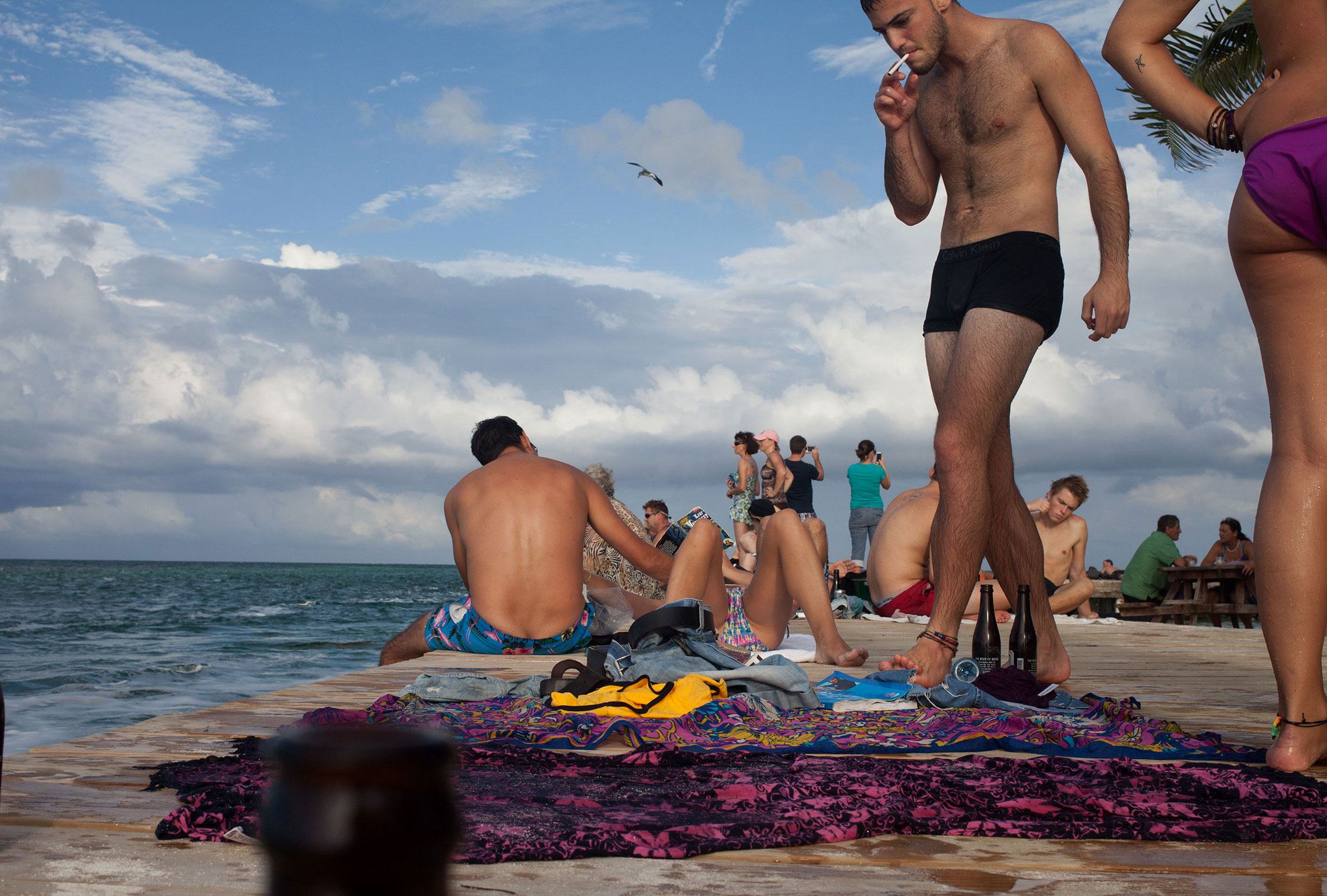
The area known as ‘The Split’ on Caye Caulker. Photo: Alex Washburn
I can see why Caye Caulker is still a backpacker and budget traveler’s paradise with a few non-budget travelers thrown in. Some of the tours are a little expensive but if you want to sleep, eat and drink cheaply you could enjoy the island for less than $50 USD a day and get a rockin’ sunburn in the process.
We were lucky that we decided to go to ‘The Split’ in the last few hours of daylight we had Wednesday – that night the storm clouds rolled in and didn’t leave for the next 40 hours.
Thursday it drizzled a lot but the crazy wind didn’t kick up till we were on our way back from our snorkel tour of Hol Chan Marine Reserve.
A portion of the tour allows you to snorkel with sting rays and nurse sharks which is pretty incredible. It is unfortunate to be surrounded by an equal number of tourists but being able to reach out and touch a sting ray or a nurse shark as they glide past you is amazing.
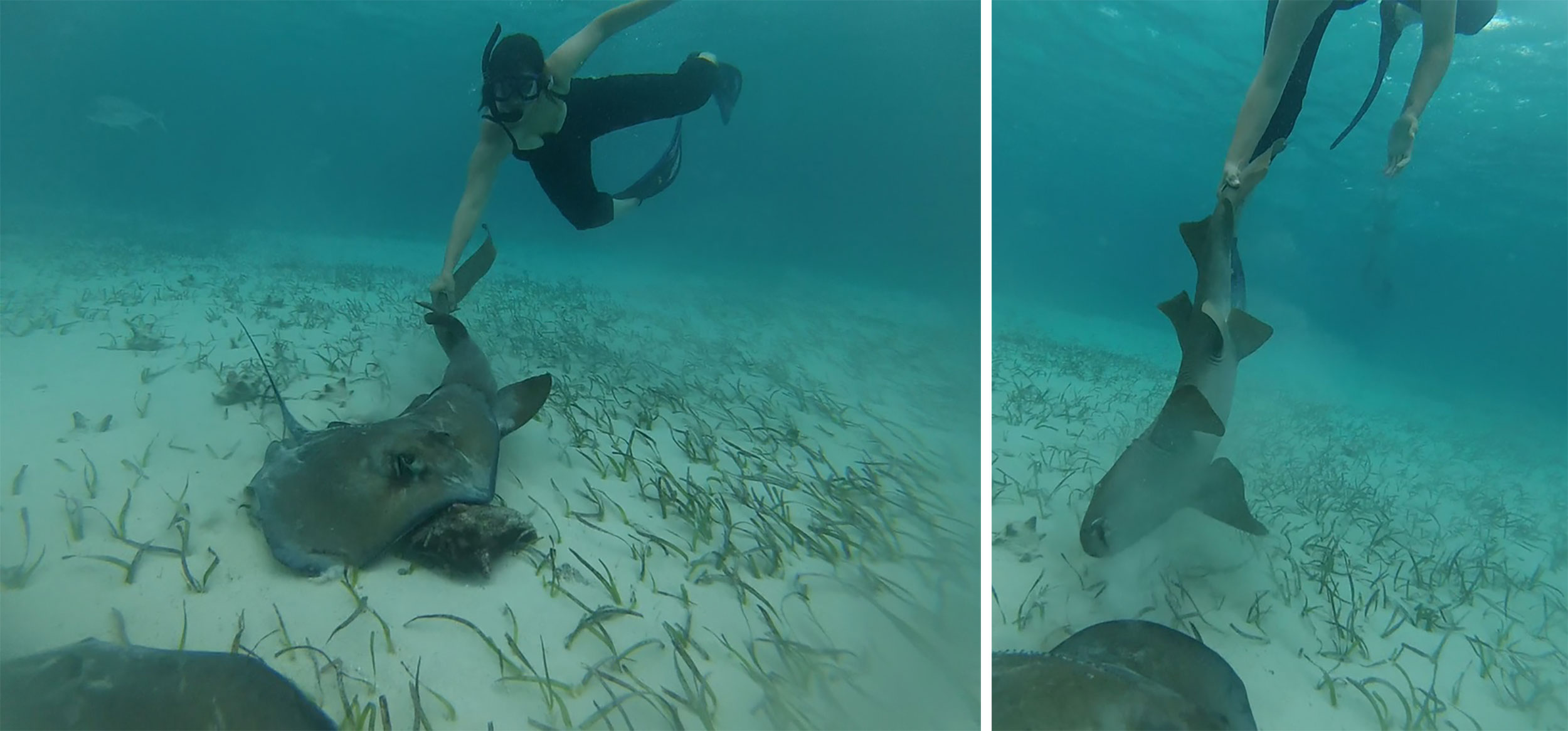
This was Alex’s second attempt at shark wrangling. She didn’t tell me she was going to try it the first time – which was a more successful attempt. Photo: Nathaniel Chaney
Well – I really wanted to see if that would work.
I picked out a smaller nurse shark perhaps 3-4 feet long and swam down to it. When I got close I reached out to grab it’s tail and very gently twisted. The shark rolled over in the water like a puppy looking for a belly rub and allowed me to bring it almost to the surface. I let it go and it swam away and went back to eating.
The entire incident lasted less than 20 seconds but I would strongly discourage other people from doing this. The guide came over to me and warned me that although nurse sharks seem docile they can hurt you.
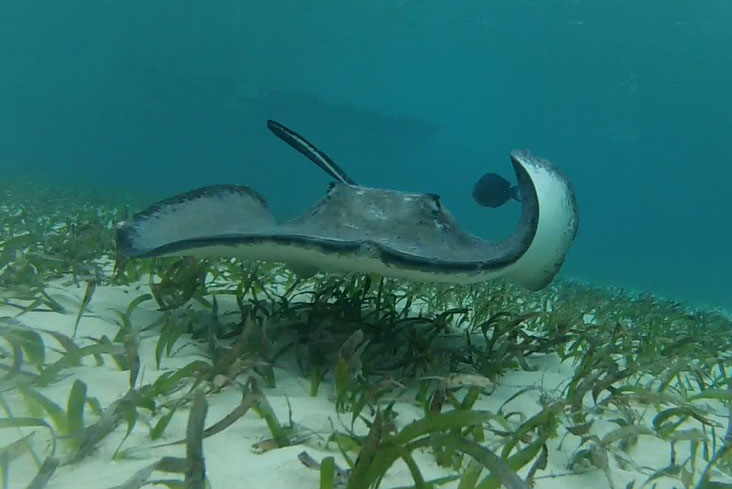
A stingray cruises the ocean floor looking for food. Photo: Nathaniel Chaney
After our day in the ocean we were pretty hungry and decided to splurge for dinner. While you can get some really legitimate meals for $5-6 on the island I really wanted to try the local lobster.
Lobsters are generally laid out near restaurant front grills on Caye Caulker and you select your lobster based on how much you want to pay for it – the dinners also come with a variety of sides. A giant lobster with garlic toast, pasta and salad for $25 USD is just not possible in the US.
Although the lobster was good I prefer eating at places the locals go when I travel. If you prefer the same I suggest grabbing some lunch at Pirates on Caye Caulker if you come. My $6 USD lunch consisted of Baked Chicken on rice and beans with a side of potato salad and a glass of limeade. If the same restaurant existed back home I’d still eat there.
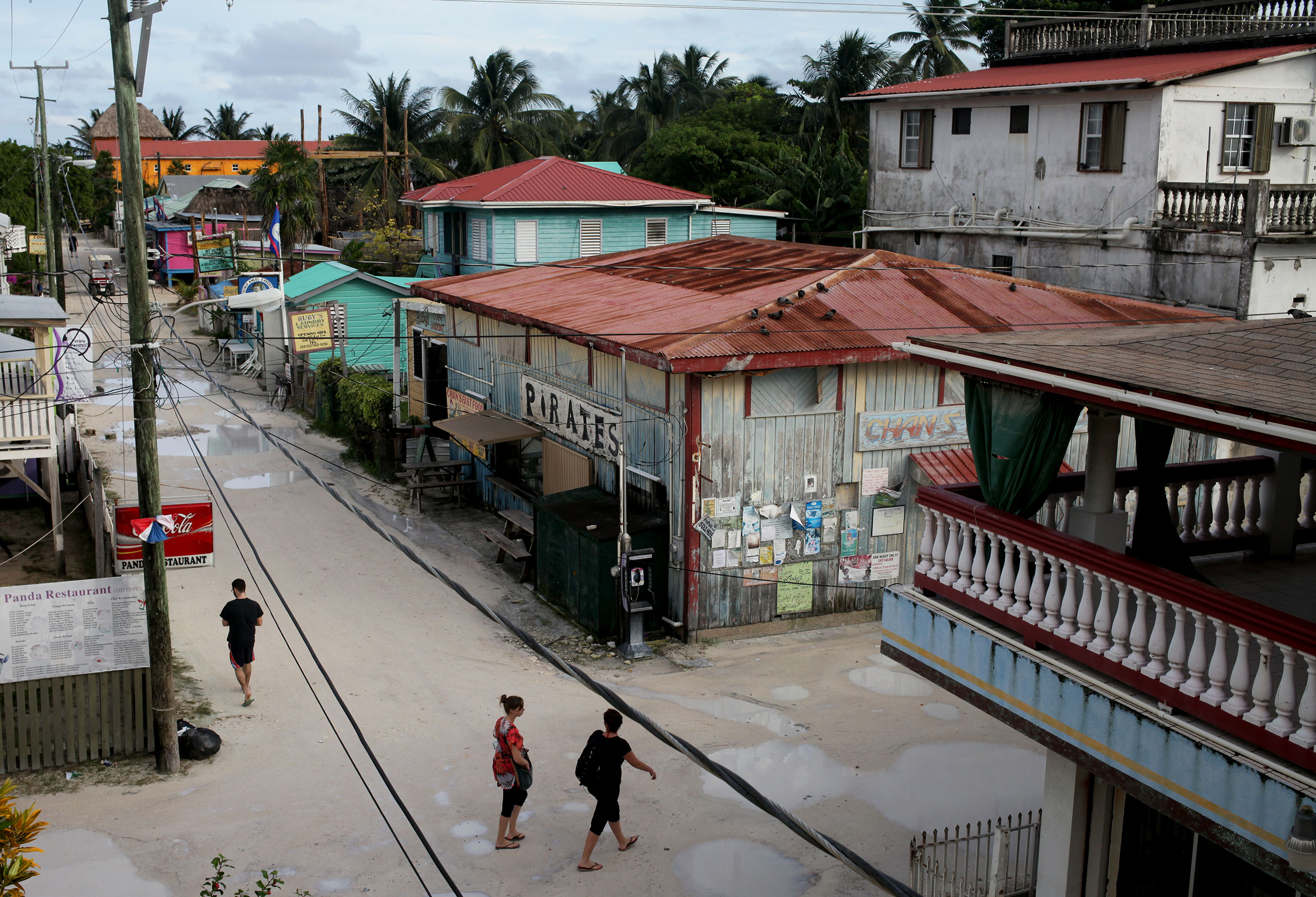
Pirates restaurant (on the corner) is where we had one of our best meals on Caye Caulker. Don’t expect a smile (they don’t cater to tourists) but you should expect good solid local food at a local price. Photo: Alex Washburn
While the rain ruined a large part of our time on the Island (and cursed me with unappealing lighting) we’ve had fun walking it’s dirt roads, talking to people and exploring this tiny island. Belize would be a great starter country for many people people in the US nervous about traveling because it’s still incredibly affordable and the dominant language is English.
TIPS: There are january flights under $500 available from San Francisco to Cancun right now. A $50 (isn) bus ride from Cancun can get you to Belize City within a few hours. Our Hotel was $56 USD a night although you can find cheaper if you book ahead.
Hello Belize
Posted on November 14, 2013

A map documenting our progress through Mexico. Photo: Alex Washburn
After waiting a day in Chetumal for the Banjercito to open, Monday morning came and the rain clouds cleared to reveal the humid boiling sun. We packed the gear, counted our remaining pesos, and fueled up at the last Pemex of the trip.
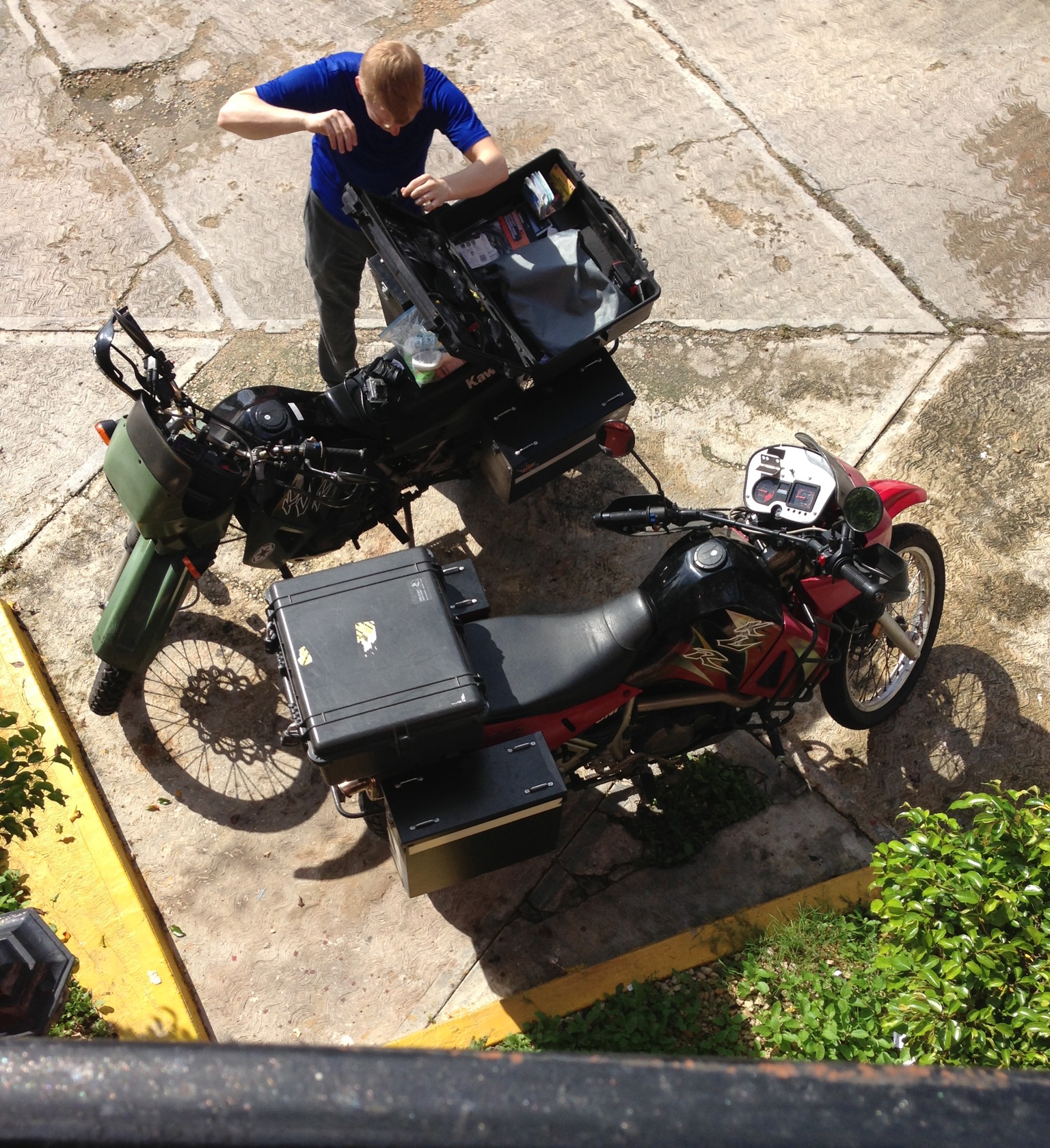
Nathaniel packs his gear, getting ready to cross the Belize border. Photo: Alex Washburn
Chetumal ended up being closer to Belize than we thought, and it took us less than ten minutes to get to the border crossing (we might have been able to cross on Friday, but after all the paperwork I think we may have gotten stuck in limbo). With all the issues we had in La Paz we knew we had all the needed paperwork, but were still ready for some bureaucracy.
First stop was to turn in our FMM cards and get stamps out of Mexico (check). Next off to the Banjercito to get our deposits back and release the bikes from Mexico, we went to the wrong Banjercito first but found our way eventually (check). Next we had to get the bikes fumigated (what?!) and get insurance for Belize.
The office where you get your fumigation certificate is also where you can purchase insurance. However, by the time we got there we were running low on money and Alex had to make a run to an ATM while I hung out with the attendant. It was during this time that a heavy rain moved in, and I discovered that the first language of Belize is English. Once Alex got back, we got the insurance slips and were informed we didn’t need to be fumigated because of the rain (sweet!).
After this it was off to immigration at the Belize border to get the bikes and us into the country. It took some time (the officers were in no hurry to fill the paperwork out to get us processed), but there were no hiccups in getting it done. Once all the stamps had been pushed, I walked over to join Alex in Belize, only to have a middle-aged man approach us.


I didn’t know who it was as Alex introduced me to Hector. The continued to talk in Spanish, and I was afriad this was a scam trying to get us to buy something before we crossed (or worse, be drug mules). I was later to find out that this was one of her Uncles who was running a load from Belize up to Huamantla. It’s such a small world, where you can run into family even at a border crossing. It was fitting, we had family at the beginning, middle, and end of Mexico, the best book ends.
As we left the immigration office we were all smiles walking back to the bikes. As we packed our documents back into the bikes, I saw another bike pass by and head towards the border, but he was soon directed (as we had been) to the immigration parking lot. This is when we met, Thiago Berto who is driving from Alaska to Brazil (or maybe all the way to Argentina, he hasn’t decided). He flew from LA to Fairbanks, Alaska and found this motorcycle (which was driven years ago from Brazil to Alaska and then left by another Brazilian, which it why it has Brazilian plates) that he is now riding down the continent.
We exchanged stories, he questioned us about the process of getting across the border, we asked him where he was going. There is a respect that fellow travelers have for each other, and that camaraderie is only magnified when they are also motorcyclists. Bikers like Thiago make us feel less bad-ass as he was riding in just a light jacket, regular pants, boots and his stuff heaped on the back of the bike, but to each his own (I seem to fall a lot so my choice of gear seems fitting).
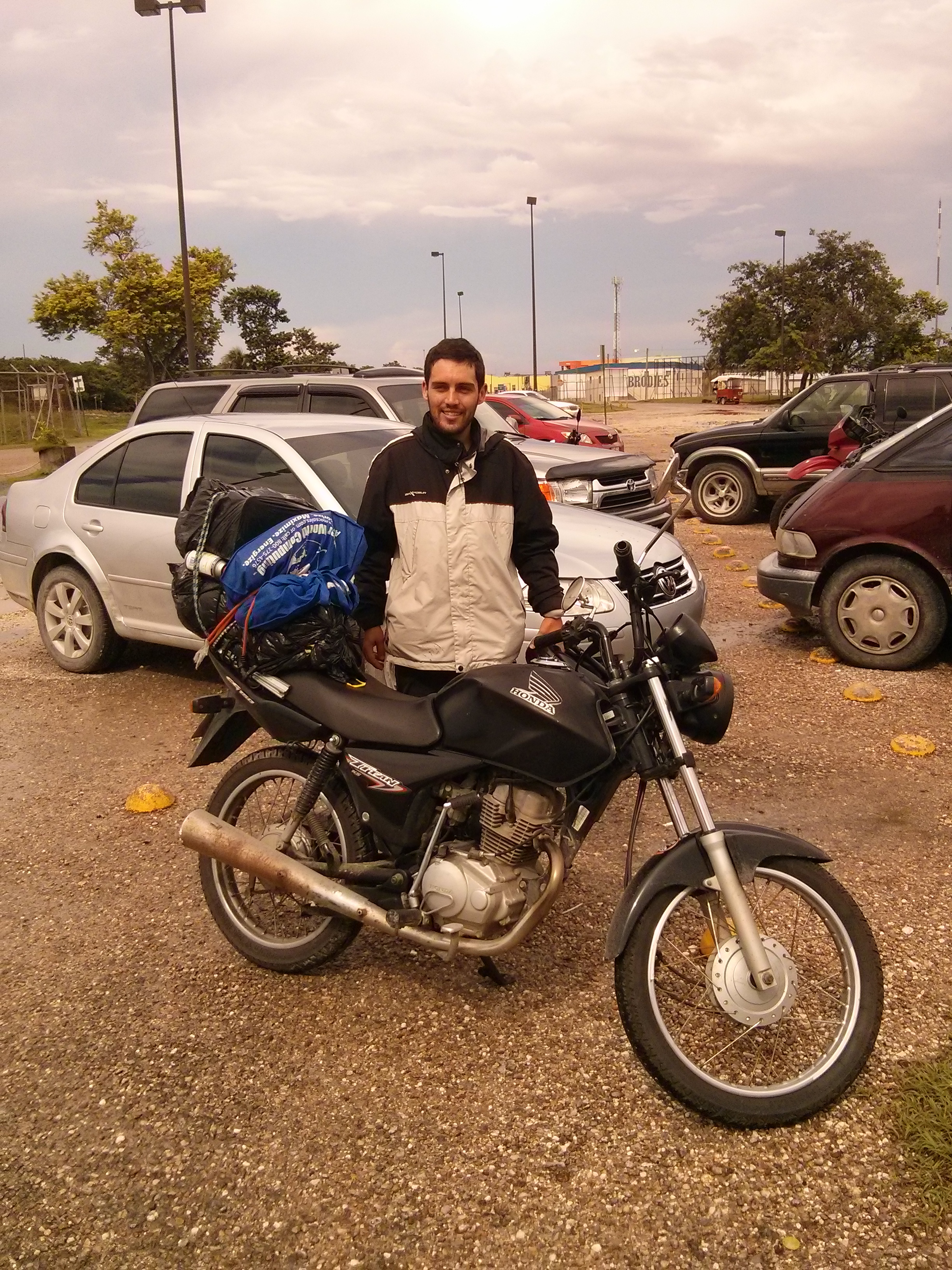
Thiago is riding from Alaska to Brazil, trying now to get through the Belize border (Photo: Nathaniel Chaney).
We wished him luck, readied our papers and made our way for the border crossing. The guard asked me if I was hot in my gear and I replied it was hot, but protective. He responded that that is true, but that falls don’t happened that often. My response? More often than you would think. And with that I was waved on.
We ran into Hector one more time after we crossed, he gave us some final directions (though there is only one real road in Belize) shook our hands and we were off.
About an hour down the road we hit the worst rain of the trip. It wasn’t just raining, it was pouring enough to work its was into our helmets and for me felt like pinpricks as the droplets hit my jacket. Knowing now that Belize is only 174 miles long, would have helped in that situation of knowing how far Belize City was, but we drove on, not worried about the gear getting wet because we knew we would have time to let it dry.
For a while, each time we broke through the black clouds and towards the blue sky the road would veer off back into the heart of the darkness. However, we finally blew past the storm and made our way to Belize City. It took a little while to find a place (Alex gets all the credit for finding the Palm Inn), but when we did and it was amazing. It had parking in the back behind high walls and under an overhang so we were out of the rain.
I will skip the details of Belize city (we were only really there a day and a half), but needless to say it isn’t the best city. It is mainly used as a stopping point for cruise ships and people heading to the Cayes (think of keys, but no bridges) and it shows. There aren’t many restaurants, and there is a hustle to the city that clearly denotes that a main portion of its income is derived from tourists.
Alex and I were happy to plan our escape to Caye Caulker the next day. We spent some time at the Belize Museum and walking around the city, but really we were just biding our time and the moment was coming to escape!
One Month in Mexico
Posted on November 10, 2013
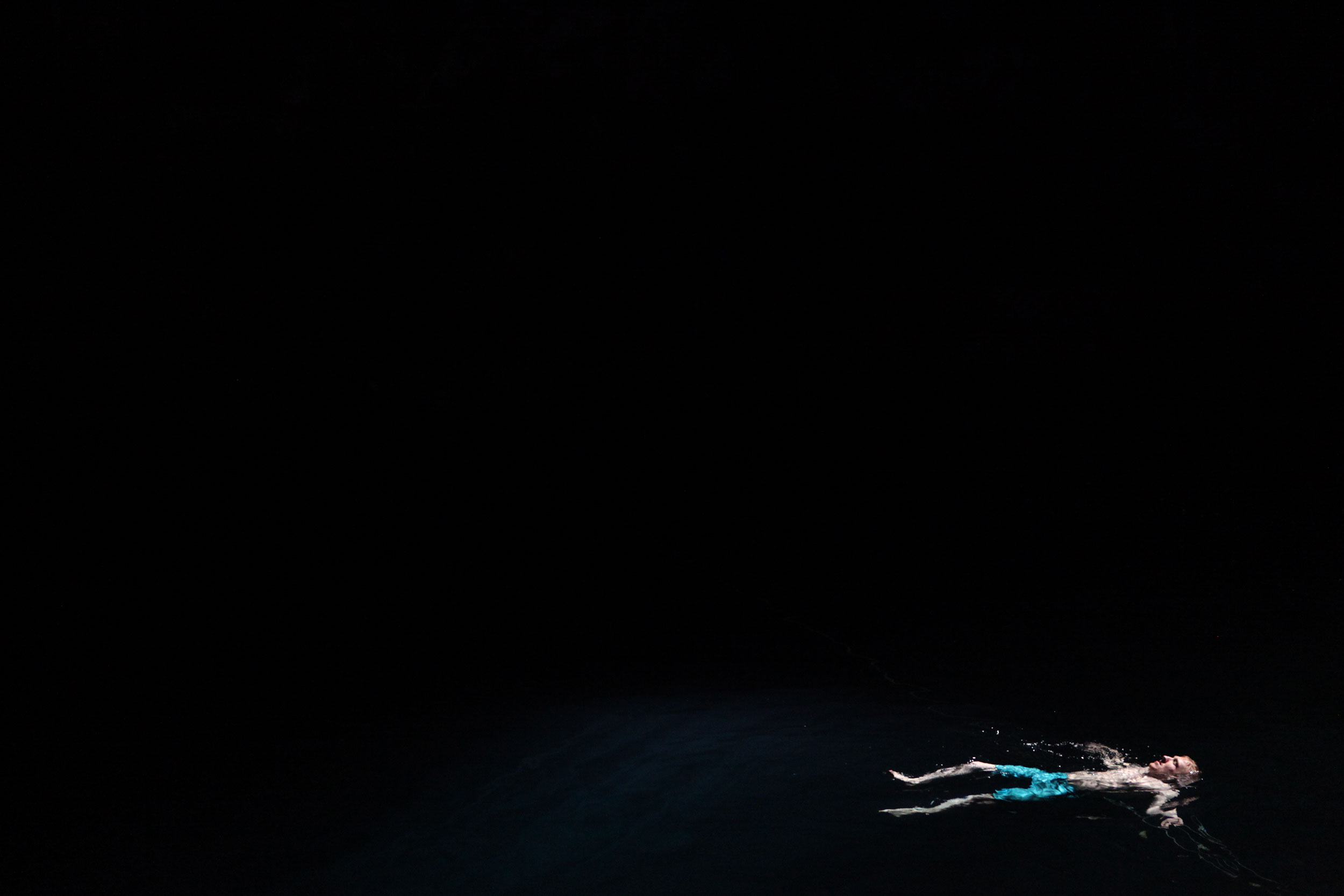
Nathaniel floating in Cenote Samula near Valladolid Mexico. Photo: Alex Washburn
It’s been one month since we left Oakley California heading towards I-5, and then quickly turned around 6 miles down the road because I forgot my wallet and Nathaniel forgot his malaria medication.
Today we find ourselves hanging out in a hotel we don’t remember the name of in Chetumal Mexico watching the rain drip till monday morning when we can cross the border to Belize.
When you drive a motor vehicle as deep into Mexico as we have from the United States your are required to leave a sizable deposit with the army bank Banjercito to pay for its temporary importation.
Once you leave Mexico the money is refunded to you in either cash or on your credit card (depending on how you first paid) and like the US most banks are not open on Sunday. We could technically leave Mexico today but it would mean giving up our $400 deposits.
Unfortunately, Chetumal is not a city I am enjoying very much. It’s the largest Mexican city to the northern Belize border and it doesn’t have a true Centro that we’ve seen with an adorable plaza and strolling families.
Chetumal is the seat of government for Quintana Roo (Our 18th state we’ve passed through) but the blocks near the water are an endless series of shoe stores, auto parts stores and Mini Supers – rinse and repeat.
This city it was almost completely destroyed in the 40’s and 50’s by three major Hurricanes. When they rebuilt they rebuilt for the next big one and I think it stripped the city of its charm.
Because of the time we killed in La Paz getting paperwork done we had to blow through a large portion of Mexico that we originally had plans for. So, we are both looking forward to getting to Belize, slowing things down a little bit and absorbing the places we see. -Alex
________________________________________________________________________________________________________________


It is sometimes mind boggling that we have been on this trip for a month and have been primarily in one country the whole time. I never fully appreciated how expansive Mexico is till driving across it, and looking at the distance reading on my speedometer.
What some may not realize is that Alex and I have now already traveled further in Mexico then we are going to travel to get through all of Central America. And thus, the reason for slowing down a bit to really absorb the places we travel through.
As we get ready to exit the country that has been our home for the last month, I look back on our time here.
Most of the concerns about this trip were over safety, with many remarking that Mexico is not a safe country to be in (Alex’s Mexican family were shocked we hadn’t had any issues with police on our ride).
Knocking on wood now, we haven’t had any issues with police, drug cartels, or petty theft and I have found the Mexican people to be overwhelmingly warm and hospitable. At a random intersection outside of Tuxtepec, a man on the side of the road saw we looked confused and told us how to get to the main city. All of the people we have asked for directions have been more then willing to help these two intrepid motorcyclists.
Many construction works and pedestrians by have waved or flashed peace signs as we have ridden by. Questions of safety ring true for any country (we did purposely ride through Baja to avoid certain parts of Northern Mexico, as much as for the beautiful scenery) as there are many areas of San Francisco I wouldn’t want to walk through after midnight, common sense goes a long way in any travel situation, even when that travel is to a local store for milk at night.
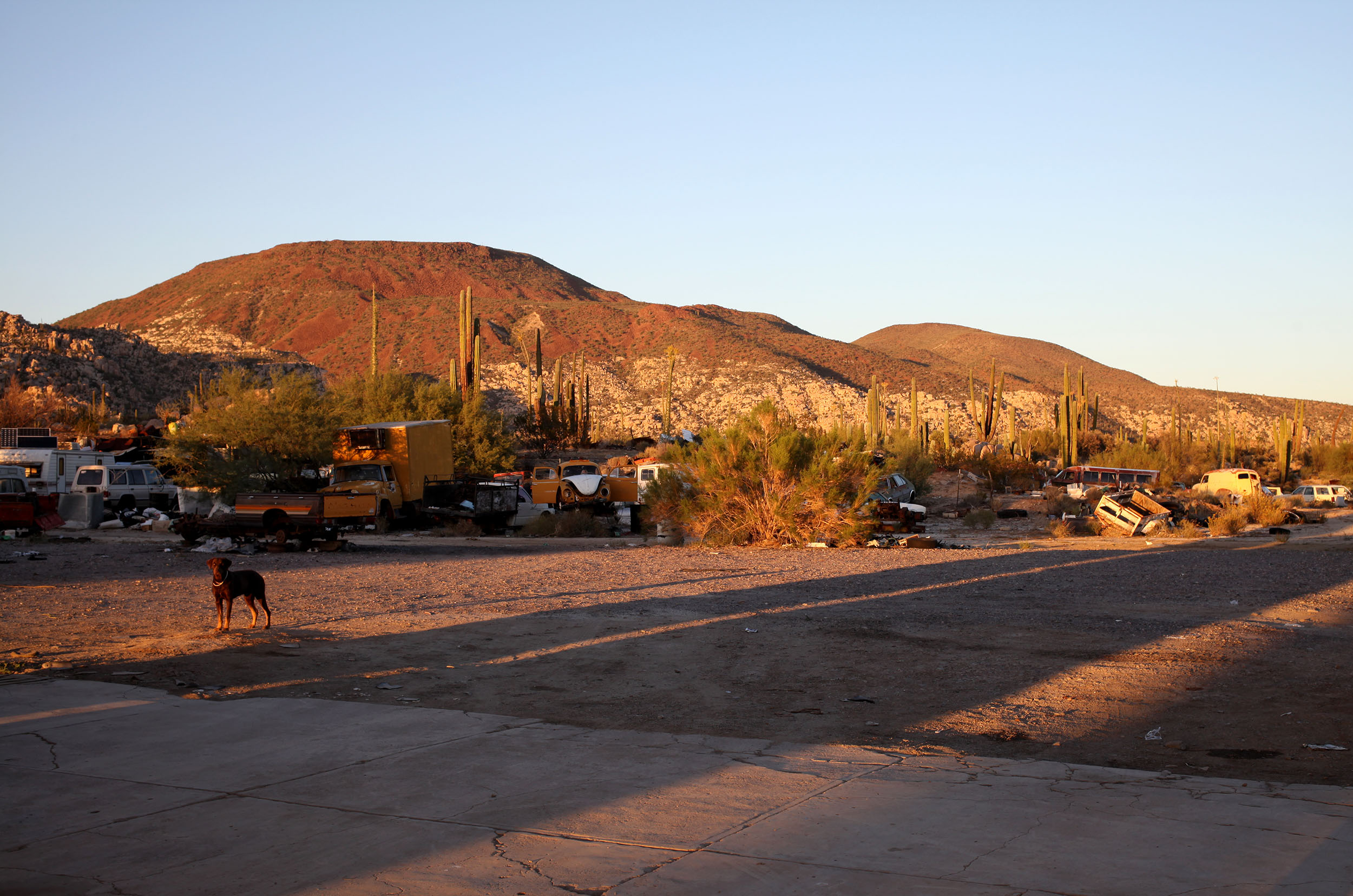
The sun sets on Cataviña Mexico. Photo: Alex Washburn
All I can recommend is getting away from the tourist traps along the coasts and diving into the rich landscape, culture, and amazing food that Mexico has to offer.
I am looking forward to Belize, and finally getting to the third country of the trip, but it is bittersweet to leave Mexico as it was the proving ground. We have spent a lot of time and sweat in this country and I look forward to returning someday.
For now, we look toward the ocean and a whole new country to explore! -Nathaniel
The land of Piñas and Topes
Posted on November 7, 2013
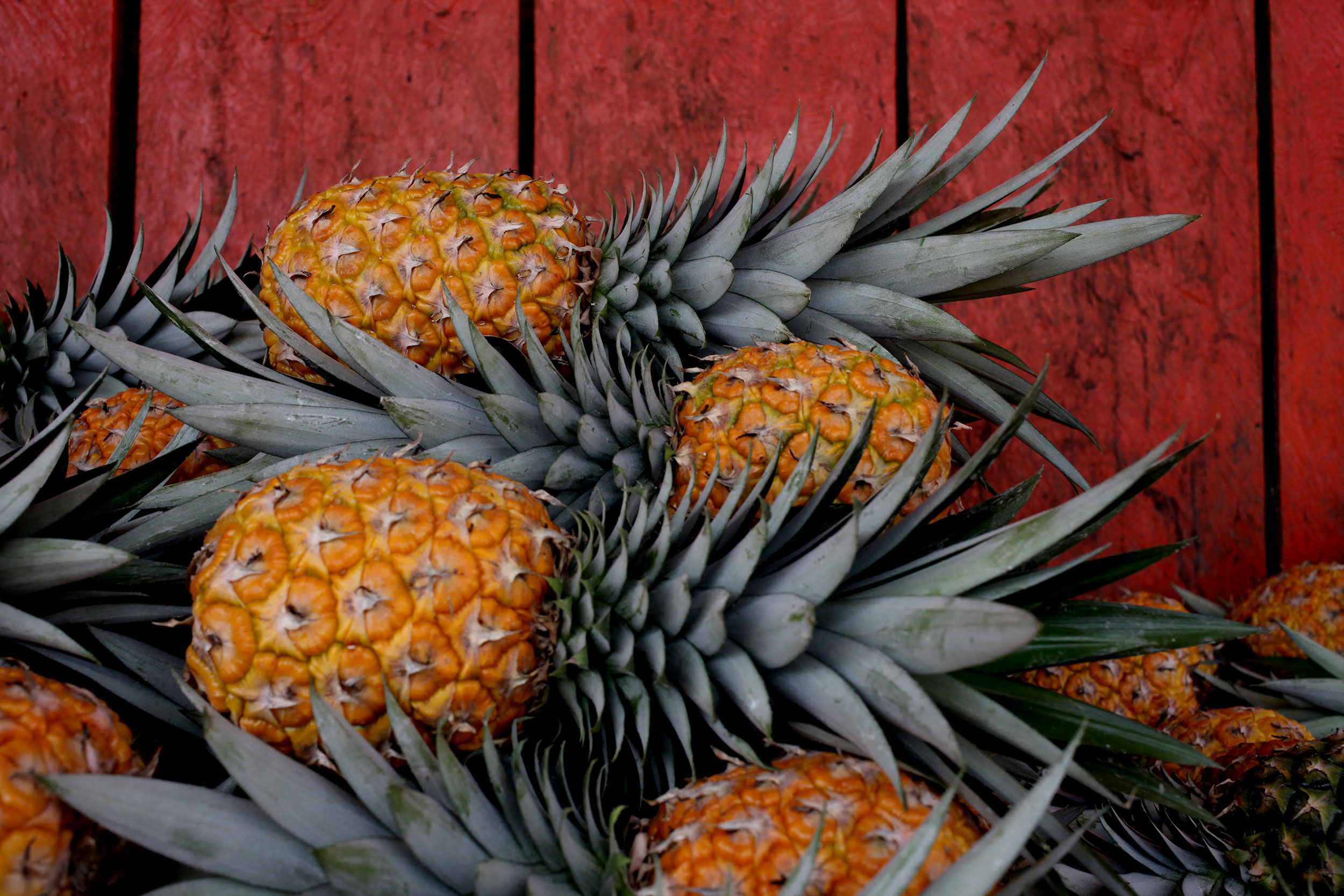
Piñas at a roadside stall just off Highway 145 in Mexico. Photo: Alex Washburn
One of the tidbits of knowledge that Ceasar (Alex’s cousin) passed onto us, well mostly for me, was that the country between Tuxtepec and Villahermosa could be considered the Land of Pineapple’s. Through Alex’s translation for me, he said something akin to “pineapples as far as the eyes can see” with a motion of the arms encompassing a wide circle.
Once we had chosen the northern road out of Oaxaca, it was predetermined for us that we would pass through the land of piñas (where you could get a bottle of fresh squeezed juice for a $1.00). Getting a later start than normal to the morning, we headed out of Tuxtepec, at fifteen miles an hour.
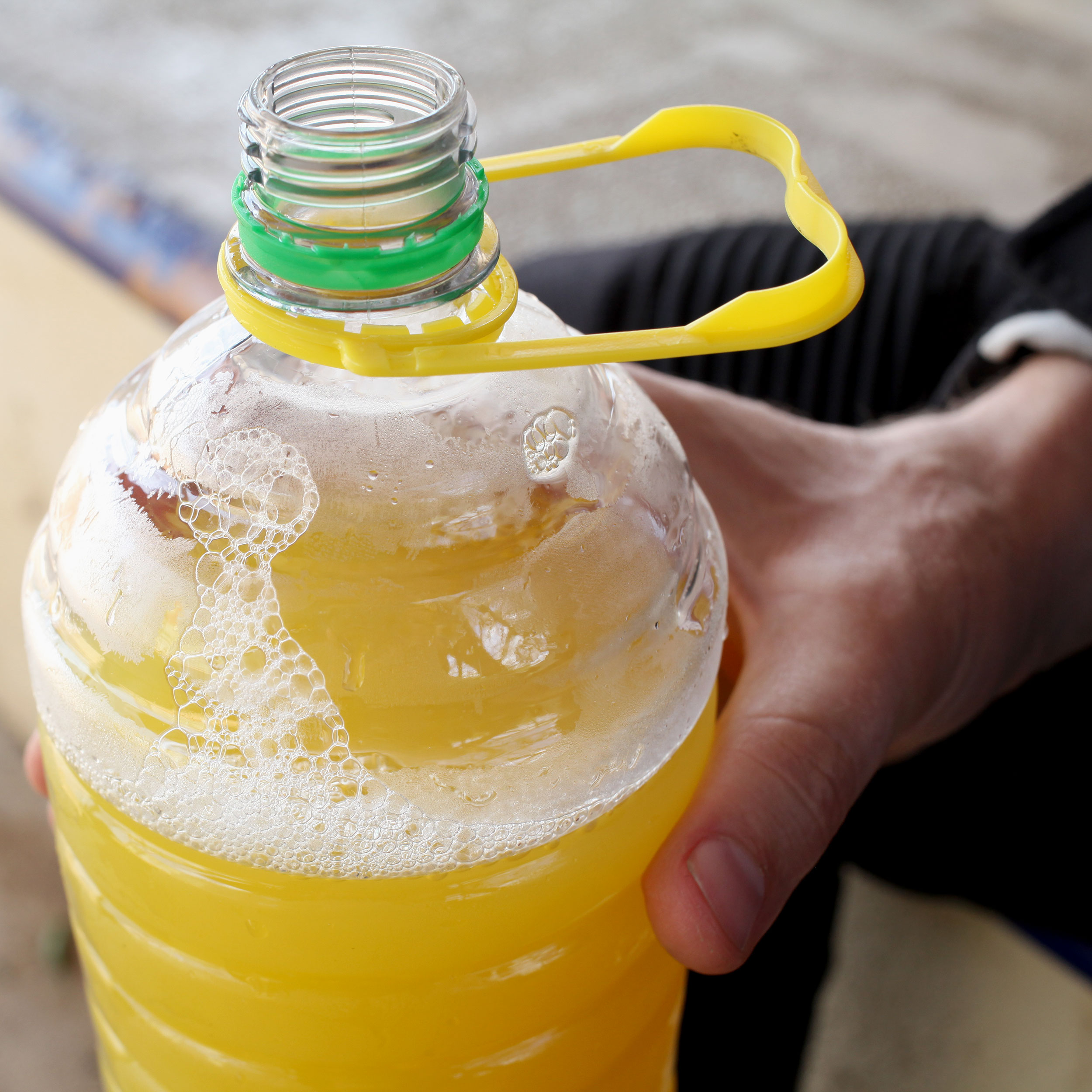
$15 pesos of Piña juice at a roadside stall off Highway 145 in Mexico. Photo: Alex Washburn
After stopping for some breakfast/lunch, Alex had me lead for a while and gave me instructions to stop at a pineapple stand that looked good. We got about fifty miles down the road, and I started sweating thinking I had missed the last one, when all of the sudden, like an oasis in the desert, a stand appeared in the distance with more pineapples than you can fathom.
Women stood in the road selling bottles of sweet, golden nectar while an older husband and wife stood in a shack on the side of the road crushing pineapples. I knew this was the place, the land of the piñas, and we pulled over, took our jackets off and picked up a bottle of fresh pineapple juice for a mere $15 pesos.
Imagine being able to stick a straw into a pineapple and drink the juice straight out of it. That is what it tasted like. Alex commented:
“You may never have pineapple juice this fresh ever again.”
It made the moment even more poignant. Sitting in the shade, the sun high in the sky and burning, the juice was as sweet and tangy as I had hoped, and it fueled us better then any Gatoraid could have (I am sure it had more sugar then two cokes together, but it was delicious).
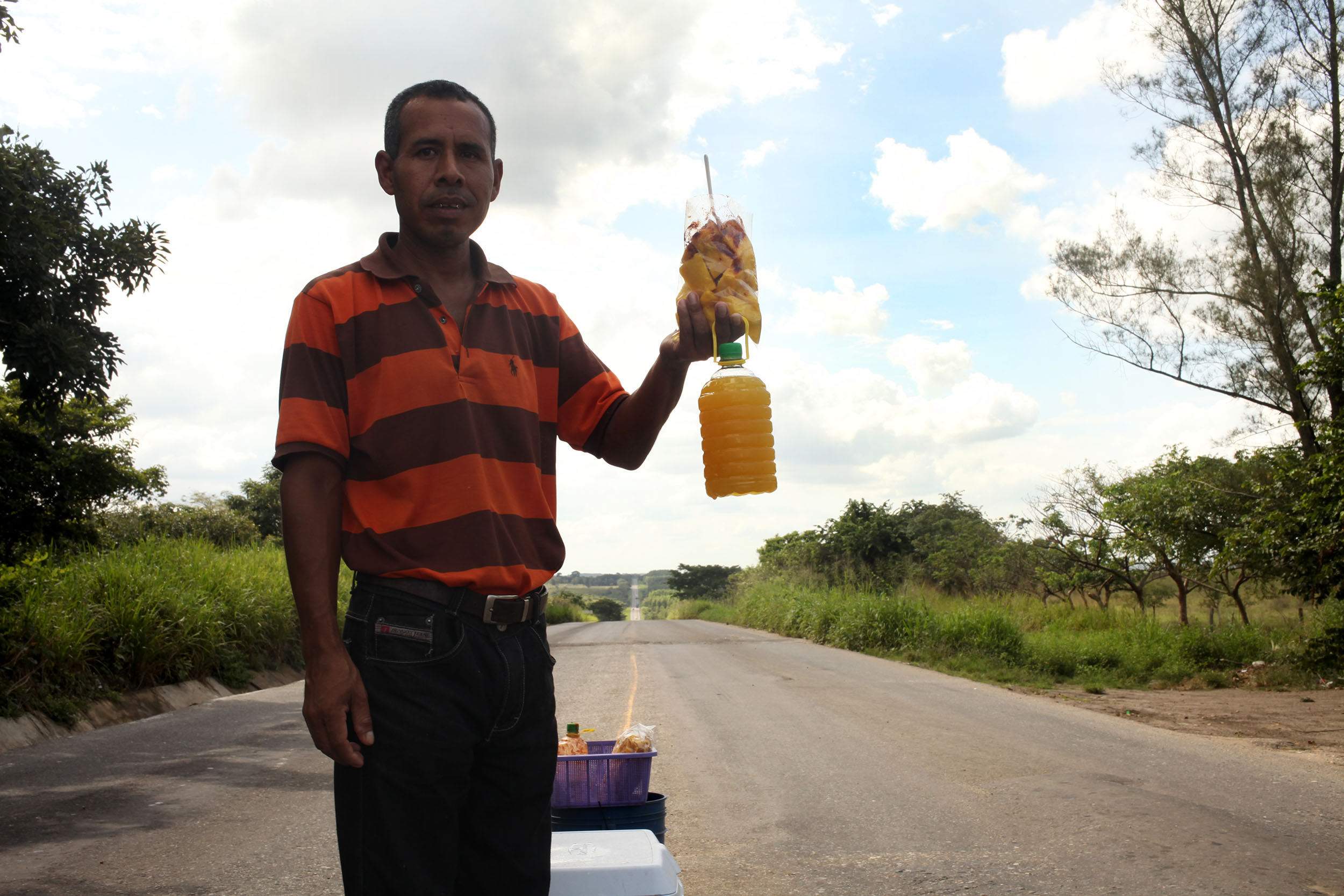
Portrait of a Piña vendor along Highway 145. They juice it, bottle it, ice it and sell it the same day. Photo: Alex Washburn
With our thirst quenched, we continued on toward our goal of Villahermosa. About fours hours into the riding of the day, the tope spotted landscape gave way to toll roads of US quality freeway status and we started to gain some distance.
We stopped for gas about an hour out of Villahermosa, and as we started to exit the Pemex (which I think are the only real gas stations in Mexico) I saw the sheen of water on the freeway. Not thinking too much of it, we both continued over it, and that is when I grasped our mistake. Alex made it across but as soon as my front tire hit the liquid, I began to skid and to my horror realized that the substance was oil.
As in all life situations where you brush against true adrenaline producing moments, time slowed down and I remember thinking clearly that I wasn’t going to be able to keep the bike up, that I was going down. The next thing I knew I was on the ground, and then I was up again, my muscles moved faster then I could think, and I was trying to lift my bike up, slipping in oil that covered a wide expanse of pavement.
It was a river.

Nathaniel does a systems check on his bike (and himself) after a car accessories vendor helped him to an oil free stretch of pavement. Photo: Alex Washburn
Luckily for me a guy came running up and offered a hand to get the bike up (Alex was able to stay upright, but couldn’t park her bike in the mess) and helped me get it over to the side of the road ahead of Alex. I thanked him as he ran off, maybe he was a guardian angel because he was gone even as quickly as he had shown up, and I assessed the damage. Other then some new scrapes to the panniers and my handle bar protecters, the bike was no worse for the wear.
Even a couple days removed, my heart still starts pumping when I think about this, but thankfully we were both going slow, and there hasn’t been any lasting damage to the bike (it fired right up once we got the situation under control). Furthermore, there was no bodily damage, I was completely protected by my equipment, I wasn’t trapped under the bike (thanks to the panniers), and the riding gear has paid off in my opinion. I now know what riding in oil is like, and I avoid substances on the road, even if they look like water just to be safe.
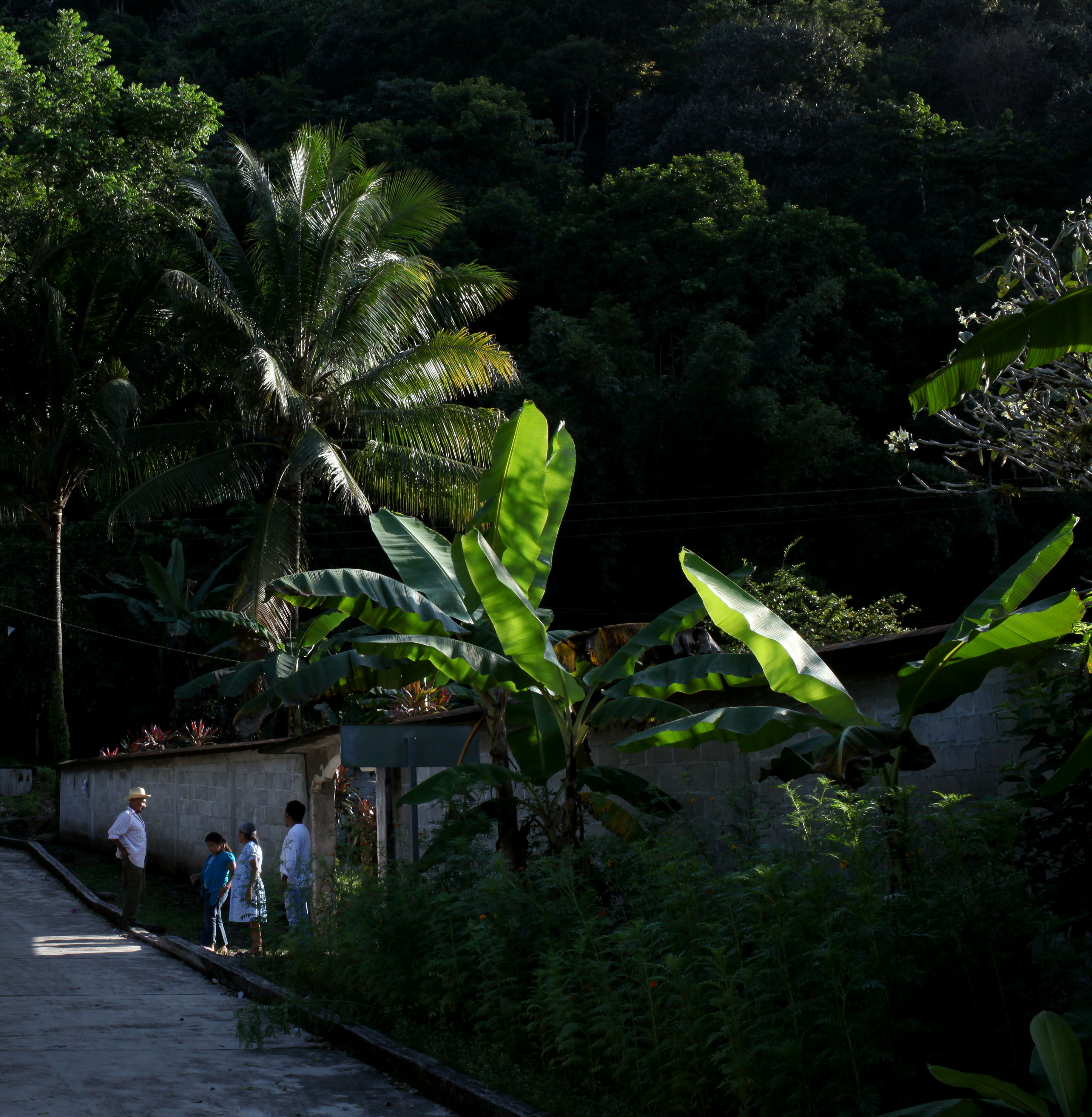
On the outskirts of San Mateo Yetla on Highway 175 out of Oaxaca. Photo: Alex Washburn
The next day was more riding, heading north, I distinctly remember getting the smell of salt in my nostrils and knowing that the ocean was near. I grew up in Santa Cruz, and while I may not have appreciated it then, the sea has a claiming effect on me that makes everything feel right with the world.
“How can things be bad if your by the ocean?”
We rode the whole day, along coasts lined with palm trees and fisherman. The final rays of the sun were fading over the water as we rode into Campache. It is the capital of the state and you can feel the forced jubilance it emulates for tourists in its historic district. For us it was just a hotel room, a warm shower, and a place to hang our helmets for the night. I am sure it is an amazing town, but we wont know on this trip.
Our days in Mexico are numbered, tonight we are sleeping in Merida and we plan Chichen-itza and a cenote (sinkhole) in the coming days, more adventures to come.
 Where the Autopista Ends